Products
Features
YouTube Video Summarizer
Summarize YouTube videos
Web & PDF Highlighter
Highlight web pages & PDFs
Chat with PDF
Ask any PDF questions with AI
Ask AI Clone
Chat with your highlights & memories
Audio Transcriber
Transcribe audio files to text
Glasp Reader
Read and highlight articles
Kindle Highlight Export
Export your Kindle highlights
Idea Hatch
Hatch ideas from your highlights
Integrations
Obsidian Plugin
Notion Integration
Pocket Integration
Instapaper Integration
Medium Integration
Readwise Integration
Snipd Integration
Hypothesis Integration
Apps & Extensions
Chrome Extension
Safari Extension
Edge Add-ons
Firefox Add-ons
iOS App
Android App
Discover
Discover
Ideas
Discover new ideas and insights
Articles
Curated articles and insights
Books
Book recommendations by great minds
Posts
Essays and notes from readers
Quotes
Inspiring quotes collection
Videos
Curated videos and summaries
Explore Glasp
Glasp Newsletter
Weekly insights and updates
Glasp Talk
Interview series with great minds
Glasp Blog
Latest news and articles
Glasp Use Cases
Learn how others use Glasp
Build & Support
Glasp API
Access Glasp's API for developers
MCP Connector
Connect Glasp to Claude & ChatGPT
Community
Glasp Reddit Community
Students
Student discount and benefits
FAQs
Frequently Asked Questions
AboutPricing
DashboardLog inSign up

Example comparing mass percentages of element in comounds
August 29, 2019
by
Khan Academy
YouTube video player
Example comparing mass percentages of element in comounds

TL;DR

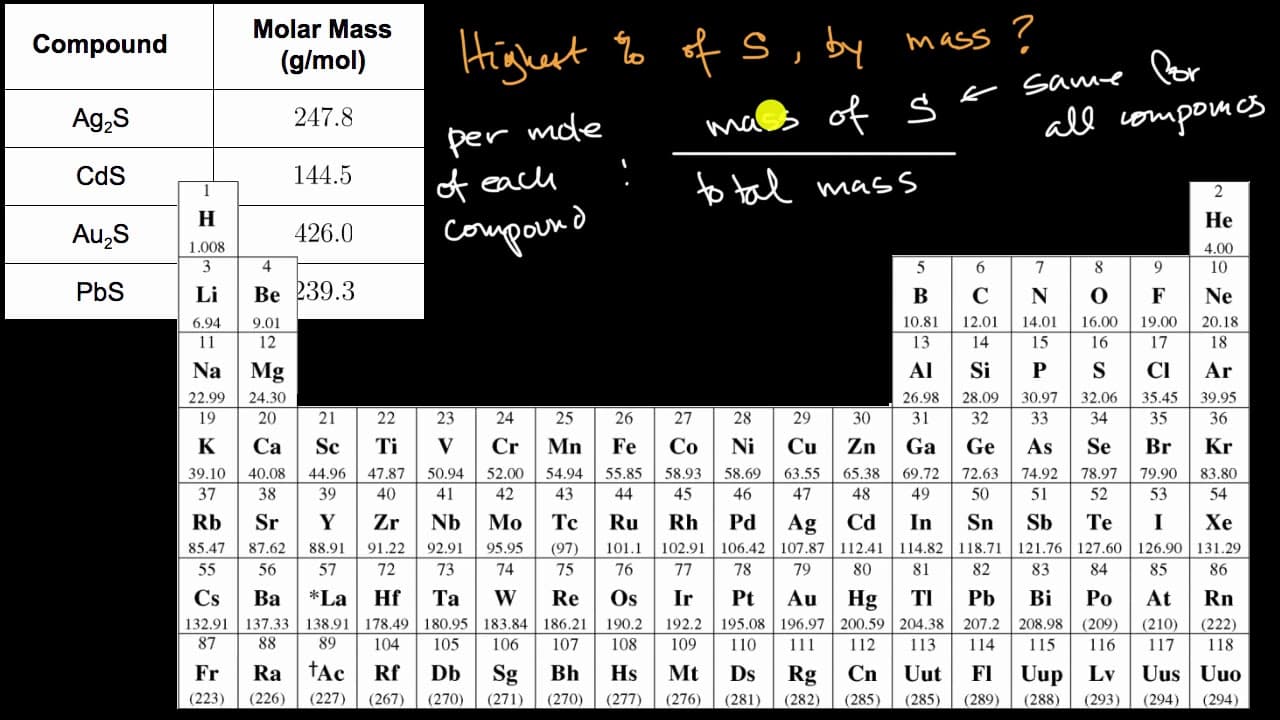
The compound with the lowest molar mass will have the highest percentage of sulfur by mass.

Transcript

  • [Instructor] So we have four different compounds here, and we also have their molar masses and what I would like you to do is think about which of these compounds has the highest, highest percentage of sulfur by mass. So pause this video and see if you can figure that out. All right, now one way to approach this is to say for each of these compou... Read More

Key Insights

  • 💆 The mass of sulfur is the same for all compounds in the given formulas.
  • 💆 The molar mass of a compound represents the mass of one mole of that compound.
  • 💆 The compound with the lowest molar mass will have the highest percentage of sulfur by mass.
  • ✋ By comparing the molar masses, we can determine the compound with the highest percentage of sulfur.
  • ❓ Additional calculations would be required to determine the actual percentage of sulfur in each compound.
  • 💆 The number of sulfur atoms in a compound affects the mass of sulfur and, consequently, the percentage of sulfur by mass.
  • 😘 The lowest molar mass indicates the compound with the lowest total mass, resulting in the highest percentage of sulfur.

Install to Summarize YouTube Videos and Get Transcripts

Explore YouTube Video Summarizer or Get YouTube Transcript Extractor

Questions & Answers

Q: How can we determine which compound has the highest percentage of sulfur by mass?

By dividing the mass of sulfur by the total mass of the compound, we can calculate the percentage. However, since the mass of sulfur is the same for all compounds, we need to find the compound with the lowest molar mass.

Q: Why does the compound with the lowest molar mass have the highest percentage of sulfur by mass?

The molar mass of a compound represents the mass of one mole of that compound. Since the mass of sulfur is the same for all compounds, the compound with the lowest molar mass will have the lowest total mass, resulting in the highest percentage of sulfur by mass.

Q: What if some compounds had more than one sulfur atom?

In that case, the mass of sulfur would be different for each compound. The compound with more sulfur atoms would have a higher mass of sulfur and potentially a lower percentage of sulfur by mass.

Q: Why is it not necessary to calculate the actual percentage of sulfur?

The question only asks for the compound with the highest percentage, so we can determine that by comparing the molar masses of the compounds. Calculating the actual percentage would involve additional calculations, but the relative comparison can be made without it.

Summary & Key Takeaways

  • The video explains how to calculate the percentage of sulfur by mass in different compounds.

  • Each compound has one mole of sulfur, so the mass of sulfur is the same for all compounds.

  • To determine the compound with the highest percentage of sulfur by mass, you need to find the one with the lowest molar mass.


Read in Other Languages (beta)

English

Share This Summary 📚

Summarize YouTube Videos and Get Video Transcripts with 1-Click

Download browser extensions on:

Try YouTube Summary with ChatGPT & Claude or YouTube Transcript Generator

Explore More Summaries from Khan Academy 📚

Introduction to entropy | Applications of thermodynamics | AP Chemistry | Khan Academy thumbnail
Introduction to entropy | Applications of thermodynamics | AP Chemistry | Khan Academy
Khan Academy
Example: Intersection of sine and cosine | Graphs of trig functions | Trigonometry | Khan Academy thumbnail
Example: Intersection of sine and cosine | Graphs of trig functions | Trigonometry | Khan Academy
Khan Academy
Word problem: What fraction of an hour should the piano still be practiced? | Khan Academy thumbnail
Word problem: What fraction of an hour should the piano still be practiced? | Khan Academy
Khan Academy
Subset, strict subset, and superset | Probability and Statistics | Khan Academy thumbnail
Subset, strict subset, and superset | Probability and Statistics | Khan Academy
Khan Academy
Adding the opposite with integer chips | 7th grade | Khan Academy thumbnail
Adding the opposite with integer chips | 7th grade | Khan Academy
Khan Academy
Double integrals 6 | Double and triple integrals | Multivariable Calculus | Khan Academy thumbnail
Double integrals 6 | Double and triple integrals | Multivariable Calculus | Khan Academy
Khan Academy

Summarize YouTube Videos and Get Video Transcripts with 1-Click

Download browser extensions on:

Try YouTube Summary with ChatGPT & Claude or YouTube Transcript Generator

Apps & Extensions

  • Chrome Extension
  • Safari Extension
  • Edge Add-ons
  • Firefox Add-ons
  • iOS App
  • Android App

Key Features

  • YouTube Video Summarizer
  • Web & PDF Summarizer
  • Web & PDF Highlighter
  • Chat with PDF
  • Ask AI Clone
  • Audio Transcriber
  • Glasp Reader
  • Kindle Highlight Export
  • Idea Hatch

Integrations

  • Obsidian Plugin
  • Notion Integration
  • Pocket Integration
  • Instapaper Integration
  • Medium Integration
  • Readwise Integration
  • Snipd Integration
  • Hypothesis Integration

More Features

  • APIs
  • MCP Connector
  • Blog & Post
  • Embed Links
  • Image Highlight
  • Personality Test
  • Quote Shots

Company

  • About us
  • Blog
  • Community
  • FAQs
  • Job Board
  • Newsletter
  • Pricing
Terms

•

Privacy

•

Guidelines

© 2026 Glasp Inc. All rights reserved.