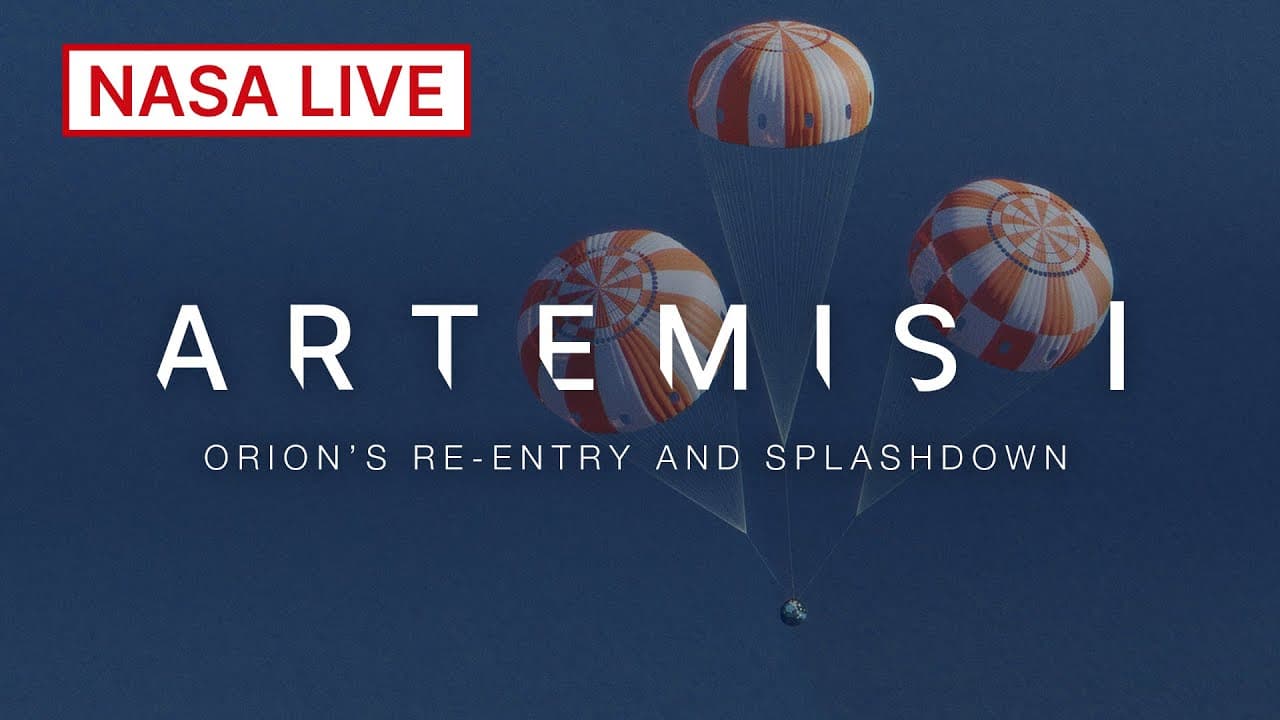
NASA’s Artemis I Mission Splashes Down in Pacific Ocean
TL;DR
Orion spacecraft successfully completes its 25-day mission, demonstrating its capabilities for future crewed missions to the Moon and beyond.
Transcript
thank you foreign thank you I'm landing a man on the moon foreign 25 feet down to two feels good 20 feet going down it to 10 feet dancing that contact [Applause] that push and then stop engine arm proceed command override off control I had old things Auto okay Houston the charger has landed Houston you can tell America that Challenger is a Taurus l... Read More
Key Insights
- 👾 The Orion spacecraft successfully completed its mission to circumnavigate the Moon and return to Earth, demonstrating its capabilities for future deep space exploration.
- 😤 The recovery team, including Navy divers and helicopters, is prepared to secure the spacecraft upon splashdown in the Pacific Ocean.
- 🎭 The heat shield of the Orion spacecraft performed well, protecting it from extreme temperatures during re-entry into Earth's atmosphere.
- 🎟️ The successful Shakedown mission paves the way for future crewed missions to the Moon and beyond.
- 🖐️ NASA's Artemis program aims to establish a sustainable presence on the Moon, with the Orion spacecraft playing a crucial role in this endeavor.
- 🦺 The teamwork between NASA, the Navy, and other organizations involved in the recovery operation is crucial for the safe return of the spacecraft.
- 👾 The Orion spacecraft's larger size and increased capabilities compared to the Apollo spacecraft make it suitable for longer missions and deeper space exploration.
Install to Summarize YouTube Videos and Get Transcripts
Explore YouTube Video Summarizer or Get YouTube Transcript Extractor
Questions & Answers
Q: How does the Orion spacecraft compare to the Apollo spacecraft in terms of capabilities?
The Orion spacecraft is larger and can carry more payload and crew members than the Apollo spacecraft. It is designed to handle longer missions and travel farther into space.
Q: What is the purpose of the Shakedown mission?
The Shakedown mission is designed to test the spacecraft's systems and capabilities in a real space environment. It helps NASA gather data and make any necessary adjustments for future missions.
Q: How does the heat shield of the Orion spacecraft protect it during re-entry?
The heat shield is made of special materials that can withstand temperatures of up to 5000 degrees Fahrenheit. It is designed to dissipate the heat generated during re-entry, protecting the spacecraft and its crew.
Q: What are the future plans for the Orion spacecraft?
The Orion spacecraft is a key component of NASA's Artemis program, which aims to return humans to the Moon by 2024. It will be used for crewed missions to explore and establish a sustainable presence on the Moon.
Summary & Key Takeaways
-
Apollo 17 Commander Gene Cernan and lunar module pilot Jack Schmidt successfully landed the Challenger spacecraft on the Moon 50 years ago in the Taurus-Littrow region.
-
NASA's newest moon explorer, the Orion spacecraft, is returning to Earth after circumnavigating the moon in its successful Shakedown mission.
-
The spacecraft will experience temperatures of up to 5000 degrees Fahrenheit as it enters Earth's atmosphere, testing the performance of its heat shield.
-
The recovery team, including Navy divers and helicopters, is ready to secure Orion upon splashdown in the Pacific Ocean.
Read in Other Languages (beta)
Share This Summary 📚
Summarize YouTube Videos and Get Video Transcripts with 1-Click
Try YouTube Summary with ChatGPT & Claude or YouTube Transcript Generator
Explore More Summaries from NASA 📚

Summarize YouTube Videos and Get Video Transcripts with 1-Click
Try YouTube Summary with ChatGPT & Claude or YouTube Transcript Generator