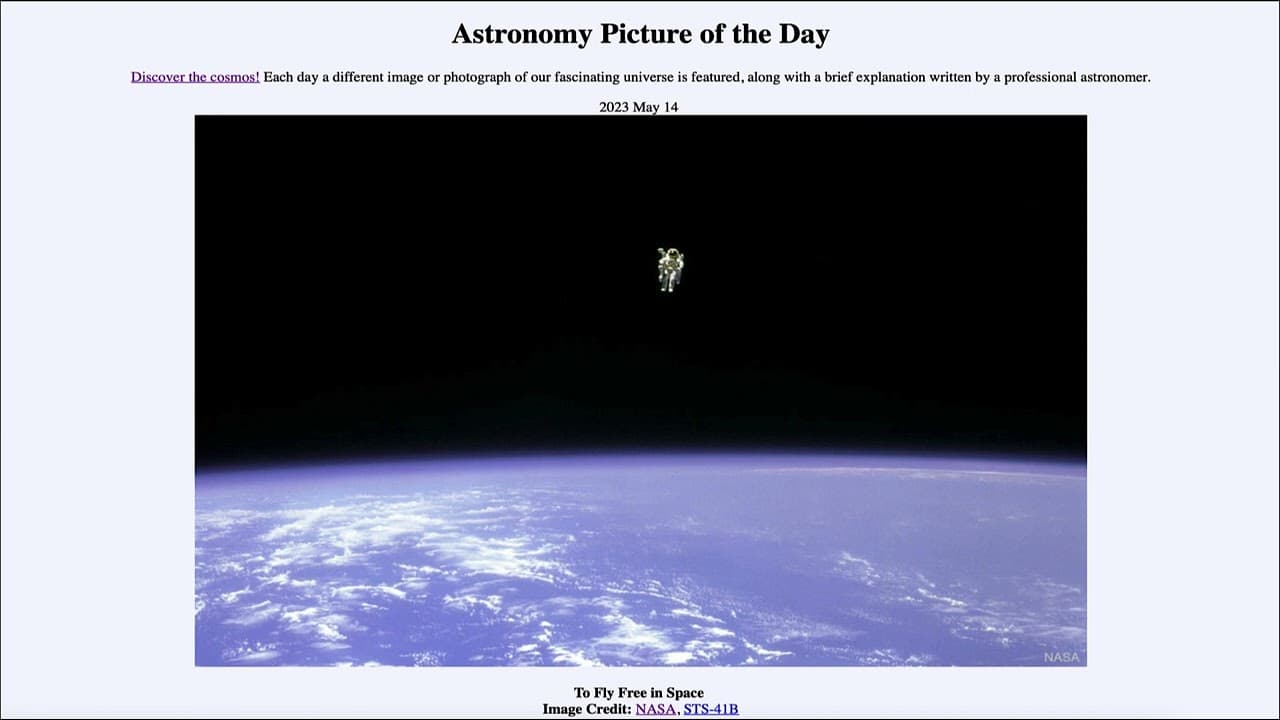
2023 May 14 - To Fly Free in Space
TL;DR
Bruce McCandless II performs the first untethered spacewalk using a nitrogen gas device to maneuver himself in space during a Space Shuttle Challenger mission in 1984.
Transcript
greetings and welcome to the introduction to astronomy one of the things that I like to do in each of my introductory astronomy classes is to begin the class with the Astronomy Picture of the Day from the NASA website that is apod.nasa.gov apod and today's picture for May 14th of 2023 well it is titled to fly free in space so what do we see here we... Read More
Key Insights
- 🫥 Tethered spacewalks were the norm before the first untethered spacewalk, where the astronaut relied on a line connected to the spacecraft.
- 🫢 The untethered spacewalk shown in the picture utilized a nitrogen gas device for propulsion.
- 👻 The absence of friction in space allows for easy travel and maneuverability.
- 👻 Untethered spacewalks allowed astronauts to access and work with satellites more efficiently.
- 🧑🚀 Astronauts in untethered spacewalks remain in the same orbit as the spacecraft, avoiding being left behind or falling to Earth.
- 🧑🚀 The relative velocity and position of the astronaut during an untethered spacewalk closely match that of the spacecraft.
- 🧑🚀 The astronaut depicted in the picture is orbiting the Earth once every 90 minutes.
Install to Summarize YouTube Videos and Get Transcripts
Explore YouTube Video Summarizer or Get YouTube Transcript Extractor
Questions & Answers
Q: What is the significance of the Astronomy Picture of the Day from the NASA website?
The Astronomy Picture of the Day is a popular feature on the NASA website that showcases stunning images and provides educational information about space-related topics. It serves as an engaging introduction to astronomy classes.
Q: How did the untethered spacewalk differ from previous spacewalks?
In previous spacewalks, astronauts were always tethered to the spacecraft using a line. However, in the untethered spacewalk depicted in the picture, Bruce McCandless II used a device with nitrogen gas jets for propulsion, allowing for greater freedom of movement.
Q: How did the absence of friction in space aid in spacecraft travel?
Space is a vacuum and lacks air resistance and friction. Once a spacecraft is launched and gains sufficient speed, it can continue traveling at that speed without the need for constant propulsion. This makes it easier to travel and maneuver in space.
Q: What were the benefits of untethered spacewalks?
Untethered spacewalks provided astronauts with more maneuverability and access to satellites. Without being constrained by a tether, they could deploy and retrieve satellites and work more effectively in space.
Summary & Key Takeaways
-
The Astronomy Picture of the Day for May 14th, 2023 showcases Bruce McCandless II performing the first untethered spacewalk during a Space Shuttle Challenger mission in 1984.
-
In an untethered spacewalk, the astronaut is not connected to the spacecraft by a line and instead uses a device with nitrogen gas jets for maneuvering.
-
Untethered spacewalks provided more freedom of movement and allowed astronauts to access and work with satellites more effectively.
Read in Other Languages (beta)
Share This Summary 📚
Summarize YouTube Videos and Get Video Transcripts with 1-Click
Try YouTube Summary with ChatGPT & Claude or YouTube Transcript Generator