Binary to decimal Conversions | Decimal to Binary | Decimal Point | STLD | Lec-04
TL;DR
This video teaches binary to decimal and decimal to binary conversions step by step.
Transcript
hi everyone in this video I'm going to explain how to convert a binary number into decimal number and a decimal number into binary number conversions are very very easy in the beginning of this switching Theory and logic design circuit because every student should know how to convert a given number into other form of the information so binary to de... Read More
Key Insights
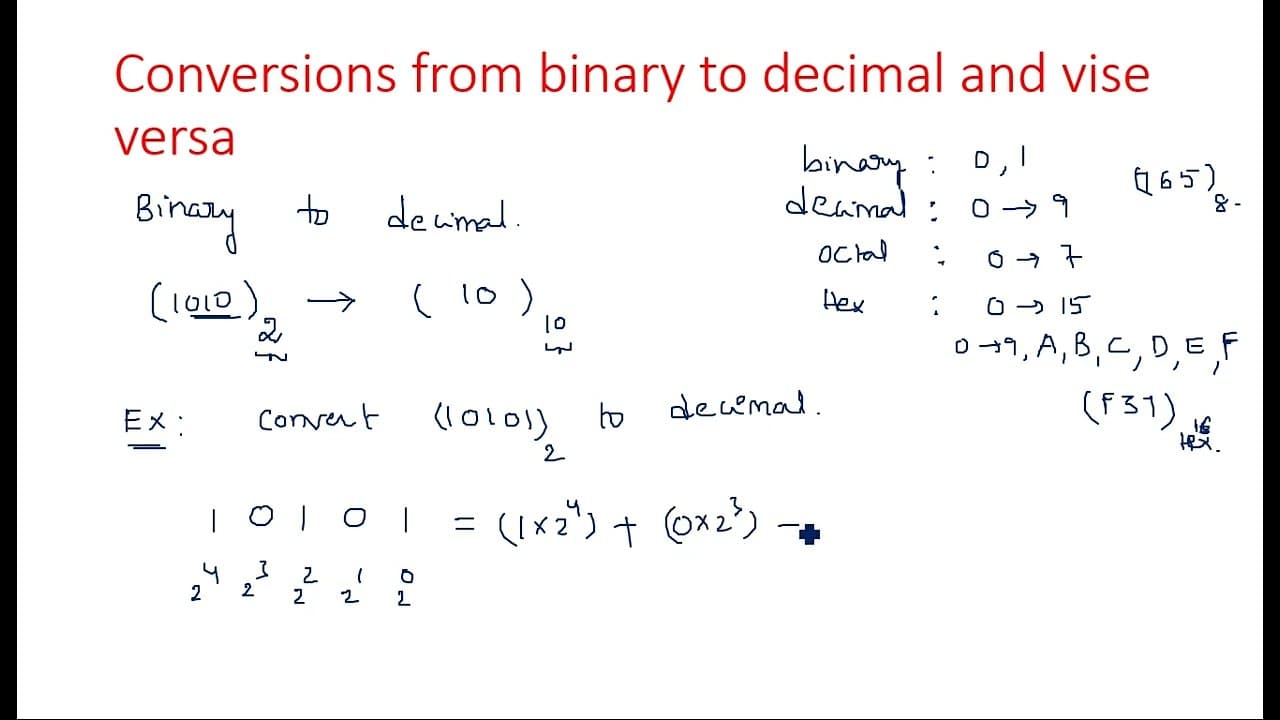
- ✊ Binary to decimal conversion involves multiplying each binary digit by the power of two corresponding to its position in the number.
- ✖️ Decimal fractions require special handling when converting to binary, using multiplication to derive the binary equivalent.
- ⚾ Understanding octal (base 8) and hexadecimal (base 16) systems is crucial as digital systems often use these bases for compact data representation.
- 😥 When encountering a decimal point in binary, differentiating weights simplifies the conversion process into decimal format.
- 🥡 The division method for converting decimal numbers into binary requires taking note of the remainders in reverse order for accuracy.
- #️⃣ For decimal numbers, multipliers for fractions can yield precise binary representations, crucial for programming and precise calculations.
- 🎨 Knowledge of number system conversions supports digital circuit design and enhances understanding of computer architecture.
Install to Summarize YouTube Videos and Get Transcripts
Explore YouTube Video Summarizer or Get YouTube Transcript Extractor
Questions & Answers
Q: Why is it important for students to learn number system conversions?
Learning number system conversions is crucial for students, especially in fields related to computer science and electronics. Understanding how to convert between binary, decimal, octal, and hexadecimal systems enables students to design and analyze digital circuits effectively. It forms the foundation for deeper concepts in programming and data representation.
Q: How do you convert a binary number like 1101 to decimal?
To convert the binary number 1101 to decimal, you multiply each digit by 2 raised to the power of its position. Starting from the right (0-indexed), calculate: 1*(2^3) + 1*(2^2) + 0*(2^1) + 1*(2^0). This results in 8 + 4 + 0 + 1, giving a total of 13 in decimal.
Q: Can you explain how to handle decimal points when converting binary to decimal?
When converting a binary number with a decimal point to decimal, you treat the part before the point using positive powers of two, while the part after uses negative powers. For example, in 1101.101, calculate 1*(2^3) + 1*(2^2) + 0*(2^1) + 1*(2^0) for the whole number part and 1*(2^-1) + 0*(2^-2) + 1*(2^-3) for the fractional part, resulting in a final decimal value.
Q: What is the division method for converting decimal numbers to binary?
To convert a decimal number to binary, you repeatedly divide the number by 2 and record the remainders. For instance, dividing 13 by 2 gives a quotient of 6 and a remainder of 1. Continuing this process until the quotient is 0, the binary number is formed by reading the remainders in reverse order, yielding 1101.
Q: How do you handle decimal fractions when converting from decimal to binary?
To convert a decimal fraction to binary, you multiply the fraction by 2. The whole number part of the result is taken as the next binary digit. Repeat the process with the fractional part until it reaches a sufficient level of precision. For example, multiplying 0.625 by 2 gives 1.25, indicating the next digit is 1, and you continue with 0.25.
Q: Why is the understanding of various number systems critical in technology?
Understanding various number systems is vital in technology because computers operate on binary, octal, and hexadecimal systems. Knowledge of how to convert between these systems is essential for programming, data encoding, networking, and system design. It allows engineers and computer scientists to optimize performance and troubleshoot effectively.
Summary & Key Takeaways
-
The video provides an overview of converting binary numbers to decimal and vice versa, highlighting the importance of understanding these conversions in digital logic design.
-
It explains the method of multiplying binary digits by powers of two to translate them into decimal values, including examples with and without decimal points.
-
For decimal to binary conversions, the video emphasizes the division approach for whole numbers and multiplication for decimal fractions, with methods illustrated through practical examples.
Read in Other Languages (beta)
Share This Summary 📚
Summarize YouTube Videos and Get Video Transcripts with 1-Click
Try YouTube Summary with ChatGPT & Claude or YouTube Transcript Generator