4.3.17 Healthcare Costs - Video 9: Results
TL;DR
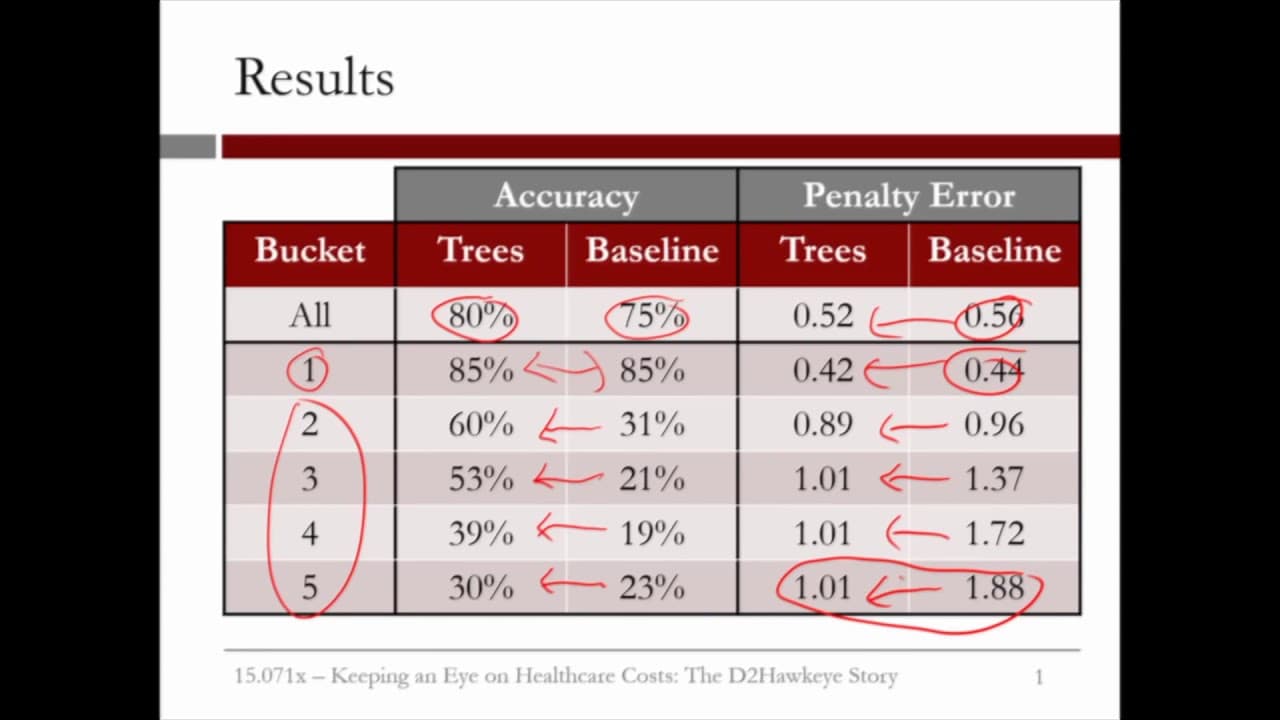
The classification tree model achieved an overall accuracy of 80%, with significant improvements in predicting patient conditions in buckets two to five compared to the baseline model.
Transcript
We will discuss the results of the classification tree model. So we first observe that the overall accuracy of the method regarding the percentage that it accurately predicts is 80%, compared to 75% of the baseline. But notice that this is done in an interesting way. For bucket one patients, the two models are equivalent. But of course this suggest... Read More
Key Insights
- 🌲 The classification tree model outperformed the baseline model, achieving an 80% accuracy compared to 75%.
- 🪣 Accuracy improvements were most significant in buckets two to five, with doubling or more the accuracy of the baseline model.
- 😘 The model's penalty error also improved, showcasing the ability to make more accurate predictions with lower penalties.
- 🉐 D2Hawkeye gained several advantages through the analytics, including better patient identification, physician engagement, and a competitive edge over outdated methods.
- 👻 The model's interpretability allowed physicians to contribute to its refinement and identification of new variables.
Install to Summarize YouTube Videos and Get Transcripts
Explore YouTube Video Summarizer or Get YouTube Transcript Extractor
Questions & Answers
Q: What is the overall accuracy of the classification tree model compared to the baseline model?
The classification tree model achieved an overall accuracy of 80%, which is higher than the 75% accuracy of the baseline model.
Q: How does the model perform in predicting patient conditions in different buckets?
The model's accuracy significantly improves as we move down the buckets. It doubles the accuracy in buckets two to four, with accuracy ranging from 31% to 60%. In bucket five, the improvement is smaller but still notable, with accuracy increasing from 23% to 30%.
Q: What is the significance of the penalty in the model's predictions?
The penalty error decreased from 0.56 to 0.52 overall, indicating a small improvement in bucket one. However, the improvement is much more substantial in the lower buckets, with the penalty error in bucket five decreasing from 1.88 to 1.01, representing a significant improvement.
Q: What advantages did the analytics provide to D2Hawkeye?
Firstly, the analytics enabled D2Hawkeye to better identify patients who require more attention. Secondly, the model's interpretability allowed physicians to enhance it by identifying new variables and refining existing ones. Lastly, the implementation of machine learning methods gave D2Hawkeye a competitive edge over competitors relying on outdated techniques.
Summary & Key Takeaways
-
The classification tree model accurately predicts patient conditions with 80% accuracy, compared to 75% accuracy of the baseline model.
-
Healthy patients tend to stay healthy, as indicated by the similar performance of both models in bucket one.
-
The accuracy of the classification tree model increases substantially from buckets two to five, ranging from 31% to 60%, doubling or more the accuracy of the baseline model.
Read in Other Languages (beta)
Share This Summary 📚
Summarize YouTube Videos and Get Video Transcripts with 1-Click
Try YouTube Summary with ChatGPT & Claude or YouTube Transcript Generator
Explore More Summaries from MIT OpenCourseWare 📚



Summarize YouTube Videos and Get Video Transcripts with 1-Click
Try YouTube Summary with ChatGPT & Claude or YouTube Transcript Generator