Talking at the table ⏲️ 6 Minute English
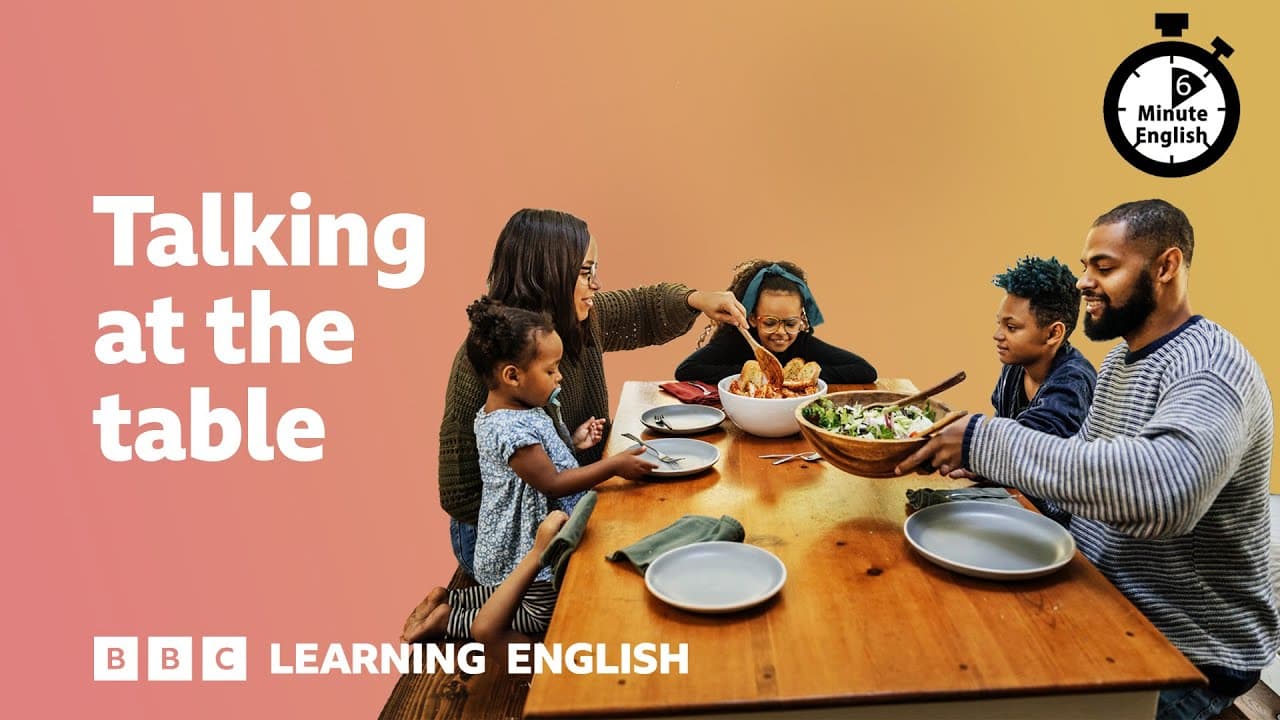
TL;DR
Discussing communication and roles at the dinner table.
Transcript
Hello. This is Six minute English from BBC Learning English. I'm Neil. And I'm Beth. In this programme, we will be discussing the dinner table, but we're not interested in food. We're talking about...talking! A lot can happen around the dinner table. Gossip, arguments. You might meet the love of your life on a blind dinner date, or find out you're ... Read More
Key Insights
- Dinner tables serve as a vital space for family interaction, often being the only time families gather to communicate and share experiences.
- Philippa Perry suggests that people often assume roles within family settings, such as 'the funny one' or 'the wise one', and advises taking these labels with a pinch of salt.
- The concept of children being 'seen and not heard' is outdated, and modern dining often encourages children to participate actively in conversations.
- Ambreia Meadows-Fernandez notes that older generations may experience culture shock when children freely ask questions at the dinner table, contrasting with past norms.
- The idiom 'take with a pinch of salt' advises skepticism towards certain expectations or beliefs, particularly those assigned by family roles.
- The fastest time to set a dinner table, as recorded in 2016, was one minute and five seconds by a German couple.
- The dinner table can be a mixed bag of experiences, offering both positive interactions and potential conflicts or challenges.
- Cultural and generational differences can impact how individuals perceive and engage in conversations at the dinner table.
Install to Summarize YouTube Videos and Get Transcripts
Explore YouTube Video Summarizer or Get YouTube Transcript Extractor
Questions & Answers
Q: What is the main focus of the program?
The main focus of the program is discussing the dynamics of communication at the dinner table, emphasizing its role as a crucial space for family interaction. The program explores how people often assume specific roles within family settings and the significance of being oneself during these interactions.
Q: How does Philippa Perry view the roles assumed at the dinner table?
Philippa Perry views the roles assumed at the dinner table, such as 'the funny one' or 'the wise one', as potentially limiting. She suggests that individuals should take these roles with a pinch of salt, meaning they should not fully believe or adhere to these labels, allowing for more authentic self-expression.
Q: What is the historical perspective on children's behavior at the dinner table?
Historically, children were often expected to be 'seen and not heard' at the dinner table, meaning they should remain quiet and well-behaved. This old-fashioned perspective contrasts with modern practices that encourage children to participate actively in conversations and express themselves freely during meals.
Q: What does Ambreia Meadows-Fernandez say about generational differences at the dinner table?
Ambreia Meadows-Fernandez notes that older generations may experience culture shock when children freely ask questions at the dinner table. This reaction stems from a shift in norms, as contemporary practices often blur the lines between adult and children's tables, encouraging open dialogue regardless of age.
Q: What is the significance of the idiom 'take with a pinch of salt'?
The idiom 'take with a pinch of salt' signifies skepticism towards certain expectations or beliefs. In the context of the dinner table, it advises individuals to approach family-assigned roles or labels with caution, allowing for more genuine interactions and preventing rigid adherence to potentially limiting roles.
Q: What record was mentioned in the program?
The program mentioned a world record set in 2016 by a German couple for the fastest time to set a dinner table. They accomplished this feat in one minute and five seconds, highlighting the efficiency and speed that can be achieved in what is typically a routine task.
Q: How does the program describe the dinner table experience?
The program describes the dinner table experience as a mixed bag, meaning it can encompass both positive and negative aspects. While it serves as a space for meaningful family interactions, it can also present challenges, such as conflicts or cultural differences, impacting the overall dining experience.
Q: What role do cultural and generational differences play at the dinner table?
Cultural and generational differences play a significant role in shaping interactions at the dinner table. These differences can influence how individuals perceive and engage in conversations, with older generations potentially experiencing culture shock at modern practices that encourage open dialogue and active participation from all family members.
Summary & Key Takeaways
-
The program explores the dynamics of communication at the dinner table, highlighting its significance as a space for family interaction. It discusses the roles people often assume within family settings and the importance of being oneself.
-
Philippa Perry advises against rigidly adhering to labels like 'the funny one' or 'the wise one', encouraging individuals to approach such roles with skepticism. The program also touches on the evolution of children's participation in table conversations.
-
Ambreia Meadows-Fernandez discusses the cultural shock older generations may feel when children engage freely at the dinner table. The program concludes with vocabulary related to communication and interactions at meal times.
Read in Other Languages (beta)
Share This Summary 📚
Summarize YouTube Videos and Get Video Transcripts with 1-Click
Try YouTube Summary with ChatGPT & Claude or YouTube Transcript Generator
Explore More Summaries from BBC Learning English 📚

Summarize YouTube Videos and Get Video Transcripts with 1-Click
Try YouTube Summary with ChatGPT & Claude or YouTube Transcript Generator