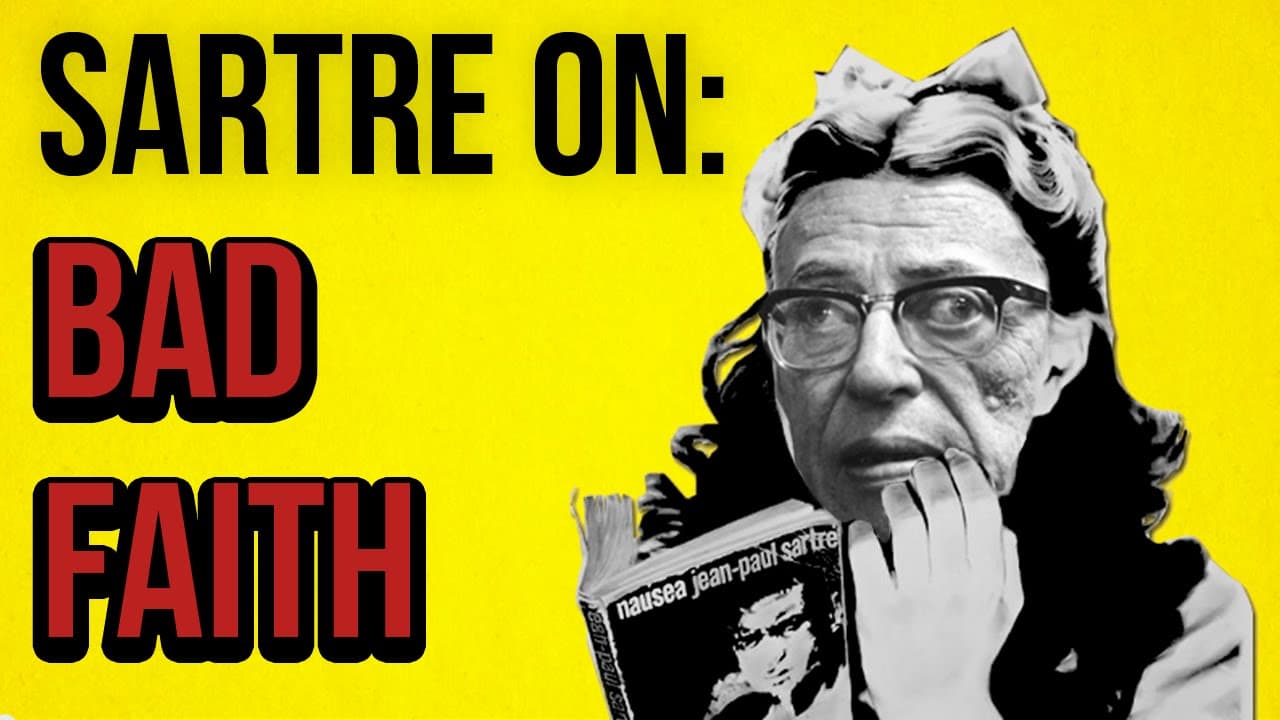
SARTRE ON: Bad Faith
TL;DR
Sartre's "bad faith" illustrates self-deception that limits personal freedom and fulfillment.
Transcript
In being and nothingness written in 1943 the French existentialist philosopher Jean-Paul Sartre identified a problem which he believed plagued modern life. Mauvaise Foi, literally "bad faith" Bad faith occurs when we lie to ourselves in order to spare ourselves short term pain, but thereby suffer from long term psychological impoverishment. We forc... Read More
Key Insights
- 🤳 Sartre's philosophy emphasizes the importance of acknowledging personal freedom and choices, challenging self-imposed limitations.
- 😌 Individuals frequently lie to themselves about their options, resulting in long-term dissatisfaction and a lack of fulfillment.
- 🦡 Bad faith is not an unusual phenomenon but rather a common aspect of human psychology and behavior.
- 💡 The existential concept that one's essence is shaped by their choices underscores the idea that identity is not fixed.
- 🥺 Relationships suffer when partners engage in bad faith, leading to miscommunication and misplaced blame for their unhappiness.
- 💦 Sartre's work encourages self-awareness, urging individuals to confront difficult truths rather than retreating into comforting illusions.
- 🥶 By recognizing the potential for change and growth, people can break free from the constraints of bad faith.
Install to Summarize YouTube Videos and Get Transcripts
Explore YouTube Video Summarizer or Get YouTube Transcript Extractor
Questions & Answers
Q: What does Sartre mean by "bad faith"?
Bad faith, or "mauvaise foi," refers to the self-deception individuals engage in to avoid facing the uncomfortable truths of their existence. It involves lying to oneself about the lack of choices available, which provides temporary comfort but ultimately leads to a diminished capacity for personal growth and freedom.
Q: How does bad faith relate to work according to Sartre?
Sartre illustrates bad faith through the example of a waiter who believes he is confined to his job, failing to recognize his inherent freedom to pursue other paths. This mindset leads individuals to resign to circumstances rather than acknowledging their autonomy and potential for change in their careers.
Q: In what scenarios does bad faith typically emerge in relationships?
Bad faith often arises in romantic relationships when partners ignore red flags about their compatibility. For example, one partner may wish to feel intellectually appreciated while dismissing doubts about the other's true interests, leading both to maintain a facade rather than confront the truth of their mismatched expectations.
Q: What is "Negative Ecstasy" in Sartre's philosophy?
Negative Ecstasy refers to the unsettling moment of realization when individuals confront the extent of their freedom and the choices available to them. It can be a harrowing experience, as it forces them to acknowledge their potential to change their lives, ultimately making them aware of any complacency or self-imposed limitations.
Summary & Key Takeaways
-
Jean-Paul Sartre's concept of bad faith describes how individuals deceive themselves to avoid confronting uncomfortable truths, which leads to long-term psychological distress.
-
He suggests that people often claim they have no options in life, which is a lie that stifles their potential for change and growth.
-
Bad faith manifests not just in work but also in personal relationships, where individuals convince themselves of compatibility despite underlying incompatibilities.
Read in Other Languages (beta)
Share This Summary 📚
Summarize YouTube Videos and Get Video Transcripts with 1-Click
Try YouTube Summary with ChatGPT & Claude or YouTube Transcript Generator