17.7 Reduction of a System to a Point Particle
TL;DR
The center of mass allows us to simplify a system of particles into a single point-like object, allowing us to analyze its translational motion.
Transcript
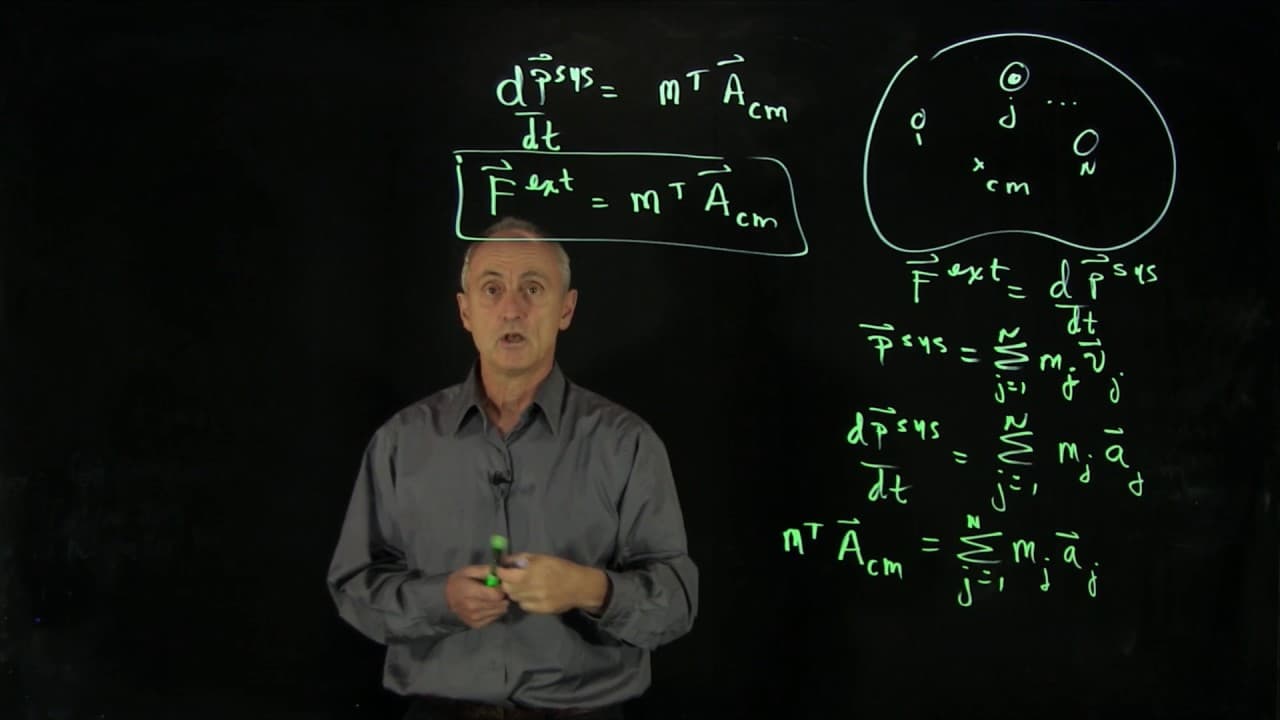
We'd like to consider a system of particles. Let's say we have object one. We'll call this the j-th object, object n. And somewhere in this system of particles is a center of mass. Now, we know that the external force is causing the momentum of the system to change, and what we'd now like to show is that we can reduce this system to an effective si... Read More
Key Insights
- 🍹 The momentum of a system of particles can be calculated by summing the individual momentums of each particle.
- 💆 The acceleration of the center of mass of a system of particles is equal to the external forces acting on the system divided by the total mass.
- 😥 By treating a system of particles as a single point particle located at the center of mass, the analysis can be simplified to focus on the translational motion.
- 👻 The center of mass allows us to reduce the complexity of a system of particles to a single object.
- 🤑 External forces are the only ones that can change the momentum of a system of particles.
- 💆 The acceleration of the center of mass is directly proportional to the external force and inversely proportional to the total mass of the system.
- 🧑🏭 The center of mass moves along a trajectory determined by the external forces acting on the system.
Install to Summarize YouTube Videos and Get Transcripts
Explore YouTube Video Summarizer or Get YouTube Transcript Extractor
Questions & Answers
Q: How can the momentum of a system of particles be calculated?
The momentum of a system of particles is the sum of the individual momentums of each particle. Mathematically, it is calculated as the sum of the product of each particle's mass and velocity.
Q: What does the equation involving the center of mass and total mass represent?
The equation represents that the momentum of the system of particles can also be changed by the total mass of the system multiplied by the acceleration of the center of mass. It shows the relationship between the change in momentum and the external forces acting on the system.
Q: How can a complicated system of particles be simplified?
A complicated system of particles can be simplified by considering it as a single point particle located at the center of mass. This allows us to focus on the translational motion of the system and treat it as a single object.
Q: What is the significance of the center of mass in analyzing the motion of a system of particles?
The center of mass allows us to simplify the analysis of a system of particles by treating it as a single point-like object. By focusing on the translational motion of the center of mass, we can analyze the overall behavior of the system.
Summary & Key Takeaways
-
The momentum of a system of particles is the sum of the individual momentums of each particle.
-
The acceleration of the center of mass of the system is equal to the external forces acting on the system divided by the total mass.
-
By treating the system as a single point particle located at the center of mass, we can simplify the analysis to focus on the translational motion.
Read in Other Languages (beta)
Share This Summary 📚
Summarize YouTube Videos and Get Video Transcripts with 1-Click
Try YouTube Summary with ChatGPT & Claude or YouTube Transcript Generator
Explore More Summaries from MIT OpenCourseWare 📚



Summarize YouTube Videos and Get Video Transcripts with 1-Click
Try YouTube Summary with ChatGPT & Claude or YouTube Transcript Generator