What Is MOSFET and How Does It Operate as a Switch?
TL;DR
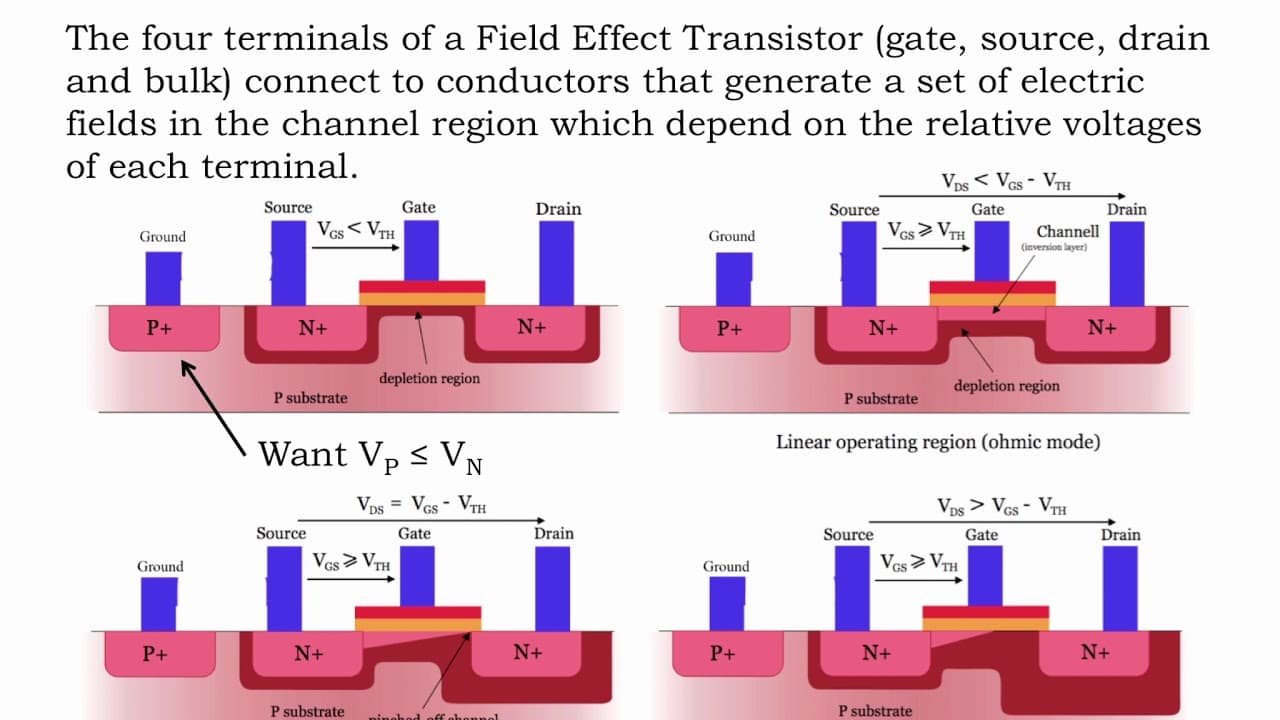
A MOSFET operates as a voltage-controlled switch, transitioning between non-conducting and conducting states based on the voltage difference between its gate and source terminals. When the gate voltage exceeds the threshold voltage, an inversion layer forms, allowing current to flow from the drain to the source. MOSFETs can be n-channel or p-channel, forming the basis of complementary MOS (CMOS) circuits.
Transcript
Now let's look at the electrical view of the MOSFET. Its operation is determined by the voltages of its four terminals. First we'll label the two diffusion terminals on either side of the gate terminal. Our convention is to call the diffusion terminal with the highest voltage potential the "drain" and the other lower-potential terminal the "source"... Read More
Key Insights
- ⚡ MOSFET operation relies on the voltage difference between the gate and source terminals, with the threshold voltage determining the switch's on/off state.
- ℹ️ The accumulation of electrons in an inversion layer forms a conducting path between the source and drain terminals, allowing current flow.
- 🅰️ The MOSFET can be built as an n-channel or p-channel device, with complementary MOS (CMOS) circuits using both types.
- ℹ️ The channel resistance and current flow change with the voltage differences between the gate and source terminals as well as the drain and source terminals.
Install to Summarize YouTube Videos and Get Transcripts
Explore YouTube Video Summarizer or Get YouTube Transcript Extractor
Questions & Answers
Q: How does the labeling of the diffusion terminals determine the direction of the current flow?
The diffusion terminal with the higher voltage potential is labeled as the drain, while the other terminal is labeled as the source. Current flows from the drain to the source in an MOSFET switch.
Q: What is the significance of the threshold voltage in MOSFET operation?
The threshold voltage determines the point at which the MOSFET transitions from non-conducting to conducting. When the gate-source voltage exceeds the threshold voltage, the switch closes and current flows between the source and drain terminals.
Q: What is the role of the substrate in MOSFET operation?
The substrate is connected to the p-type material and must always have a voltage equal to or less than the source and drain voltages for the MOSFET to operate correctly.
Q: How does the pinch-off effect impact the current flowing through the MOSFET?
When the drain-source voltage becomes larger than the gate-source voltage, the inversion layer pinches off near the drain end. However, the electrons can still tunnel across the pinch-off point, allowing some current flow. The current becomes approximately constant in this saturated region.
Summary & Key Takeaways
-
MOSFETs have four terminals: source, drain, gate, and bulk. The diffusion terminals are labeled as source and drain, with the drain having a higher voltage potential.
-
The MOSFET operates as a switch, transitioning from non-conducting (open) to conducting (closed) depending on the voltage difference between the gate and source terminals.
-
The switch is controlled by the accumulation of electrons in an inversion layer, which forms when the gate voltage exceeds the threshold voltage.
Read in Other Languages (beta)
Share This Summary 📚
Summarize YouTube Videos and Get Video Transcripts with 1-Click
Try YouTube Summary with ChatGPT & Claude or YouTube Transcript Generator
Explore More Summaries from MIT OpenCourseWare 📚



Summarize YouTube Videos and Get Video Transcripts with 1-Click
Try YouTube Summary with ChatGPT & Claude or YouTube Transcript Generator