What Is Horizontal vs. Vertical Scaling in System Design?

TL;DR
Horizontal scaling involves adding more machines to handle increased requests, while vertical scaling means upgrading to larger machines. Each approach has trade-offs: horizontal scaling offers better resilience and scalability, whereas vertical scaling provides faster communication and data consistency. A hybrid solution often combines the benefits of both methods for optimal system design.
Transcript
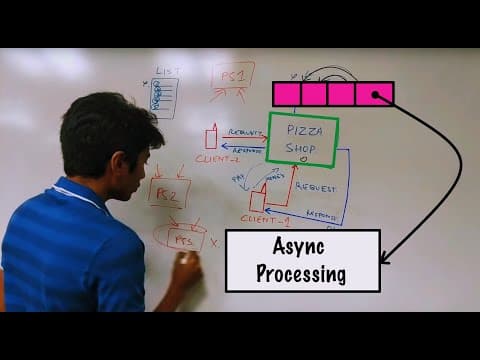
This video is on the basics of system design. If you have never designed a system before, this is probably the place to start. So imagine you have a computer with you in which you have written an algorithm. So some code is running on this computer and this code is like a normal function. It takes some input and it gives out an output. Now people lo... Read More
Key Insights
- 😶🌫️ System design involves exposing code through APIs and hosting services on the cloud.
- 🚥 Scalability can be achieved through vertical scaling or horizontal scaling.
- 💨 Vertical scaling offers faster communication and data consistency, while horizontal scaling provides better resilience and scalability.
- 😥 Trade-offs in system design include load balancing, point of failure, communication speed, data consistency, and hardware limitations.
Install to Summarize YouTube Videos and Get Transcripts
Explore YouTube Video Summarizer or Get YouTube Transcript Extractor
Questions & Answers
Q: What is the purpose of exposing code through APIs?
Exposing code through APIs allows others to access and use your code by making requests and receiving responses. This enables code to be usable without giving access to the entire computer.
Q: What is the difference between a desktop and the cloud?
The cloud is a set of computers provided by a service provider, such as Amazon Web Services, that offer computational power for running services. Unlike a desktop, the cloud allows for better reliability and configuration as provided by the solution providers.
Q: How can scalability be achieved in system design?
Scalability can be achieved by either vertically scaling (buying a bigger machine) or horizontally scaling (buying more machines). Vertical scaling increases processing speed, while horizontal scaling allows for distributing requests among multiple machines to handle more requests.
Q: What are the trade-offs in vertical scaling and horizontal scaling?
Vertical scaling does not require load balancing, but it has a single point of failure and slower communication between servers. Horizontal scaling requires load balancing, but it is more resilient with multiple machines and allows for faster interprocess communication.
Summary & Key Takeaways
-
System design involves exposing code through APIs to make it accessible for others to use.
-
Hosting services on the cloud allows for better configuration, reliability, and scalability.
-
Scalability options include vertical scaling (buying a bigger machine) and horizontal scaling (buying more machines) to handle increasing requests.
Read in Other Languages (beta)
Share This Summary 📚
Summarize YouTube Videos and Get Video Transcripts with 1-Click
Try YouTube Summary with ChatGPT & Claude or YouTube Transcript Generator
Explore More Summaries from Gaurav Sen 📚




Summarize YouTube Videos and Get Video Transcripts with 1-Click
Try YouTube Summary with ChatGPT & Claude or YouTube Transcript Generator