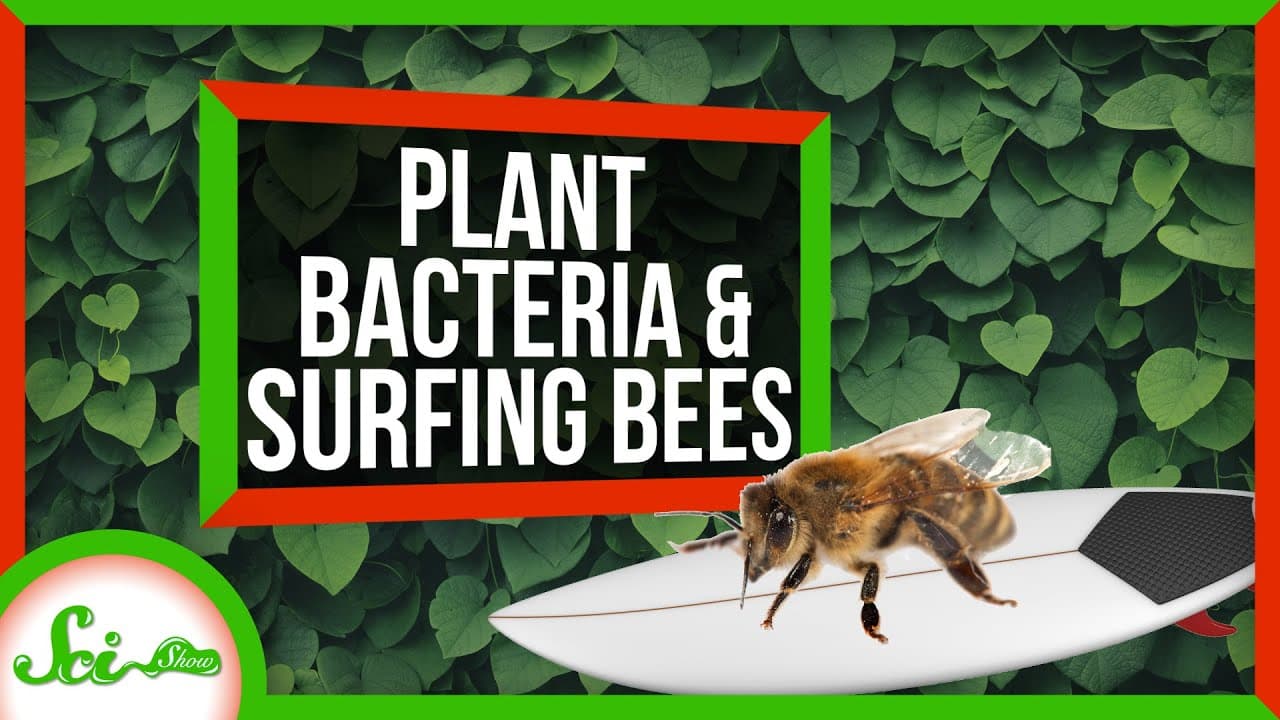
How Bacteria Helped Plants Take Over the World | SciShow News
TL;DR
Scientists discover shared genes between early land plants and algae, hinting at bacterial gene transfer for land survival.
Transcript
Thanks to Brilliant for supporting this week of SciShow! Go to Brilliant.org/SciShow to learn more. [ intro ] There’s a lot written about how early animals transitioned from living in water to living on land. But you rarely hear how /plants/ did it. That’s kind of a shame, because plants reached land first, and they conquered the planet way faster ... Read More
Key Insights
- 🏝️ Early land plants' transition from water to land is a complex process with limited fossil evidence.
- 🌱 Shared genes between land plants and Zygnematophyceae algae highlight a common genetic ancestry.
- 🖐️ Soil bacteria may have played a role in transferring survival genes to early land plants.
- 😘 Honeybees exhibit unique surfing behavior on water surfaces, utilizing their wings as hydrofoils.
- 🛄 Researchers aim to apply honeybees' surfing technique to robotics for navigating air and water efficiently.
- 💨 Brilliant.org provides interactive courses in science, math, and engineering, offering engaging ways to learn about various topics.
- 🌱 Understanding genetic links between plants and algae sheds light on the evolutionary history of plants on land.
Install to Summarize YouTube Videos and Get Transcripts
Explore YouTube Video Summarizer or Get YouTube Transcript Extractor
Questions & Answers
Q: What challenges do scientists face in understanding the transition of early land plants from water?
Scientists encounter difficulties due to the lack of fossil evidence, prompting them to rely on analyzing DNA from modern plants and algae for clues.
Q: How did researchers confirm the genetic relationship between land plants and Zygnematophyceae algae?
By sequencing genomes and identifying shared genes, researchers established a genetic link between early land plants and Zygnematophyceae algae.
Q: Why is the discovery of bacterial genes in land plants and algae significant?
The presence of bacterial genes indicates a potential link suggesting that soil bacteria may have contributed to the survival adaptation of early plants on land.
Q: How are honeybees unique in their ability to surf on water?
Honeybees can alter their wingbeats to create lift and propel themselves on water surfaces, showcasing a remarkable skill unique among insects.
Summary & Key Takeaways
-
Early land plants' evolutionary transition from water remains a mystery due to limited fossil evidence.
-
Scientists identified shared genes between land plants and Zygnematophyceae algae, suggesting common ancestry.
-
Soil bacteria may have transferred genes to early plants, aiding in their adaptation to survive on land.
Read in Other Languages (beta)
Share This Summary 📚
Summarize YouTube Videos and Get Video Transcripts with 1-Click
Try YouTube Summary with ChatGPT & Claude or YouTube Transcript Generator
Explore More Summaries from SciShow 📚


Summarize YouTube Videos and Get Video Transcripts with 1-Click
Try YouTube Summary with ChatGPT & Claude or YouTube Transcript Generator