Is the Intelligence-Explosion Near? A Reality Check.
TL;DR
Leopold Ashen brener predicts impending AGI, but limitations hinder rapid progress.
Transcript
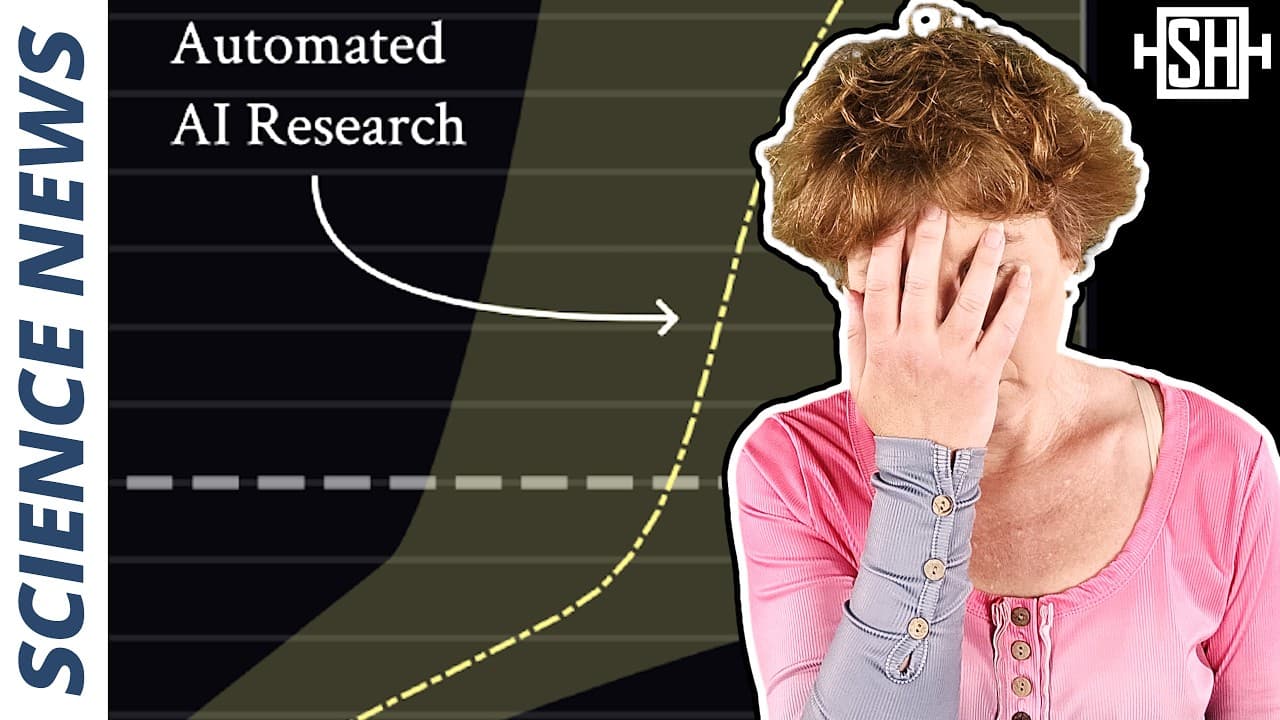
everyone's now talking about AI but few have the faintest glimmer of what's about to hit them that's a quote from Leopold Ashen brener who was recently fired from open AI he believes that artificial superintelligence is just around the corner and has written a 165 page essay explaining why I spent the last weekend reading this essay and want to tel... Read More
Key Insights
- 🛰️ The vision of artificial superintelligence is often met with skepticism due to historical inaccuracies in technological predictions.
- ❓ Major challenges such as energy consumption and data availability are often underestimated in the discourse surrounding AGI.
- 🤳 The notion of AGI self-improving rapidly is complicated by the realities of resource limitations and economic structures.
- 👨🔬 Improvements in AI could unlock existing knowledge trapped within the vast body of research, improving decision-making and innovation.
- 🙈 The author observes that current discourse around AGI is heavily influenced by a narrow view focused on US-China competition, ignoring the broader global context.
- 🥺 Simply scaling up AI may lead to diminishing returns if not aligned with sustainable energy sources and sufficient data streams.
- 🥺 The author acknowledges that AGI can eliminate common human errors, potentially leading to significant gains in efficiency and effectiveness.
Install to Summarize YouTube Videos and Get Transcripts
Explore YouTube Video Summarizer or Get YouTube Transcript Extractor
Questions & Answers
Q: Who is Leopold Ashen brener, and what are his main assertions about AI?
Leopold Ashen brener is a young AI researcher who formerly worked at OpenAI. In his recent essay, he claims that advancements in computing and algorithms will lead to artificial general intelligence (AGI) by 2027. He argues that current limitations will soon be overcome, allowing AI to exceed human intelligence across various tasks.
Q: What are the key limiting factors to the advancement of AGI, according to the author?
The author identifies energy and data constraints as critical limiting factors for AGI development. Training larger models requires substantial energy, and the projection of needing numerous power plants highlights the potential impossibility of meeting these energy demands. Additionally, the continuous need for new data poses significant challenges in progressing towards AGI.
Q: How does the author respond to Ashen brener's predictions about the future of AI and AGI?
The author is skeptical of Ashen brener’s timeline for AGI, suggesting that while there may be significant advancements, an "intelligence explosion" is unlikely to happen as quickly as predicted. The author points out that past predictions of machine intelligence have often missed the mark, leading to a cautious outlook on the rapidity of AI advancements.
Q: What potential benefits of AGI does the author acknowledge?
The author agrees that AGI has the potential to revolutionize science and technology by analyzing vast amounts of published research, making connections that humans may overlook. AGI could minimize human errors and improve overall efficiency in various fields, fostering significant advancements without necessarily creating new data or technologies.
Q: Why does the author compare current technological predictions with historical predictions?
The author argues that past projections about AI and machine intelligence have frequently proven inaccurate, citing examples from influential figures in the 1960s through the 1990s who estimated rapidly approaching human-level machine intelligence. This comparison emphasizes a persistent tendency within the tech community to overestimate how quickly transformative changes will occur.
Q: What does Ashen brener mean by 'unhobbling' AI, and why is the author skeptical about this concept?
Ashen brener uses 'unhobbling' to refer to the idea that current AI systems have limitations that can be fundamentally addressed, allowing for rapid progression towards AGI. The author is skeptical, arguing that overcoming these limitations will require substantial shifts in infrastructure and resources that are not immediate or likely to happen as quickly as suggested.
Summary & Key Takeaways
-
Leopold Ashen brener argues that artificial superintelligence is imminent, forecasting AGI by 2027 due to advances in computing power and algorithms.
-
The author challenges Ashen brener’s optimism, citing energy constraints and data limitations as significant obstacles that will delay the realization of AGI.
-
Despite the skepticism, the author acknowledges that AGI could unlock vast scientific knowledge and improve technology, although not as quickly as predicted.
Read in Other Languages (beta)
Share This Summary 📚
Summarize YouTube Videos and Get Video Transcripts with 1-Click
Try YouTube Summary with ChatGPT & Claude or YouTube Transcript Generator
Explore More Summaries from Sabine Hossenfelder 📚






Summarize YouTube Videos and Get Video Transcripts with 1-Click
Try YouTube Summary with ChatGPT & Claude or YouTube Transcript Generator