L13.10 Mean of the Sum of a Random Number of Random Variables
TL;DR
The content discusses a model where the total amount of money spent is the sum of random variables, including the twist that the number of stores visited is also a random variable.
Transcript
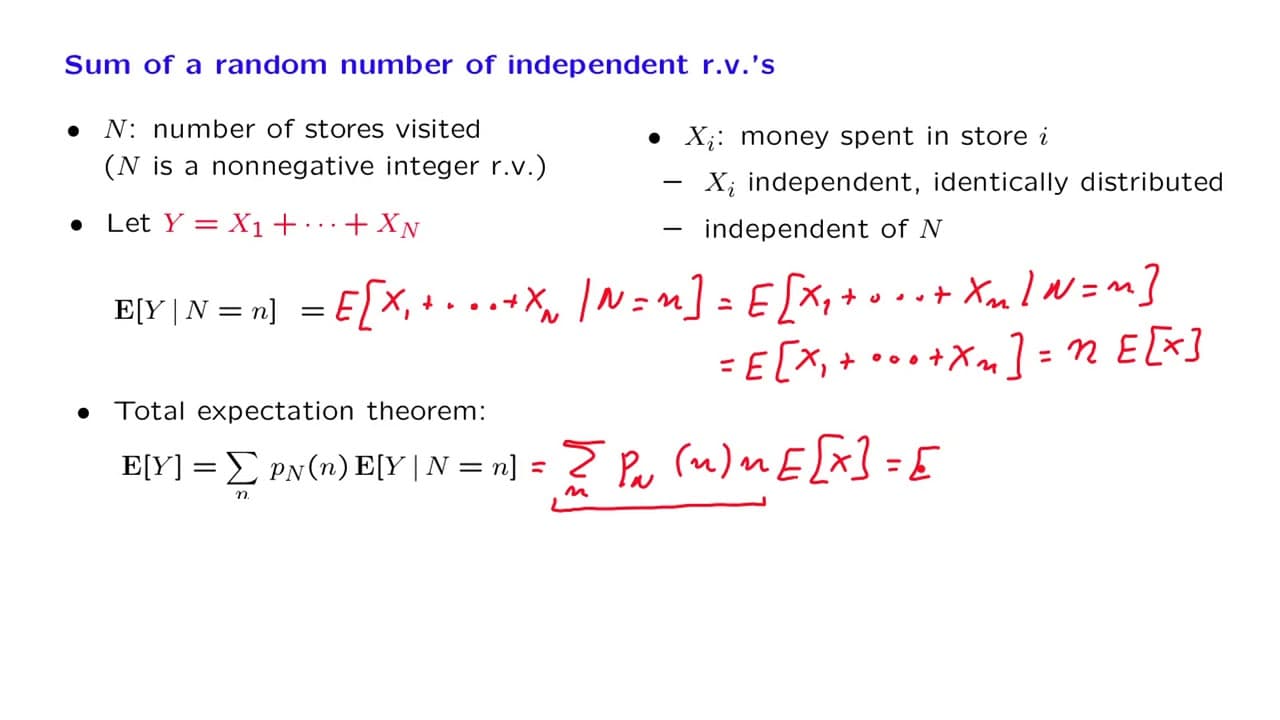
We now study a model that involves the sum of independent random variables, but with a twist. It's going to be the sum of a random number of independent random variables, as opposed to a fixed number. This is a model that shows up in a variety of applications, but it will also help us fine tune our command of the law of iterated expectations, and t... Read More
Key Insights
- #️⃣ The model discussed involves the sum of a random number of independent random variables, with the number of variables representing the number of stores visited.
- ❓ The assumptions of independence and identical distribution of the random variables are crucial for the analysis.
- #️⃣ Conditioning on a specific value of the number of stores visited helps simplify the problem by reducing it to the sum of a fixed number of random variables.
- 🏪 The expected value of the total amount spent is the product of the expected number of stores visited and the expected amount spent at each store.
- 🤩 The abstract conditional expectation is a key concept in applying the law of iterated expectations in this context.
- 👮 The law of total variance can also be useful in analyzing the variance of the total amount spent.
- 💄 The derived formula for the expected value of the total amount spent intuitively makes sense, but it is important to verify it mathematically.
Install to Summarize YouTube Videos and Get Transcripts
Explore YouTube Video Summarizer or Get YouTube Transcript Extractor
Questions & Answers
Q: What is the model discussed in the content?
The model involves the sum of a random number of independent random variables, where the number of variables represents the number of stores visited, and each variable represents the amount of money spent at a store.
Q: What assumptions are made about the random variables?
The random variables representing the amount of money spent are assumed to be independent, identically distributed, and independent of the random variable representing the number of stores visited.
Q: How is the expected value of the total amount of money spent calculated?
The expected value is calculated by conditioning on the specific value of the number of stores visited, treating it as a fixed number. The expected value is then the product of the expected number of stores visited and the expected amount of money spent at each store.
Q: Why is conditioning on the specific value of the number of stores visited helpful?
Conditioning on a fixed specific value allows us to deal with a finite sum of random variables, which is a situation that can be easily handled. It simplifies the problem by removing the randomness associated with the number of stores visited.
Summary & Key Takeaways
-
The content introduces a model where the total amount of money spent is the sum of random variables, with the number of stores visited being a random variable as well.
-
The assumptions made include the independent and identically distributed nature of the random variables and their independence from the number of stores visited.
-
The content explores the calculation of the expected value of the total amount of money spent by conditioning on the specific value of the number of stores visited.
Read in Other Languages (beta)
Share This Summary 📚
Summarize YouTube Videos and Get Video Transcripts with 1-Click
Try YouTube Summary with ChatGPT & Claude or YouTube Transcript Generator
Explore More Summaries from MIT OpenCourseWare 📚



Summarize YouTube Videos and Get Video Transcripts with 1-Click
Try YouTube Summary with ChatGPT & Claude or YouTube Transcript Generator