Maths Visualizing Shapes part 1 (Introduction) CBSE Class 8 Mathematics VIII
TL;DR
This video provides an introduction to three-dimensional objects and explains the difference between two-dimensional and three-dimensional shapes.
Transcript
hello friends this video on visualizing shapes part 1 is brought to you by exam fear calm no more fear from exam topics to be covered in this lesson our introduction to dimensional figures three-dimensional shapes mapping space around us faces edges and vertices polyhedrons regular and irregular polyhedrons concave and convex polyhedron and Euler's... Read More
Key Insights
- 😨 Objects that we see around us, like tables and cars, are solid objects and require three parameters (length, breadth, and height) to describe their size.
- 💠 Two-dimensional shapes can be described with only two dimensions (length and breadth), while three-dimensional shapes require an additional dimension (height).
- 🏮 Two-dimensional shapes can be drawn on a sheet of paper, while three-dimensional shapes stand out from the paper.
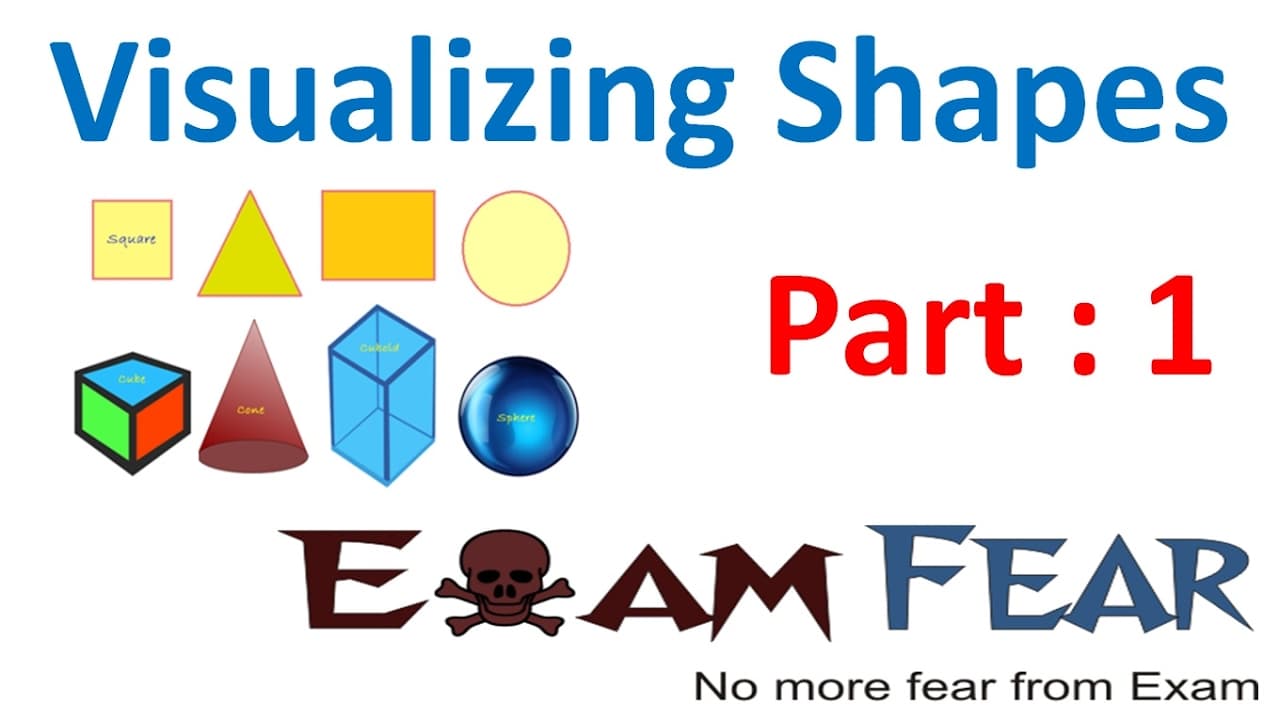
- 💠 Examples of two-dimensional shapes include rectangles, circles, triangles, squares, and pentagons, while examples of three-dimensional shapes include spheres, cones, cubes, and cuboids.
- ❓ Understanding the difference between two-dimensional and three-dimensional objects is essential in geometry.
- 🧑🏫 A quick recap of three-dimensional objects helps reinforce the concept taught in previous classes.
Install to Summarize YouTube Videos and Get Transcripts
Explore YouTube Video Summarizer or Get YouTube Transcript Extractor
Questions & Answers
Q: What are three-dimensional objects and how are they different from two-dimensional objects?
Three-dimensional objects are solid objects that require three parameters (length, breadth, and height) to describe their size. In contrast, two-dimensional objects only require length and breadth. Two-dimensional objects can be drawn on a sheet of paper, while three-dimensional objects cannot.
Q: What are some examples of three-dimensional shapes?
Some examples of three-dimensional shapes are spheres (e.g., balls), cones (e.g., ice cream cones), cubes (e.g., dice), and cuboids (e.g., matchboxes).
Q: Can three-dimensional figures be drawn on a sheet of paper like two-dimensional figures?
No, three-dimensional figures cannot be drawn on a sheet of paper. Unlike two-dimensional figures, which lie along the sheet of paper, three-dimensional figures stand out or protrude from the paper due to their extra third dimension.
Q: Why do three-dimensional objects require three parameters to describe their size?
Three-dimensional objects require three parameters (length, breadth, and height) to describe their size because they have three dimensions. Each dimension represents a different aspect of the object's size, and all three dimensions together provide a complete description of the object.
Summary & Key Takeaways
-
The video introduces the concept of three-dimensional objects and explains that they require three parameters (length, breadth, and height) to describe their size.
-
It compares two-dimensional objects (which only require length and breadth) to three-dimensional objects using examples like playing cards and towers.
-
The video also discusses the difference between two-dimensional and three-dimensional shapes and explains that two-dimensional shapes can be drawn on a sheet of paper, while three-dimensional shapes cannot.
Read in Other Languages (beta)
Share This Summary 📚
Summarize YouTube Videos and Get Video Transcripts with 1-Click
Try YouTube Summary with ChatGPT & Claude or YouTube Transcript Generator
Explore More Summaries from LearnoHub - Class 11, 12 📚




Summarize YouTube Videos and Get Video Transcripts with 1-Click
Try YouTube Summary with ChatGPT & Claude or YouTube Transcript Generator