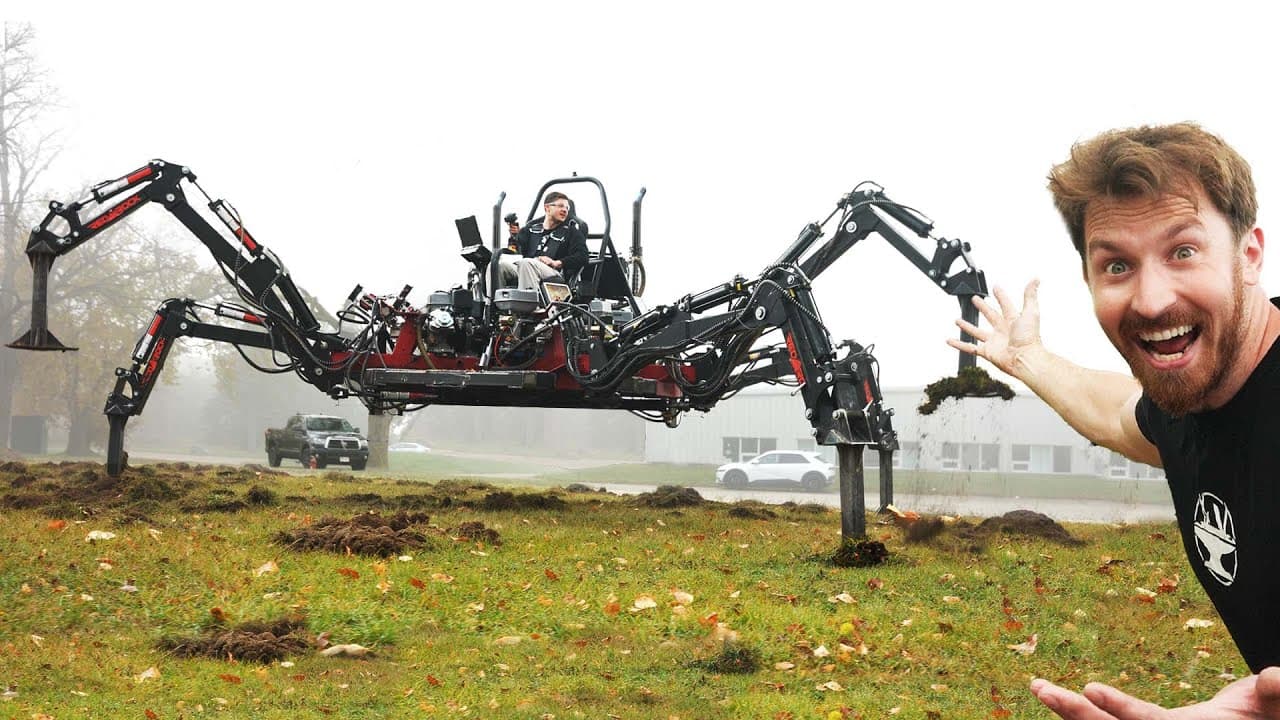
Our BIGGEST project yet! (SPIDER MECH!)
TL;DR
After a year and a half of challenges, failures, and setbacks, the team finally builds and tests the world's largest rideable hexapod.
Transcript
In this video I take on building the world's largest rideable hexapod, Megahex. A passion project of mine that has taken up the past year and a half of my life. What started out as a simple three-month build turned into a year and a half of failures, breakdowns, and rewrites. So close. And I think we have to cut our losses with this project. We... Read More
Key Insights
- 🏛️ Building a project of this scale requires extensive planning, engineering expertise, and a significant investment of time and resources.
- 🥳 Mass-manufactured parts often require modifications and tolerancing to fit the specific needs of the project.
- 📽️ Overheating and servo failures can be common challenges in hydraulic projects, necessitating regular monitoring and troubleshooting.
- 🛩️ Testing and continuous improvements are crucial in complex projects, as small adjustments can have a significant impact on performance.
- 🫵 Project setbacks and failures can be valuable learning opportunities and can provide interesting content for viewers.
- 📽️ Funding and community support are essential for undertaking ambitious projects like the Megahex.
- 😤 The team's dedication and perseverance were instrumental in overcoming the numerous challenges they faced.
Install to Summarize YouTube Videos and Get Transcripts
Explore YouTube Video Summarizer or Get YouTube Transcript Extractor
Questions & Answers
Q: What inspired the team to build the world's largest rideable hexapod?
The team was inspired by a video of an excavator capable of standing up and maneuvering using its bucket. They wanted to see if more legs could work together as one giant unit.
Q: What were some of the challenges the team faced during the project?
The team encountered challenges such as frame size limitations, differences in leg motion, mass-manufactured parts not aligning properly, failed welding, overheating servos, hydraulic leaks, and communication issues.
Q: How did the team address the issues with overheating servos?
The team changed the springs and added a computer fan to keep the servos cooler. They also replaced the servos that failed and tuned the system to prevent excessive overheating.
Q: Was there a significant setback during the project?
Yes, one of the main frames of the hexapod tore itself in half during testing, requiring significant repairs and welding.
Q: Did the team achieve their goal of creating a walking hexapod?
Yes, after months of testing, making improvements, and overcoming challenges, the team succeeded in making the hexapod walk and demonstrated it to others.
Summary & Key Takeaways
-
The project started as a simple three-month build but turned into a long and difficult journey filled with failures, rewrites, and constant problem-solving.
-
The team faced various challenges, including redesigning the frame, dealing with mass-manufactured parts, and tolerancing the frames themselves.
-
They encountered issues with welding, servo motors, hydraulic systems, and communication, but they persisted, made improvements, and finally achieved their goal of creating a walking hexapod.
Read in Other Languages (beta)
Share This Summary 📚
Summarize YouTube Videos and Get Video Transcripts with 1-Click
Try YouTube Summary with ChatGPT & Claude or YouTube Transcript Generator
Explore More Summaries from Hacksmith Industries 📚

Summarize YouTube Videos and Get Video Transcripts with 1-Click
Try YouTube Summary with ChatGPT & Claude or YouTube Transcript Generator