J K Flip flop | Edge triggered | STLD | Lec-119
TL;DR
JK flip flop avoids indeterminate states and toggles outputs unlike SR flip flop.
Transcript
hi everyone in this video I'm going to explain about the edge triggered JK flipflop Ed triggered JK flipflop J and K stands for Johnson Kelby which which is an advantage of which is having an advantage compared to Sr fpop in Sr fpop the main drawback was when s is equal to 1 and r equal to 1 the output is an indeterminate State because both q and Q... Read More
Key Insights
- 🐬 The JK flip flop is named after inventors Jack Kilby and Robert Noyce, highlighting its pivotal role in digital electronics.
- 👻 Feedback loops in the JK flip flop significantly increase its versatility compared to its predecessors, allowing for complex state management in circuits.
- ✋ State transitions in a JK flip flop are only recognized during the active clock edge, minimizing erratic behaviors during high levels of logic signals.
- 🉑 The truth table of the JK flip flop shows distinct outputs based on varied combinations of the J and K inputs, clearly defining its operation in both set, reset, and toggle conditions.
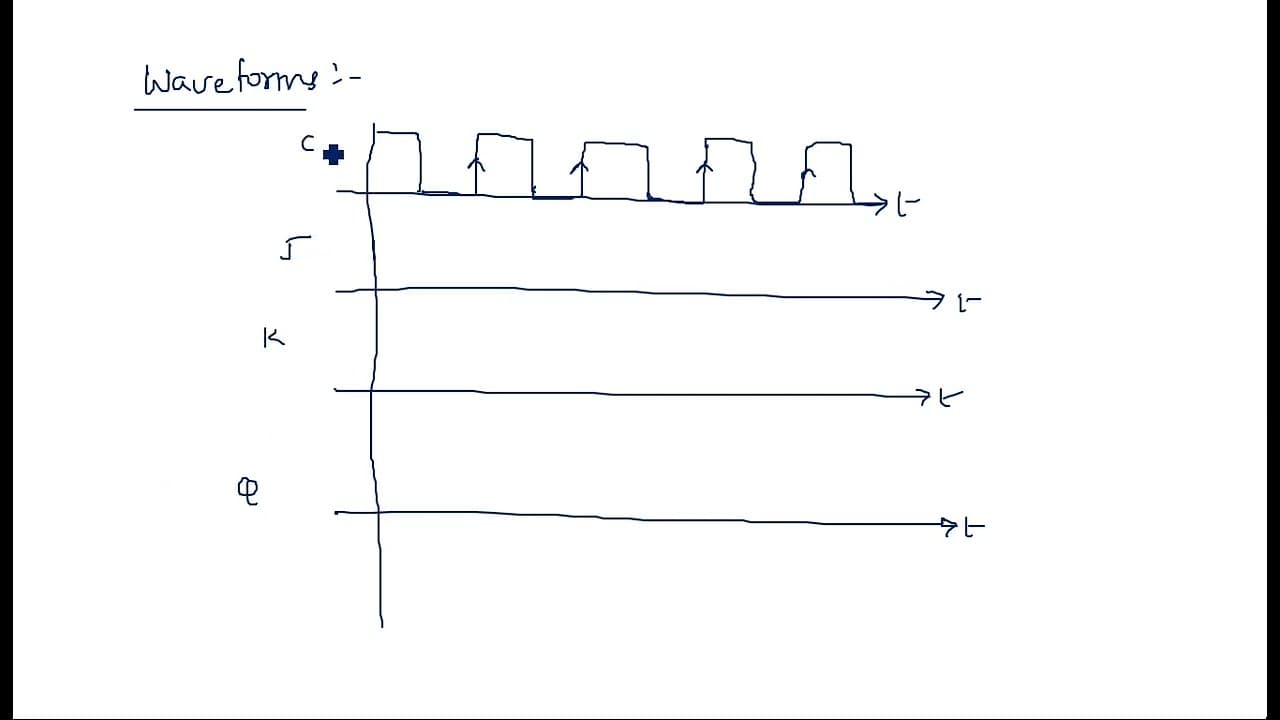
- 💗 Visual waveform representations help in comprehensively understanding the relationship between clock pulses and output changes, illustrating the sequential processing nature of the flip flop.
- 🐬 The JK flip flop’s ability to maintain outputs until the next triggering event makes it essential for reliable data storage in sequential circuits.
- 🔄 It is often implemented in counters, shift registers, and memory cells due to its robustness and efficiency in toggling operations.
Install to Summarize YouTube Videos and Get Transcripts
Explore YouTube Video Summarizer or Get YouTube Transcript Extractor
Questions & Answers
Q: What is the primary advantage of the JK flip flop over the SR flip flop?
The primary advantage of the JK flip flop is its ability to avoid indeterminate states, which occur in the SR flip flop when both inputs are set to high. By introducing feedback mechanisms, the JK flip flop allows for a well-defined toggle output when both inputs are high, making it more reliable for memory storage in digital circuits.
Q: How does the JK flip flop achieve its toggle functionality?
The toggle functionality of the JK flip flop is achieved by configuring the flip flop to change its output state with each clock pulse when both inputs, J and K, are set to one. This state change is facilitated by feedback loops that ensure the current output becomes the complement of the previous output, thereby providing an alternating series of outputs on successive clock edges.
Q: Can you explain the internal architecture of the JK flip flop?
The internal architecture of the JK flip flop includes two sets of NAND gates. The first set serves as controlling gates that take inputs J and K, while the second set acts as memory gates that store the output states. The additional feedback from the outputs connects back to the inputs, distinguishing it from the simpler SR flip flop design and increasing its functionality and reliability.
Q: How is the clock signal integrated into the operation of the JK flip flop?
The clock signal plays a crucial role in the operation of the JK flip flop by determining when the output should respond to the input states. The flip flop is typically designed to be edge-triggered, meaning that it only changes its output state on the rising or falling edge of the clock. This synchronization ensures that the flip flop operates correctly in time with other sequential elements in a circuit.
Summary & Key Takeaways
-
The JK flip flop improves upon the SR flip flop by eliminating the indeterminate state that occurs when both inputs are high, creating a reliable toggle output instead.
-
Unlike the SR flip flop that risks undefined behavior with specific input combinations, the JK flip flop adds feedback that stabilizes output in all cases, which makes it versatile and commonly used.
-
The internal architecture of the JK flip flop consists of feedback mechanisms using NAND gates that process input signals based on the clock's rising edge, ensuring controlled output changes.
Read in Other Languages (beta)
Share This Summary 📚
Summarize YouTube Videos and Get Video Transcripts with 1-Click
Try YouTube Summary with ChatGPT & Claude or YouTube Transcript Generator