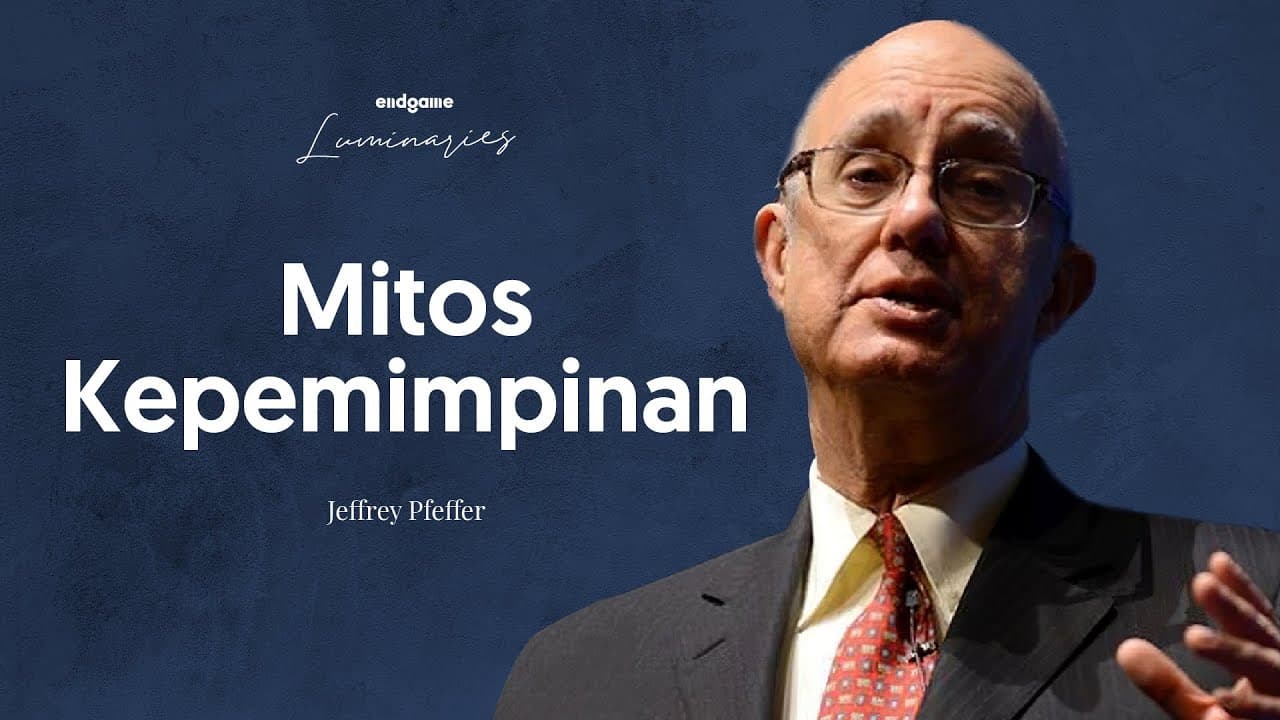
Jeffrey Pfeffer: Harness Power for Good | Endgame #114 (Luminaries)
TL;DR
Jeffrey Pfeffer discusses his book '7 Rules of Power' and its practical applications.
Transcript
"I could leave our strategic plan on a plane, and it wouldn't matter." The difference for us is not strategy, it's execution. And execution requires influence. I mean that's what leadership is, leadership is about getting things done through other people. Unless they were going to do it anyway, you have to influence them. Hi friends and fellows. W... Read More
Key Insights
- Execution, not strategy, is the key to success, and it requires influence and leadership to get things done through others.
- Writing requires a unique idea and a structured outline, similar to planning a class with a beginning, middle, and end.
- Getting out of one's own way involves not worrying about being liked and avoiding disempowering self-descriptions.
- Breaking the rules can be a strategic move to gain power, as it catches people by surprise and can lead to innovation.
- Projecting power through body language and voice is crucial, as first impressions are formed quickly and based on appearance and sound.
- Building a powerful brand and networking are essential for leadership, as they help in getting things done through others.
- Using power effectively increases influence and attracts more opportunities, as people invest in those who can make things happen.
- Cultural differences may influence the application of power rules, but the principles of standing out and being different are universal.
Install to Summarize YouTube Videos and Get Transcripts
Explore YouTube Video Summarizer or Get YouTube Transcript Extractor
Questions & Answers
Q: What is the key to success according to Jeffrey Pfeffer?
According to Jeffrey Pfeffer, the key to success is execution rather than strategy. Execution involves influencing others to get things done, which is a fundamental aspect of leadership. Pfeffer emphasizes that leadership is about achieving results through people, and this requires effective influence.
Q: How does Jeffrey Pfeffer approach writing his books?
Jeffrey Pfeffer approaches writing by first identifying a unique idea that interests him and hasn't been extensively covered by others. He then creates a structured outline, ensuring the book has a clear beginning, middle, and end. This process is akin to planning a class, where the flow and order are crucial.
Q: What does Pfeffer mean by 'getting out of your own way'?
Pfeffer explains that 'getting out of your own way' involves not being overly concerned with being liked and avoiding self-descriptions that limit one's potential. It means shedding any narratives that disempower oneself, such as attributing limitations to gender or minority status, and avoiding preemptive apologies.
Q: Why does Pfeffer advocate for breaking rules?
Pfeffer advocates for breaking rules as a strategic move to gain power. He argues that breaking rules catches people by surprise, making actions memorable and often leading to innovation. He cites historical figures like Rosa Parks and Nelson Mandela, who broke rules for impactful change.
Q: How important is body language in projecting power?
Body language is crucial in projecting power, according to Pfeffer. First impressions, formed within seconds, are largely based on appearance and sound. Using powerful gestures and speaking with authority can significantly influence how one is perceived and can enhance one's leadership presence.
Q: What role do networking and branding play in leadership?
Networking and building a powerful brand are essential components of leadership. They enable leaders to get things done through others by expanding their influence and reach. A strong network and brand help in creating opportunities and facilitating the execution of strategies.
Q: How does using power effectively increase influence?
Using power effectively increases influence by demonstrating the ability to achieve results. Pfeffer explains that as one uses power to make things happen, it attracts more opportunities and investment from others, creating a positive cycle of influence and achievement.
Q: Are the principles of power universal across cultures?
While cultural differences may influence how power is applied, Pfeffer believes the principles of standing out and being different are universal. He notes that his books on power have been well-received in various cultures, indicating that the fundamental strategies for gaining and using power are broadly applicable.
Summary & Key Takeaways
-
Jeffrey Pfeffer emphasizes that execution, not strategy, is crucial for success and requires leadership to influence others. He discusses his writing process, highlighting the importance of a unique idea and structured outline, similar to planning a class.
-
Pfeffer explains how getting out of one's own way involves shedding the need to be liked and avoiding self-disempowering narratives. He advocates for breaking rules strategically to gain power and highlights the role of body language in projecting power.
-
Networking and building a powerful brand are vital for leadership, allowing one to get things done through others. Using power effectively increases influence and attracts opportunities, and while cultural differences exist, the principles of standing out are universal.
Read in Other Languages (beta)
Share This Summary 📚
Summarize YouTube Videos and Get Video Transcripts with 1-Click
Try YouTube Summary with ChatGPT & Claude or YouTube Transcript Generator
Explore More Summaries from Gita Wirjawan 📚






Summarize YouTube Videos and Get Video Transcripts with 1-Click
Try YouTube Summary with ChatGPT & Claude or YouTube Transcript Generator