Series generators | Shunt generators | Characteristics | DC machines | Lec-48
TL;DR
The content explains the characteristics and applications of shunt and series DC generators.
Transcript
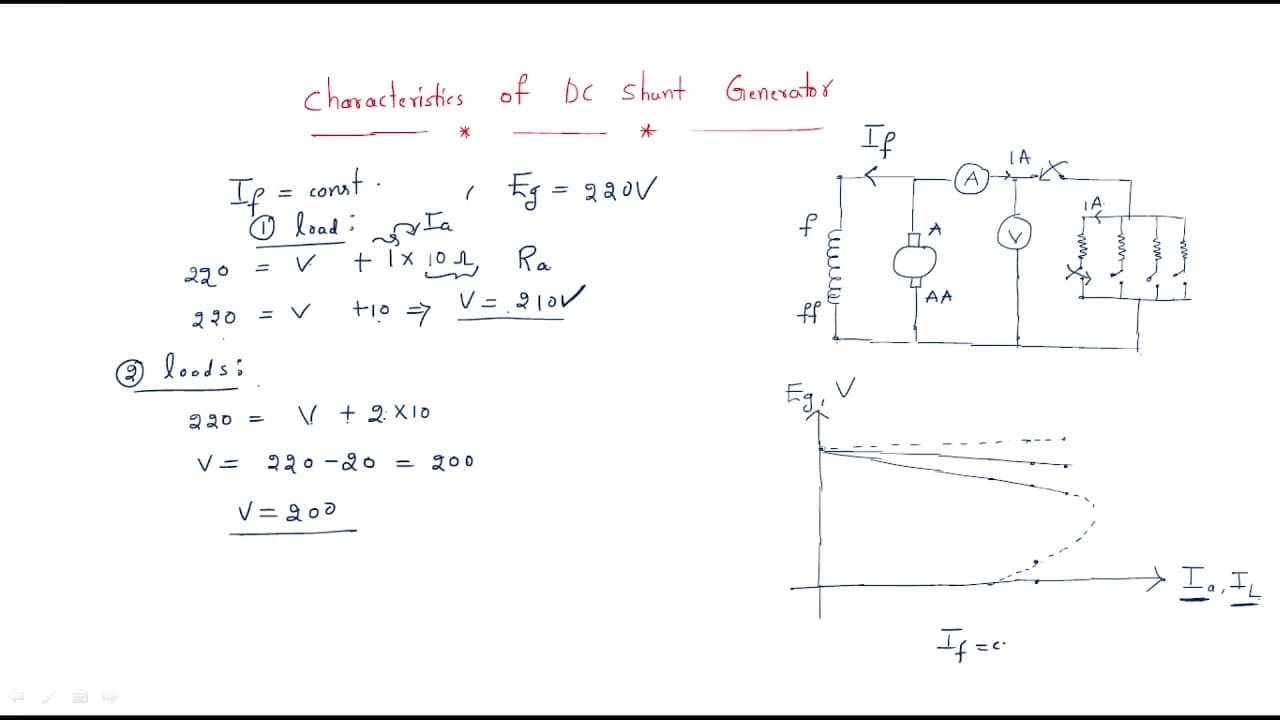
hello everyone next we will discuss about the next topic is characteristics of decision generator so we have so many types of dc generators in this we will discuss about the decision generator here generally you know that the decision to generator is consisting like this this is the armature generally represents with and we have the field ef and ff... Read More
Key Insights
- ⚡ Shunt generators maintain a constant field current, resulting in variable terminal voltages under different load conditions.
- 💦 Voltage drops in shunt generators occur due to armature resistance, especially as load increases.
- 🏑 Series generators provide a direct relationship between field current and generated EMF, vital for operations under load.
- 🌸 The ideal output of generators may differ from practical applications due to losses from armature reaction and resistance.
- 🫥 Shunt and series generators are suitable for different applications, such as battery charging and voltage boosting in transmission lines.
- 🖐️ Both generator types play critical roles in power systems, each with distinct operational characteristics and benefits.
- ⚡ Understanding voltage profiles is important for generator performance, especially in fluctuating load scenarios.
Install to Summarize YouTube Videos and Get Transcripts
Explore YouTube Video Summarizer or Get YouTube Transcript Extractor
Questions & Answers
Q: What is a shunt generator, and how does it work?
A shunt generator consists of its armature and field coils connected in parallel. The field current remains nearly constant regardless of the load. As loads increase, the armature current rises, leading to voltage drops across the armature resistance, impacting the terminal voltage experienced by the load.
Q: How do changes in load affect the voltage in a shunt generator?
In a shunt generator, as the load increases and draws more current, voltage drops due to increased armature resistance. For example, with one load, the terminal voltage may be 210V, but with additional loads, voltage can decrease to 200V reflecting the rise in armature current and associated resistance.
Q: What unique characteristics do series generators exhibit?
Series generators have their armature and field windings connected in series, meaning all currents are equal. Under no load, the residual magnetism is zero, leading to zero EMF. Additionally, as the field current increases with load, the generated EMF increases proportionally.
Q: What are the practical applications of shunt and series generators?
Shunt generators are widely used as voltage sources and for battery charging, while series generators find applications as boosters in DC transmission lines to compensate for voltage drops. These applications leverage the distinct characteristics of each generator type.
Q: How does armature reaction affect voltage in a DC generator?
Armature reaction refers to the impact of current flowing through the armature winding on the distribution of the magnetic field. It affects the voltage profile by introducing losses. For accurate voltage predictions, both the armature resistance drop and armature reaction must be considered.
Q: What role does a series generator play in a DC transmission system?
In a DC transmission system, a series generator acts as a booster to counteract voltage drops caused by line resistance. This ensures that the voltage remains stable and meets the needs of connected loads, maintaining performance in the delivery of power.
Q: Why is field current considered constant in shunt generators?
In shunt generators, the field winding is connected in parallel with the armature, resulting in a constant field current across varying load conditions. As load current increases in the armature, the field current remains stable, allowing for reliable voltage output.
Q: What factors determine the performance of a series generator?
The performance of a series generator is influenced by factors such as load conditions, armature current, and the strength of residual magnetism. Each factor affects the EMF generated, making it crucial to consider these elements for accurate assessments of performance.
Summary & Key Takeaways
-
The characteristics of shunt generators are mainly defined by their constant field current, which impacts the generated EMF as load increases, causing voltage drops under higher loads.
-
Series generators differ by demonstrating an ideal scenario where generated EMF is directly proportional to field and armature currents, and they are commonly utilized to maintain voltage profiles in DC transmission lines.
-
Both types of generators exhibit specific behaviors, such as voltage drops under load conditions and distinctive applications in battery charging and boosting in electrical systems.
Read in Other Languages (beta)
Share This Summary 📚
Summarize YouTube Videos and Get Video Transcripts with 1-Click
Try YouTube Summary with ChatGPT & Claude or YouTube Transcript Generator