What Is Summation Notation and How Do You Use It?
TL;DR
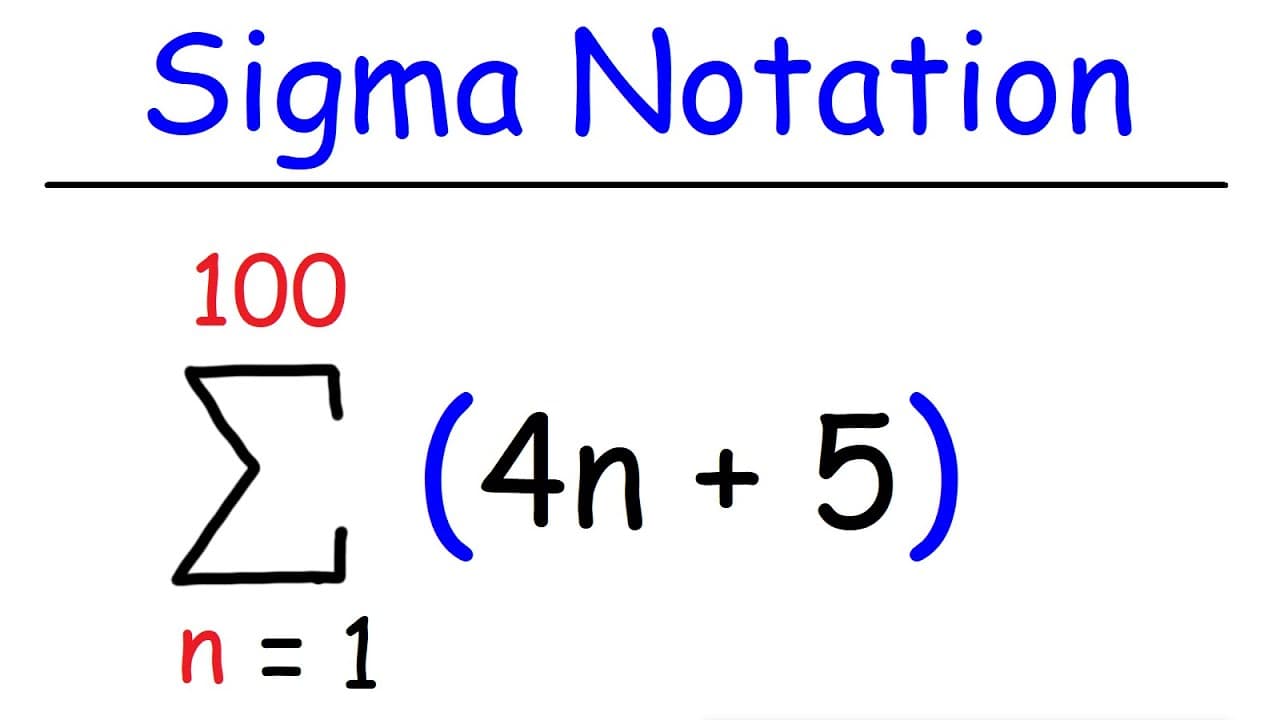
Summation notation, denoted by the sigma symbol, is a method for calculating the sum of a sequence of numbers. To use it, simply define your sequence and apply either arithmetic or geometric summation formulas, especially for large data sets. Understanding this notation streamlines the process of summing values efficiently.
Transcript
what would you do if you were to see a problem like this what is the answer so this represents summation you probably heard of the expression sigma notation when you see this funny looking e symbol it's basically tell you to find the sum of something now what we're going to do is we're going to write out some numbers starting from 1 and then to 5 u... Read More
Key Insights
- 🍹 Summation notation is a useful tool for finding the sum of sequences of numbers.
- ✊ Different types of functions, such as squared numbers, powers of 2, and arithmetic sequences, can be evaluated using summation notation.
- 🍹 Formulas for calculating the sum of arithmetic and geometric sequences provide a shortcut for finding the sum of large sequences.
- 🥳 Geometric sequences converge to a specific value if the absolute ratio is less than one, while arithmetic sequences may increase indefinitely.
Install to Summarize YouTube Videos and Get Transcripts
Explore YouTube Video Summarizer or Get YouTube Transcript Extractor
Questions & Answers
Q: What is summation notation?
Summation notation is represented by the sigma symbol and is used to find the sum of a series of numbers. It allows you to express the pattern or formula for adding up the terms in a concise way.
Q: How do you find the sum of squared numbers using summation notation?
To find the sum of squared numbers, you would write the expression as Σ(n^2), where n represents the numbers being squared. You would then substitute the values for n and add up all the squared values.
Q: How do you find the sum of powers of 2 using summation notation?
The expression Σ(2^n) represents the sum of powers of 2. By substituting the values for n and adding up the resulting values, you can find the sum.
Q: How do you evaluate arithmetic sequences using summation notation?
An arithmetic sequence is a sequence where each term is obtained by adding a common difference to the previous term. You can evaluate the sum of an arithmetic sequence by using the formula S_n = (n/2)(a_1 + a_n), where S_n is the sum of the first n terms, a_1 is the first term, and a_n is the last term.
Q: How do you evaluate geometric sequences using summation notation?
In a geometric sequence, each term is obtained by multiplying the previous term by a common ratio. To evaluate the sum of a geometric sequence, use the formula S_n = (a_1(1 - r^n))/(1 - r), where S_n is the sum of the first n terms, a_1 is the first term, r is the common ratio, and n is the number of terms.
Summary & Key Takeaways
-
Summation notation, represented by the sigma symbol, is used to find the sum of a sequence of numbers.
-
Examples are provided for finding the sum of squared numbers, powers of 2, and arithmetic sequences.
-
Formulas for calculating the sum of arithmetic and geometric sequences are explained.
-
The importance of using formulas to find sums of large sequences efficiently is highlighted.
Read in Other Languages (beta)
Share This Summary 📚
Summarize YouTube Videos and Get Video Transcripts with 1-Click
Try YouTube Summary with ChatGPT & Claude or YouTube Transcript Generator
Explore More Summaries from The Organic Chemistry Tutor 📚
Summarize YouTube Videos and Get Video Transcripts with 1-Click
Try YouTube Summary with ChatGPT & Claude or YouTube Transcript Generator