Vertical amplifier | Horizontal sweep generator | Electrical Instruments ( EIM ) | Lec - 31
TL;DR
This video details the structure and function of vertical amplifiers in oscilloscope signal amplification.
Transcript
hi everyone in this video i will explain about the vertical amplifier and what is the internal block of vertical amplifier how it is used to amplify the signal in the vertical deflection system already in the cro block diagram you have seen what are the blocks of vertical deflection system and what are the blocks of horizontal reflection system in ... Read More
Key Insights
- 🖐️ The vertical amplifier plays a vital role in adjustments to gain and frequency bandwidth, impacting oscilloscope performance.
- 🉐 The gain-bandwidth product is a critical concept that governs the trade-offs between gain and bandwidth achievable in amplifiers.
- 🔠 Understanding the input amplifier's characteristics, including high input impedance from FETs, helps optimize signal handling.
- 💁 The phase inverter is essential for converting single polarity signals into a dual-polarity format for more accurate representation on oscilloscopes.
- 🎊 In oscilloscope designs, the influence of component selection, like FETs and BJTs, significantly impacts signal clarity and output quality.
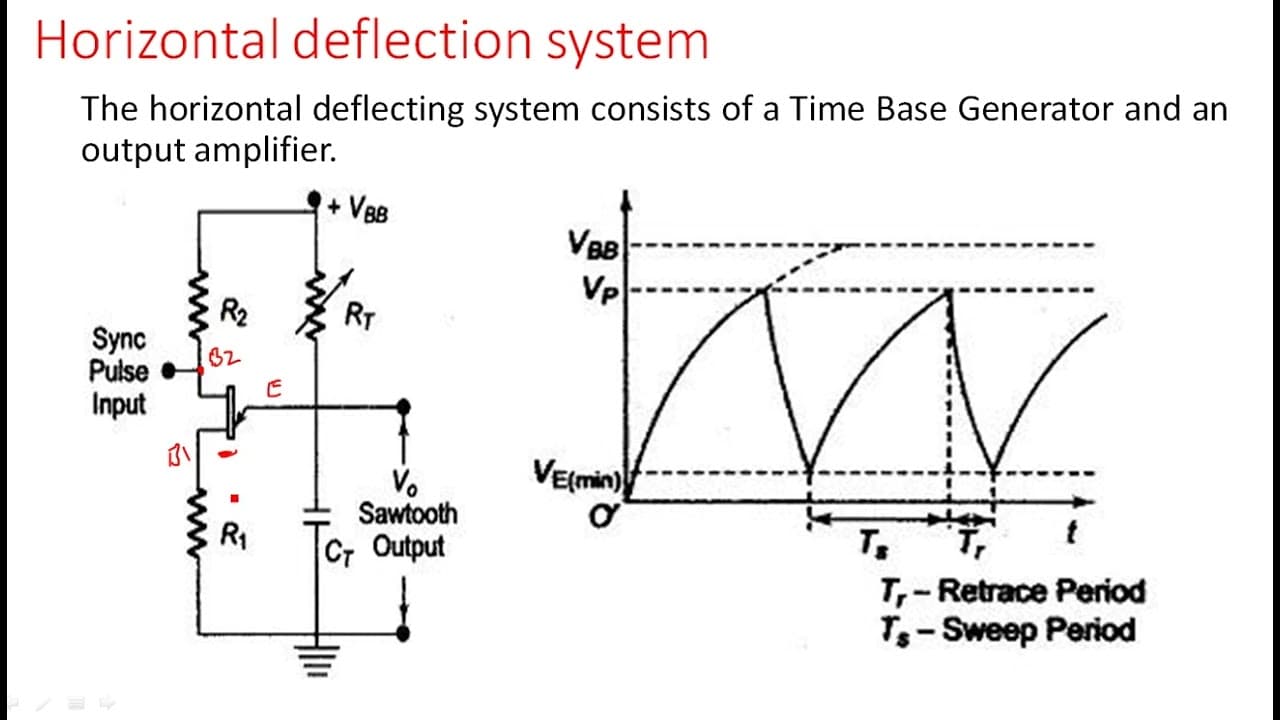
- 🚥 The operation of the UJT relaxation oscillator ensures that horizontal deflection occurs smoothly, producing necessary waveforms for image display.
- 👻 Careful tuning of the vertical amplifier allows oscilloscopes to display a wide variety of experimental signals with precision and accuracy.
Install to Summarize YouTube Videos and Get Transcripts
Explore YouTube Video Summarizer or Get YouTube Transcript Extractor
Questions & Answers
Q: What is the primary function of the vertical amplifier in an oscilloscope?
The vertical amplifier's primary function is to amplify input signals for the vertical deflection system of an oscilloscope. It determines the sensitivity, gain, and frequency response of the oscilloscope, allowing for accurate display of waveforms, and plays a critical role in signal clarity and detailing.
Q: How does the gain-bandwidth product affect the vertical amplifier's performance?
The gain-bandwidth product is a crucial parameter for vertical amplifiers. It states that increasing gain will reduce bandwidth and vice versa, maintaining a constant product. This principle influences how accurately a waveform can be displayed, as the amplifier must balance between gaining detail and managing frequency response.
Q: What components constitute the internal structure of a vertical amplifier?
A typical vertical amplifier consists of an input stage (often a FET input amplifier) and a main stage (usually a bipolar junction transistor). The input stage has high input impedance, while the main amplifier focuses on high output power, allowing for effective signal amplification without losing integrity.
Q: Can both high gain and wide bandwidth be achieved simultaneously in vertical amplifiers?
No, vertical amplifiers cannot achieve both high gain and wide bandwidth simultaneously due to the inherent design trade-offs described by the gain-bandwidth product. Increasing one will necessitate a reduction in the other, requiring users to prioritize based on their measurement needs.
Q: What role does the phase inverter play in the vertical amplifier circuit?
The phase inverter in a vertical amplifier circuit converts the input signal into two polarities, allowing the amplifier to process both positive and negative voltages. This is essential for creating a comprehensive representation of the input signal on the display, ensuring accurate waveform reproduction.
Q: How does the UJT relaxation oscillator integrate into the horizontal deflection system?
The UJT relaxation oscillator is integral to the horizontal deflection system as it generates the sawtooth waveforms that drive the horizontal deflection plates. By controlling the charging and discharging cycles of a capacitor, it creates the necessary timing signals for accurate horizontal sweeping of the oscilloscope.
Q: What is the significance of input attenuation in the vertical amplifier?
Input attenuation in the vertical amplifier is significant as it eliminates unnecessary noise and reduces the loading effect that could distort the input signal. By filtering out unwanted components, the system can function more efficiently, allowing for clearer and more accurate signal measurement.
Summary & Key Takeaways
-
The vertical amplifier is essential in oscilloscope systems, defining gain and bandwidth, affecting signal clarity and accuracy. It consists of an input amplifier and a main amplifier, often utilizing different transistor types to optimize performance.
-
Vertical amplifiers have trade-offs between gain and bandwidth, requiring careful adjustment to maintain a constant gain-bandwidth product, meaning improving one often hinders the other.
-
The video also touches on the horizontal deflection system, specifically the UJT relaxation oscillator, which generates sweep voltages essential for displaying signals on oscilloscopes.
Read in Other Languages (beta)
Share This Summary 📚
Summarize YouTube Videos and Get Video Transcripts with 1-Click
Try YouTube Summary with ChatGPT & Claude or YouTube Transcript Generator