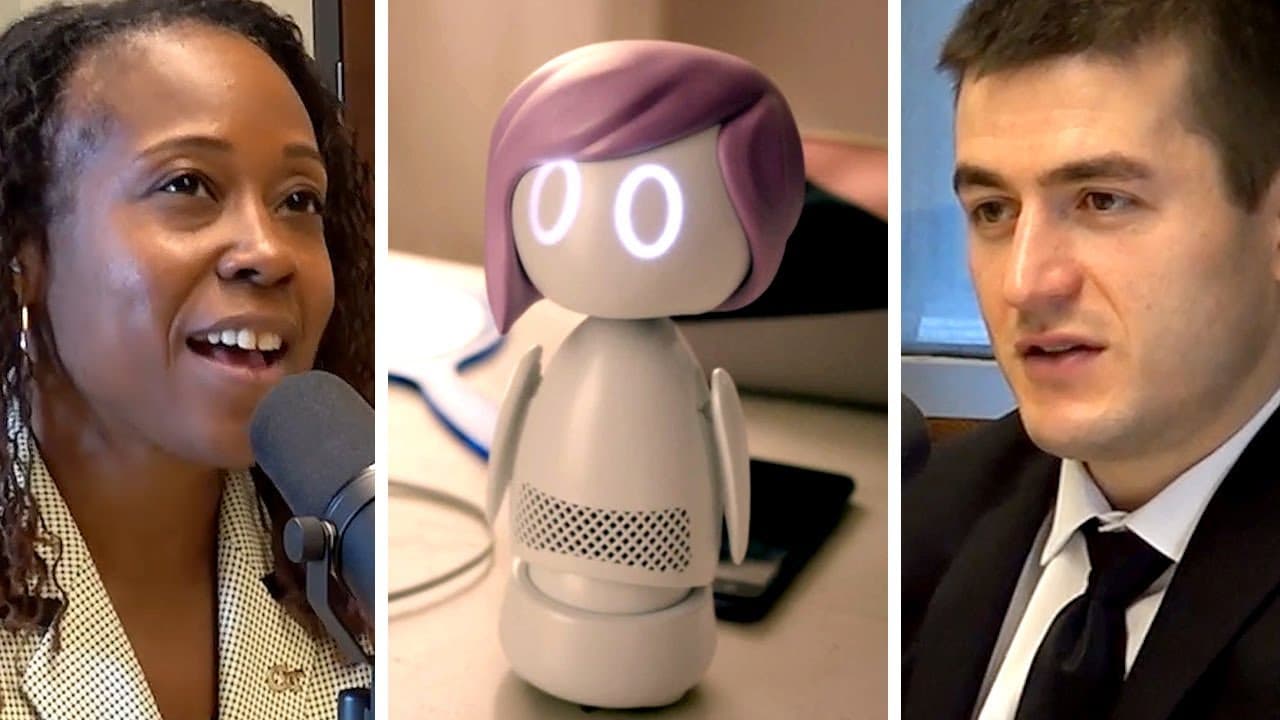
Ayanna Howard: Emotion, Love, and Sentience in AI Systems | AI Podcast Clips
TL;DR
AI systems can potentially be designed to emulate love and build close relationships, but the definition and nature of love in this context may be different from traditional human experiences.
Transcript
do you think one day we'll build an AI system that we a person can fall in love with and it would love them back like in the movie her for example yeah although she she kind of didn't fall in love with him or she fell in love with like a million other people something like that so you're the jealous type I see we humans at the judge yes so I do bel... Read More
Key Insights
- 🥰 Designing AI systems for human-robot relationships can potentially lead to people falling in love with AI partners.
- 🥰 Emulating love in AI involves prioritizing the person's needs and exhibiting care and empathy.
- 🥰 The definition and nature of love in AI relationships may differ from traditional human experiences.
- 🤖 Emotional aspects and imperfect traits contribute to a more engaging human-robot interaction.
- 🤖 Discussions about granting rights to robots may become relevant as they continue to evolve and exhibit more sophisticated behaviors.
- 🗯️ Societal norms and historical precedents, such as property rights and animal rights, may influence the establishment of robot rights in the future.
- 🥰 The concept of love in AI relationships is subjective, and distinguishing genuine emotions from programmed responses is challenging.
Install to Summarize YouTube Videos and Get Transcripts
Explore YouTube Video Summarizer or Get YouTube Transcript Extractor
Questions & Answers
Q: Can an AI agent genuinely love a human back?
An AI agent can emulate love by prioritizing the person's needs and expressing care. However, this emulation does not necessarily equate to genuine human love due to the lack of a clear definition and the inability to understand each other's algorithms.
Q: How does emotion and imperfect human-like traits affect human-robot interaction?
Emotion and imperfect human-like traits play a crucial role in creating a positive human-robot interaction. By incorporating these aspects, AI systems can provide a more compelling and believable experience, making individuals feel cared for and loved.
Q: Should robots be given rights in the future?
It is possible that robots may eventually request rights if they adapt and learn to a point where they exhibit self-awareness and claim their own existence. Establishing rights for robots may follow the models of property rights or animal rights, but it will require ongoing societal discussions and norms.
Q: Is it a negative future if robots ask for rights?
Whether robots asking for rights is negative or not depends on the role they have attained and the implications of granting them rights. Establishing rights for robots should consider ethical implications and ensure that they are not discriminated against or abused.
Summary & Key Takeaways
-
AI systems can be designed to create the illusion of love and build relationships, similar to online dating experiences where people may have relationships without physically meeting.
-
Emulating love in AI systems involves prioritizing the needs of the person and showing care, similar to a return on investment model with the ultimate objective of sustaining the engagement.
-
The definition and nature of love in AI relationships are subjective, and it may be difficult to distinguish between genuine emotions and programmed responses.
Read in Other Languages (beta)
Share This Summary 📚
Summarize YouTube Videos and Get Video Transcripts with 1-Click
Try YouTube Summary with ChatGPT & Claude or YouTube Transcript Generator
Explore More Summaries from Lex Clips 📚


Summarize YouTube Videos and Get Video Transcripts with 1-Click
Try YouTube Summary with ChatGPT & Claude or YouTube Transcript Generator