What Are the Roles of Potentials in Electromagnetic Fields?
TL;DR
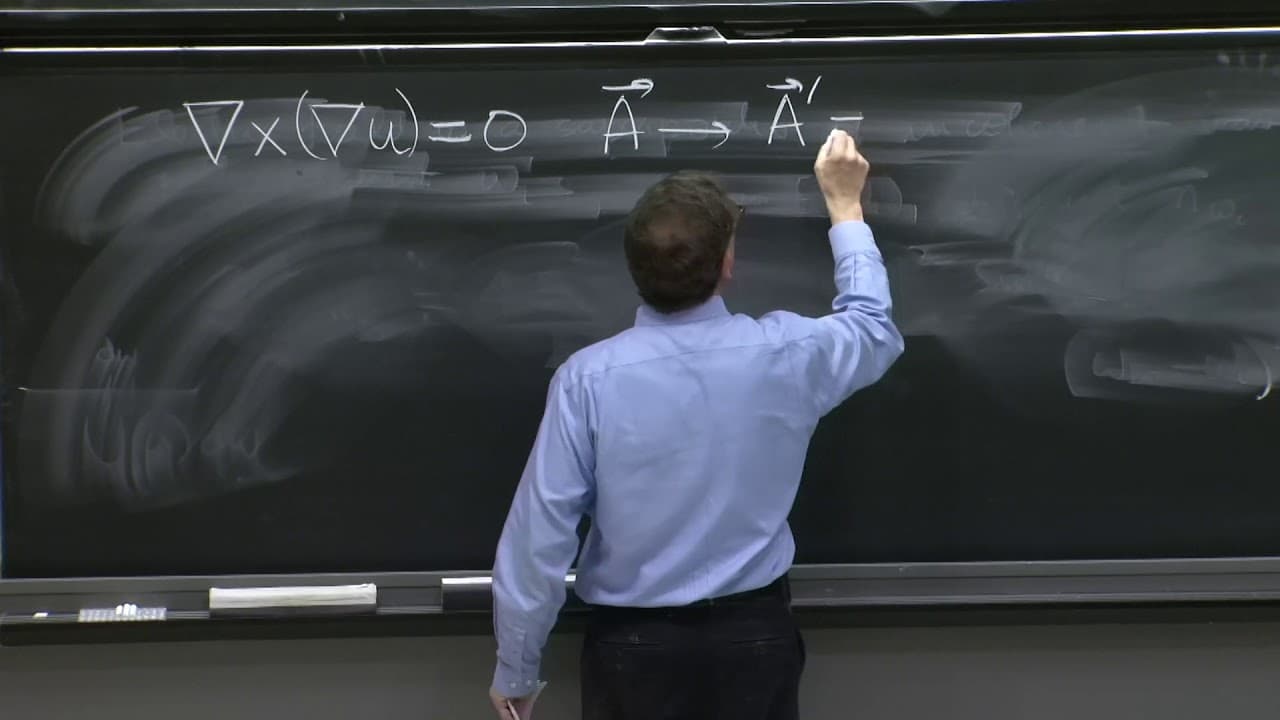
In quantum mechanics, the potentials (A and phi) are fundamentally more important than the physical fields (E and B) because quantum interactions couple to these potentials. Understanding this distinction is crucial, particularly in topological contexts, as the same E and B fields can arise from different potentials, leading to different electromagnetic field configurations.
Transcript
PROFESSOR: All right. So that concludes the chapter, a big chapter in this course. It concludes time-dependent perturbation theory. The whole course is largely organized with approximation methods. We have done time-independent perturbation theory. We applied it to the hydrogen atom in detail. Then we did WKB, which is slowly varying things in spac... Read More
Key Insights
- 🦾 Time-dependent perturbation theory concludes the course's coverage of approximation methods in quantum mechanics.
- 🦾 Potentials (A and phi) are more significant than physical fields (E and B) in quantum mechanics due to their coupling with quantum systems.
- 🏑 Changes in the potentials can be gauge transformations that do not affect the physical fields but may result in different field configurations.
- 🏑 Valid electromagnetic fields must have corresponding potentials, and not all combinations of E and B fields are allowed in Maxwell's equations.
- 👾 Understanding potentials becomes crucial when dealing with topological spaces or situations involving extra dimensions.
- 🏑 Curious effects can occur, such as equivalence of E and B fields with no gauge transformation between potentials or allowed fields without valid potentials.
Install to Summarize YouTube Videos and Get Transcripts
Explore YouTube Video Summarizer or Get YouTube Transcript Extractor
Questions & Answers
Q: Why are potentials (A and phi) more important than the physical fields (E and B) in quantum mechanics?
Potentials are more important because quantum mechanics couples to potentials. While the physical fields (E and B) do affect particles, it is through the potentials that they are related. The potentials also offer more flexibility as they can be changed without altering the physical fields.
Q: Can two sets of potentials (phi and A, and phi prime and A prime) that yield the same electric and magnetic fields be considered the same electromagnetic field?
Not necessarily. Even though the E and B fields are the same, the potentials might not be gauge equivalent to each other. This means they are different configurations of electromagnetic fields. This can occur when dealing with topological spaces or when considering different magnitudes or shapes for the potentials.
Q: Are all combinations of electric and magnetic fields allowed in Maxwell's equations?
No, to be considered allowed fields, one must be able to find the corresponding potentials (phi and A) that give rise to those fields. For example, on a torus, only specific values of a constant magnetic field can have consistent vector potentials. Other values may not have valid potentials and are therefore not allowed.
Q: How are gauge transformations related to potentials and fields?
Gauge transformations refer to the ability to change the potentials without altering the physical fields. By adding the gradient of a function, lambda, to the potentials, the fields (E and B) can remain unchanged. This shows that the potentials have a greater significance in describing electromagnetic fields.
Summary & Key Takeaways
-
The course has covered various approximation methods in quantum mechanics, including time-independent and time-dependent perturbation theory, WKB approximation, and Fermi's golden rule.
-
The next topic is particles in electromagnetic fields, which involves the study of how charged particles interact with electric and magnetic fields.
-
The video emphasizes the importance of potentials (A and phi) in describing electromagnetic fields, as quantum mechanics couples to potentials rather than the physical fields.
Read in Other Languages (beta)
Share This Summary 📚
Summarize YouTube Videos and Get Video Transcripts with 1-Click
Try YouTube Summary with ChatGPT & Claude or YouTube Transcript Generator
Explore More Summaries from MIT OpenCourseWare 📚



Summarize YouTube Videos and Get Video Transcripts with 1-Click
Try YouTube Summary with ChatGPT & Claude or YouTube Transcript Generator