How to Add Vectors Using Components and Trigonometry
TL;DR
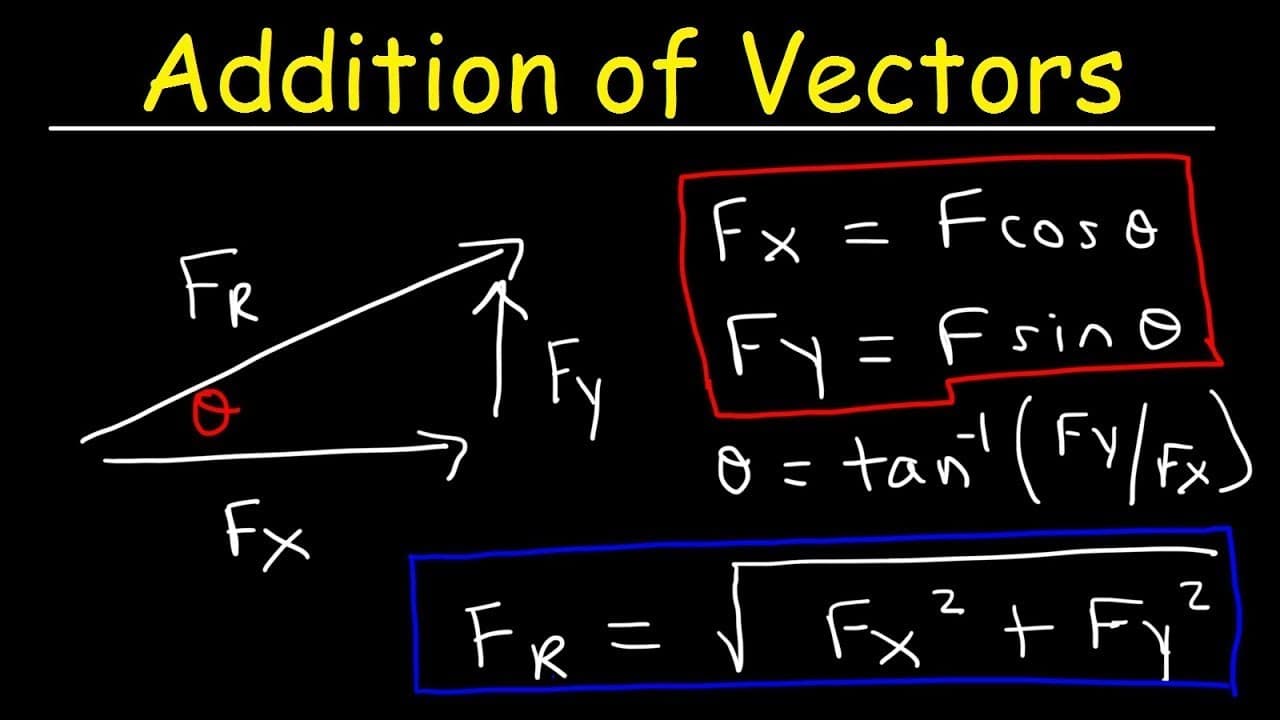
To add vectors, break them into their x and y components, sum each component, and apply the Pythagorean theorem to find the magnitude of the resultant vector. For direction, use the inverse tangent function based on the summed components. This method applies to both parallel and non-parallel vectors.
Transcript
in this video we're going to talk about how to add vectors so a vector is a quantity that has magnitude and direction so let's say if we have a force vector that's 100 newtons directed towards the east the magnitude is the size of the force it's 100 newtons and the direction is east and let's say if we want to add it to another force that's directe... Read More
Key Insights
- ❓ Vectors have both magnitude and direction.
- 🪜 Adding parallel vectors is as simple as adding their magnitudes.
- ❣️ Adding vectors that are not parallel or perpendicular requires finding their x and y components and using trigonometric formulas.
- ❓ The magnitude of a resultant force vector can be found using the Pythagorean theorem.
- ❓ The direction of a resultant force vector can be found using the inverse tangent function.
- 🪜 Vectors can be added using the component method.
- ❣️ Trigonometric formulas, such as cosine and sine, are used to calculate the x and y components of vectors.
Install to Summarize YouTube Videos and Get Transcripts
Explore YouTube Video Summarizer or Get YouTube Transcript Extractor
Questions & Answers
Q: What is a vector?
A vector is a quantity that has both magnitude (size) and direction.
Q: How do you add two parallel vectors?
To add two parallel vectors, simply add their magnitudes to get the resultant sum.
Q: How do you add two vectors that are not parallel or perpendicular?
Break the vectors into their x and y components, add the respective components, and use trigonometric formulas to find the magnitude and direction of the resultant vector.
Q: How do you find the magnitude of a resultant force vector?
The magnitude of a resultant force vector can be found using the Pythagorean theorem: the square root of the sum of the squared magnitudes of the x and y components.
Q: How do you find the direction of a resultant force vector?
The direction of a resultant force vector can be found using the inverse tangent (arctangent) function, by taking the ratio of the y component to the x component.
Summary & Key Takeaways
-
A vector is a quantity with both magnitude and direction.
-
When adding two parallel vectors, simply add their magnitudes to find the resultant sum.
-
To add vectors that are not parallel or perpendicular, break them into their x and y components, add the respective components, and use trigonometric formulas to find the magnitude and direction of the resultant vector.
Read in Other Languages (beta)
Share This Summary 📚
Summarize YouTube Videos and Get Video Transcripts with 1-Click
Try YouTube Summary with ChatGPT & Claude or YouTube Transcript Generator
Explore More Summaries from The Organic Chemistry Tutor 📚



Summarize YouTube Videos and Get Video Transcripts with 1-Click
Try YouTube Summary with ChatGPT & Claude or YouTube Transcript Generator