Fluid Mosaic Model of the Plasma Membrane - Phospholipid Bilayer
TL;DR
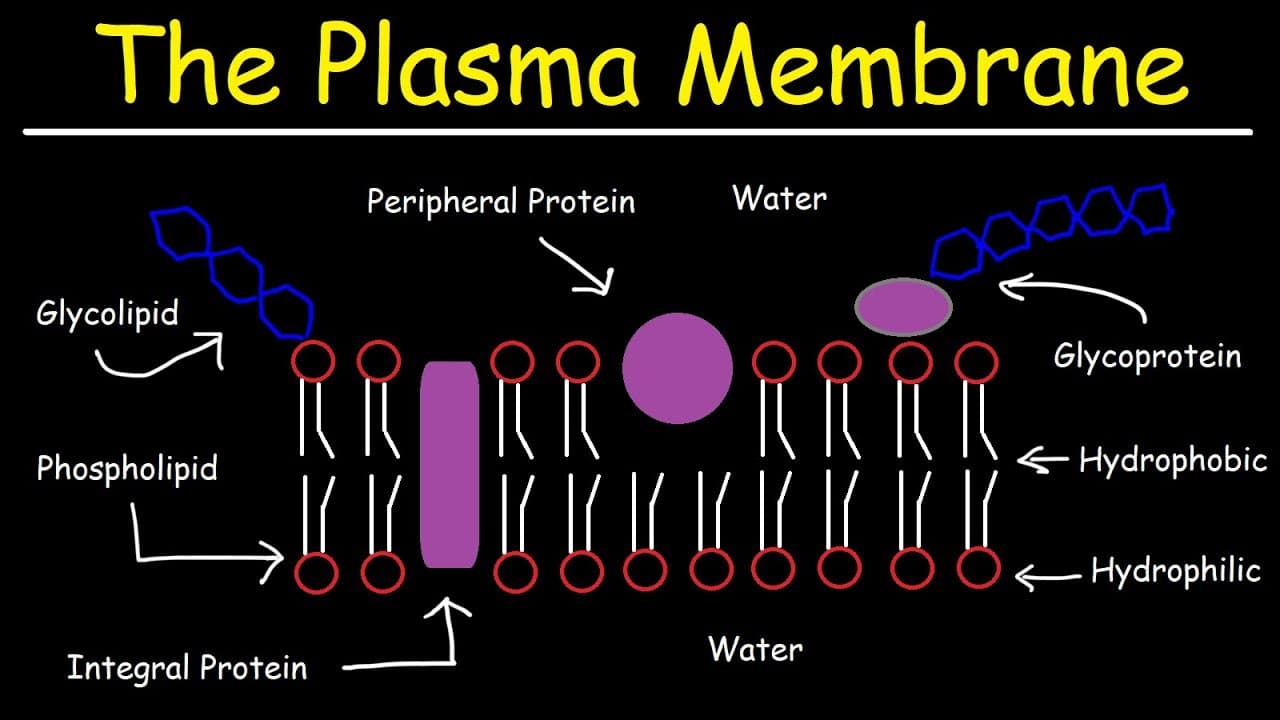
The plasma membrane is composed of phospholipids arranged in a bilayer, with a polar head attracted to water and nonpolar tails repelling water. It also contains integral, peripheral, and surface proteins, as well as carbohydrates, glycoproteins, glycolipids, and cholesterol.
Transcript
in this video we're going to talk about the plasma membrane the plasma membrane of cells is made up of something called phospholipids and here is a typical structure of a phospholipid the phospholipid is made up of three subunits it has a phosphate group a glycerol molecule and two fatty acid tails the head of the phospholipid is the phosphate grou... Read More
Key Insights
- 💁 The plasma membrane is composed of phospholipids, which form a bilayer structure.
- ❓ Integral, peripheral, and surface proteins are embedded in the plasma membrane.
- ❓ Carbohydrates can be attached to proteins (glycoproteins) or lipids (glycolipids) on the plasma membrane.
- 🆘 Cholesterol helps regulate the fluidity of the plasma membrane.
- 💦 Phospholipids have a polar head attracted to water and nonpolar tails repelling water.
- 🥶 The fluid mosaic model describes the free movement of phospholipids and proteins in the plasma membrane.
- 👥 The phosphate group, glycerol molecule, and fatty acid chains make up a phospholipid.
Install to Summarize YouTube Videos and Get Transcripts
Explore YouTube Video Summarizer or Get YouTube Transcript Extractor
Questions & Answers
Q: What is the composition of the plasma membrane?
The plasma membrane is composed of phospholipids, proteins (integral, peripheral, surface), carbohydrates (glycoproteins, glycolipids), and cholesterol.
Q: What is the structure of a phospholipid?
A phospholipid consists of a phosphate group, a glycerol molecule, and two fatty acid tails. The phosphate group is polar (hydrophilic) and attracted to water, while the tails are nonpolar (hydrophobic) and repel water.
Q: How do phospholipids arrange in the plasma membrane?
Phospholipids arrange in a bilayer, with the polar heads facing the aqueous environment on both sides of the membrane, and the nonpolar tails directed away from water.
Q: What is the role of cholesterol in the plasma membrane?
Cholesterol maintains the fluidity of the membrane. It acts as a spacer, preventing phospholipids from getting too close together at low temperatures and keeping them together at high temperatures.
Summary & Key Takeaways
-
The plasma membrane is made up of phospholipids, which form a bilayer structure with polar heads attracting water and nonpolar tails repelling water.
-
Integral, peripheral, and surface proteins are embedded in the plasma membrane, while carbohydrates are attached to proteins (glycoproteins) or lipids (glycolipids).
-
Cholesterol helps maintain the fluidity of the membrane by acting as a spacer, preventing it from becoming too rigid or too fluid.
Read in Other Languages (beta)
Share This Summary 📚
Summarize YouTube Videos and Get Video Transcripts with 1-Click
Try YouTube Summary with ChatGPT & Claude or YouTube Transcript Generator
Explore More Summaries from The Organic Chemistry Tutor 📚





Summarize YouTube Videos and Get Video Transcripts with 1-Click
Try YouTube Summary with ChatGPT & Claude or YouTube Transcript Generator