Lecture 1: Classical Field Theories and Principle of Locality
TL;DR
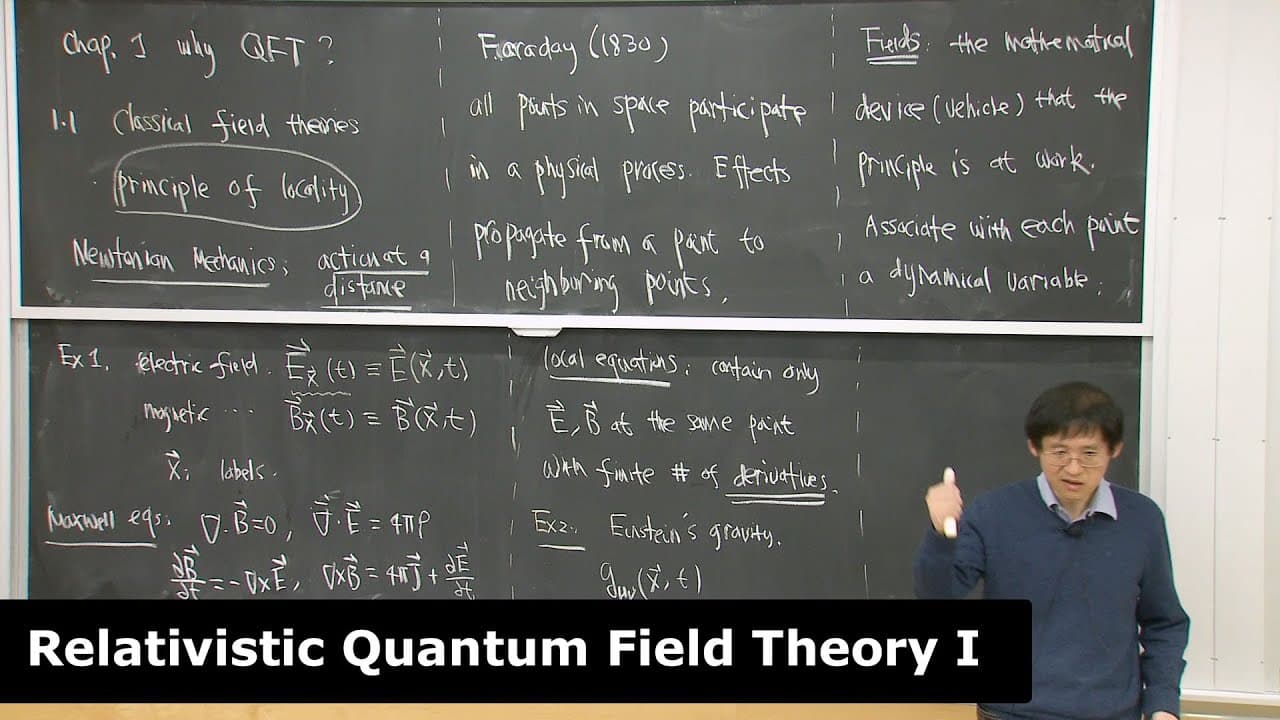
Quantum field theory (QFT) is a fundamental framework for describing the quantum dynamics of fields and has applications in various branches of physics. This introduction explains the goals of QFT, its relationship to classical field theories, and provides examples of classical field theories such as Maxwell's equations and Einstein's gravity.
Transcript
[SQUEAKING] [RUSTLING] [CLICKING] PROFESSOR: Yeah, so I'm Hong, so you can just call me Hong. I'm a theoretical physicist. I work on high energy theory, including string theory, quantum gravity, non equilibrium statistical physics, et cetera, and many different topics. So now let me say a few words regarding the QFT, the quantum field theory itself... Read More
Key Insights
- 🏑 Quantum field theory aims to develop concepts, formalism, and techniques for understanding the quantum dynamics of fields.
- 🥺 Treating electric and magnetic fields quantum mechanically leads to the emergence of the photon as the fundamental particle for electromagnetic interactions.
- 🏑 Quantum field theory offers a complete description of three out of the four fundamental interactions in nature and has applications in various branches of physics.
Install to Summarize YouTube Videos and Get Transcripts
Explore YouTube Video Summarizer or Get YouTube Transcript Extractor
Questions & Answers
Q: What is the goal of quantum field theory (QFT)?
The goal of QFT is to develop concepts, formalism, and techniques for understanding and describing the quantum dynamics of fields, which is crucial in the quantum world.
Q: How does treating electric and magnetic fields quantum mechanically lead to the concept of photons?
By treating electric and magnetic fields quantum mechanically, the concept of the photon emerges as the fundamental particle that mediates electromagnetic interactions. This provides a different physical picture compared to classical physics.
Q: What are some applications of quantum field theory beyond particle physics?
Quantum field theory has found applications in various branches of physics, including condensed matter and statistical physics. It has become a universal language in theoretical physics, making it important for physicists in different fields to understand and communicate with each other.
Q: Why is quantum field theory considered difficult, and how can one overcome the difficulties?
Quantum field theory can be challenging due to its conceptual nature and lack of intuition. Developing good intuition and understanding requires working through examples, exercises, and problems to build experience. It is essential to change perspectives and connect difficulties with concepts from quantum mechanics to overcome challenges.
Q: What are the key elements of a classical field theory, such as the Maxwell theory?
In classical field theories like the Maxwell theory, the fields are described by Lagrangian densities, which involve derivatives of the fields and their values at each point in space. The equations of motion are obtained from variations of the action, which involve the Lagrangian density, derivatives, and field values.
Summary & Key Takeaways
-
Quantum field theory (QFT) aims to develop concepts, formalism, and techniques for understanding the quantum dynamics of fields, which is essential in the quantum world.
-
Maxwell's equations, which describe classical dynamics of electric and magnetic fields, can be understood and extended to quantum electrodynamics (QED) by treating these fields quantum mechanically.
-
QFT offers a complete description of three out of the four fundamental interactions in nature, and can also be used to describe gravity, although a complete description of quantum gravity is not yet achieved.
-
QFT has found applications in various branches of physics, such as condensed matter and statistical physics, making it a universal language in theoretical physics.
Read in Other Languages (beta)
Share This Summary 📚
Summarize YouTube Videos and Get Video Transcripts with 1-Click
Try YouTube Summary with ChatGPT & Claude or YouTube Transcript Generator
Explore More Summaries from MIT OpenCourseWare 📚


Summarize YouTube Videos and Get Video Transcripts with 1-Click
Try YouTube Summary with ChatGPT & Claude or YouTube Transcript Generator