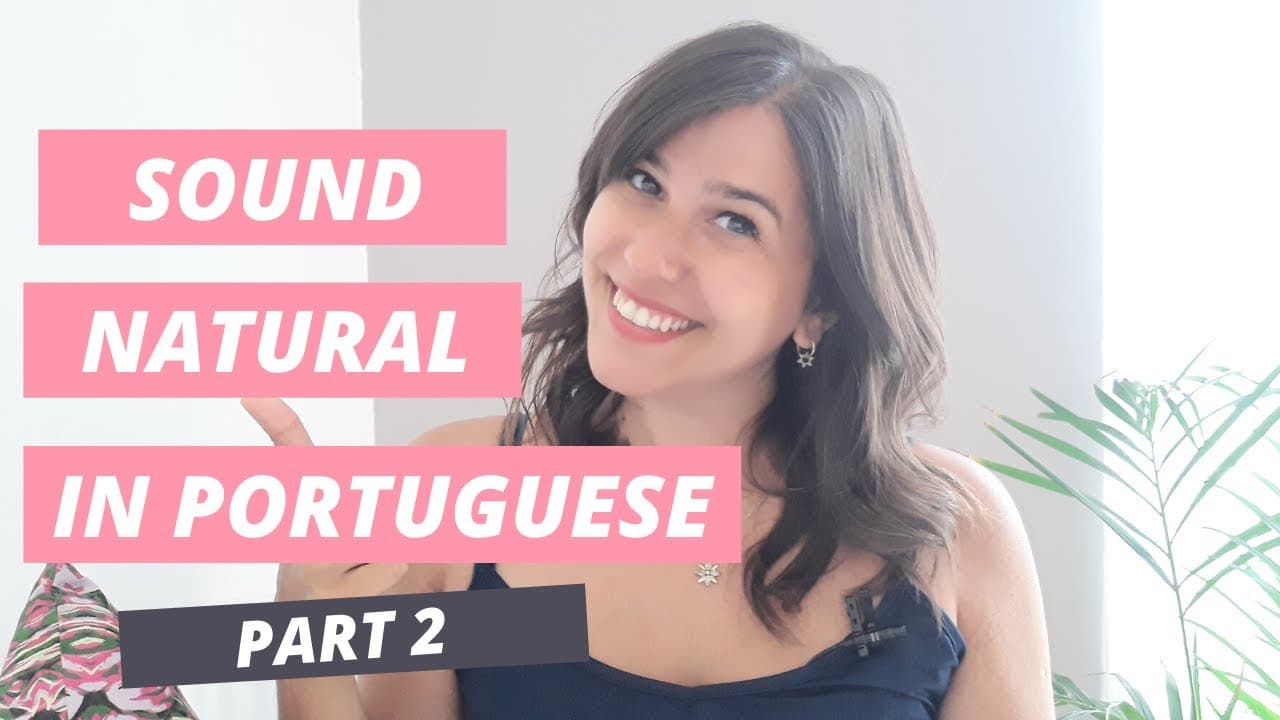
European Portuguese - MORE Filler Words to Make You Sound Natural!
TL;DR
Learn Portuguese filler words to sound more natural.
Transcript
to sound more like a local when you're speaking Portuguese you need to use the words that locals use and as we know this includes a lot of filler words so words that don't have a lot of meaning but are like little threads that knit a whole conversation together a few weeks ago I made this video that talked you through a few of these filler words an... Read More
Key Insights
- Using filler words can make your Portuguese sound more natural and conversational, reflecting how locals speak.
- The video introduces several Portuguese filler words, explaining their meanings and contexts in which they are used.
- The word 'Ora bem' is used as an exclamation, similar to 'so then' or 'right', often at the beginning of lessons.
- 'Ora essa' is a polite way to say 'don't worry about it', often used in response to gratitude.
- 'Pronto' is a versatile word that can mean 'there you go' or 'okay then', often pronounced without the 'o' at the end.
- 'Pois não' is used to agree with negative statements, while 'pois é' agrees with positive ones.
- 'Olha' translates to 'look' or 'listen', used informally to grab attention in conversations.
- 'Vá' is used at the end of conversations to mean 'off you go', a friendly way to say goodbye.
Install to Summarize YouTube Videos and Get Transcripts
Explore YouTube Video Summarizer or Get YouTube Transcript Extractor
Questions & Answers
Q: What is the purpose of using filler words in Portuguese?
Filler words in Portuguese serve to make conversations sound more natural and fluid, similar to how locals speak. They help to knit together sentences and can convey subtleties in meaning that enhance communication. By using these words, learners can improve their conversational skills and sound more like native speakers.
Q: How is 'Ora bem' used in Portuguese conversations?
'Ora bem' is an exclamation used in Portuguese to mean 'so then', 'right', or 'let's see'. It is often used at the beginning of a lesson or when changing subjects, similar to the English word 'okay'. This filler word helps to introduce new topics or transitions in conversation.
Q: What does 'Ora essa' mean and when is it used?
'Ora essa' is a polite phrase used in Portuguese to mean 'don't worry about it' or 'it's fine'. It is often used in response to expressions of gratitude or apologies, similar to the English phrase 'no problem'. This expression conveys politeness and reassurance in conversations.
Q: Can you explain the use of 'Pronto' in Portuguese?
In Portuguese, 'Pronto' can mean 'there you go' or 'okay then' when used alone. It is a versatile word often used to acknowledge understanding or agreement. Native speakers may pronounce it without the 'o' at the end, making it sound like 'Pront', which is a common feature of spoken Portuguese.
Q: How do 'Pois é' and 'Pois não' differ in their usage?
'Pois é' is used to agree with positive statements, similar to saying 'so it is' in English. In contrast, 'Pois não' is used to agree with negative statements, akin to saying 'is it not' or 'is it so'. These phrases help convey agreement or confirmation in conversations.
Q: What is the function of 'Olha' in Portuguese dialogue?
'Olha' is derived from the verb 'olhar', meaning 'to look', and is used informally to grab someone's attention, similar to 'look' or 'listen' in English. It is often used in friendly conversations to draw attention to what is being said. This word helps engage the listener in dialogue.
Q: When do Portuguese speakers use 'Vá'?
'Vá' is used at the end of conversations to mean 'off you go' or 'I'll let you go'. Derived from the verb 'ir', meaning 'to go', it is a friendly way to say goodbye. This expression is commonly used to conclude interactions in a polite and amicable manner.
Q: What does the word 'Boa' signify in Portuguese?
'Boa' is the feminine form of 'good' in Portuguese and is used informally to express approval or satisfaction, similar to saying 'nice one' or 'good one' in English. It is often used in casual settings to acknowledge something positive or agreeable, adding a friendly tone to conversations.
Summary & Key Takeaways
-
The video focuses on teaching European Portuguese filler words to help learners sound more natural when speaking the language. Filler words are essential to mimic local speech patterns and enhance conversational skills.
-
Several filler words are introduced, such as 'Ora bem', 'Ora essa', and 'Pronto', each with specific uses and meanings. These words help knit together conversations and make speech flow more naturally.
-
The instructor, Liz, emphasizes the importance of understanding and using these filler words in everyday conversations. She provides examples and encourages learners to practice these words to improve their fluency.
Read in Other Languages (beta)
Share This Summary 📚
Summarize YouTube Videos and Get Video Transcripts with 1-Click
Try YouTube Summary with ChatGPT & Claude or YouTube Transcript Generator
Explore More Summaries from Talk the Streets 📚

![Practice Portuguese with Mixologist Fábio Guerreiro! [English & Portuguese Subtitles] thumbnail](/_next/image?url=https%3A%2F%2Fi.ytimg.com%2Fvi%2F1-T2PNWuiWY%2Fhqdefault.jpg&w=750&q=75)
![Learn European Portuguese Outside of Portugal! [NEW apps & TOP tips!] thumbnail](/_next/image?url=https%3A%2F%2Fi.ytimg.com%2Fvi%2F0K81C-5Z1I0%2Fhqdefault.jpg&w=750&q=75)
Summarize YouTube Videos and Get Video Transcripts with 1-Click
Try YouTube Summary with ChatGPT & Claude or YouTube Transcript Generator