Lecture 22: Exterior Orientation, Recovering Position & Orientation, Bundle Adjustment, Object Shape
TL;DR
This video discusses the concept of surface curvature and its application in representation, recognition, and alignment of 3D objects.
Transcript
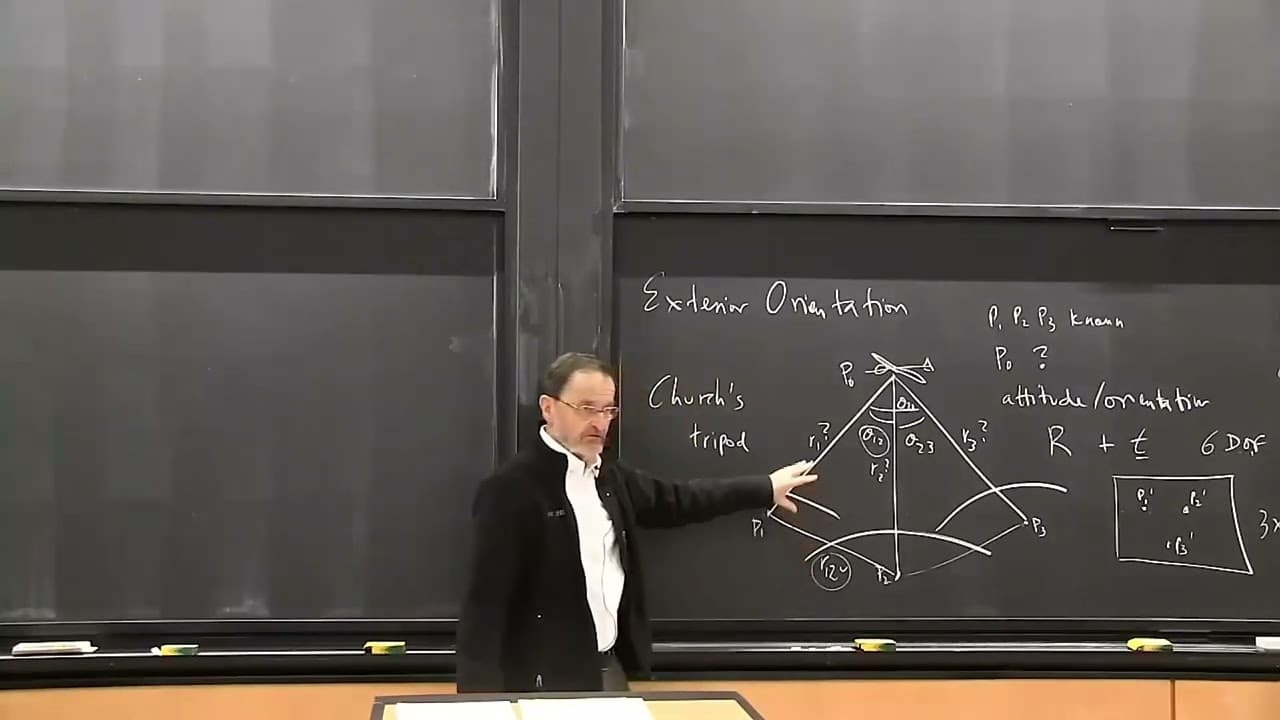
[SQUEAKING] [RUSTLING] [CLICKING] PROFESSOR: End of the photogrammetry section. We'll just briefly talk about exterior orientation, which is the fourth of the photogrammetric subjects we are talking about. So what's this about? This is best illustrated by thinking about a drone flying above some terrain of which we have a detailed model. So we know... Read More
Key Insights
- 💨 The representation of 3D objects using generalized cylinders or extended Gaussian images provides a unique and intuitive way to compare and align objects.
- 🕴️ Generalized cylinders are primarily suited for convex objects and may not be unique for non-convex objects.
- 😥 Surface curvature plays a crucial role in determining the distribution of points on the unit sphere in extended Gaussian images.
Install to Summarize YouTube Videos and Get Transcripts
Explore YouTube Video Summarizer or Get YouTube Transcript Extractor
Questions & Answers
Q: How does the representation of a 3D object using generalized cylinders help in alignment and recognition?
Generalized cylinders provide a simple and intuitive representation of objects, allowing for easy comparison and alignment. By comparing the distribution of points on the unit sphere, one can determine the best alignment and recognize the object based on its unique representation.
Q: What are the limitations of using generalized cylinders as a representation for 3D objects?
One limitation is that the representation is not unique for non-convex objects, as there may be multiple points on the sphere with the same surface normal. Additionally, the representation does not provide information about translation, and determining orientation can be ambiguous for objects with high symmetry.
Q: How is surface curvature related to the extended Gaussian images?
Surface curvature is inversely proportional to the density of points on the unit sphere in the extended Gaussian image. High curvature corresponds to low density, indicating a more curved surface, and vice versa. This information can be used to determine the orientation and shape of 3D objects.
Summary & Key Takeaways
-
The video introduces the concept of surface curvature and its importance in representing, recognizing, and aligning 3D objects.
-
It discusses the use of generalized cylinders as a representation for objects and how they can be used for alignment and recognition.
-
The video also explores the concept of extended Gaussian images, which map surface normals to points on a unit sphere, and their application in representing convex objects.
Read in Other Languages (beta)
Share This Summary 📚
Summarize YouTube Videos and Get Video Transcripts with 1-Click
Try YouTube Summary with ChatGPT & Claude or YouTube Transcript Generator
Explore More Summaries from MIT OpenCourseWare 📚



Summarize YouTube Videos and Get Video Transcripts with 1-Click
Try YouTube Summary with ChatGPT & Claude or YouTube Transcript Generator