How does the INTERNET work? | ICT #2
TL;DR
Understand how data travels from a data center to your device using optical fiber cables, IP addresses, DNS servers, and protocols.
Transcript
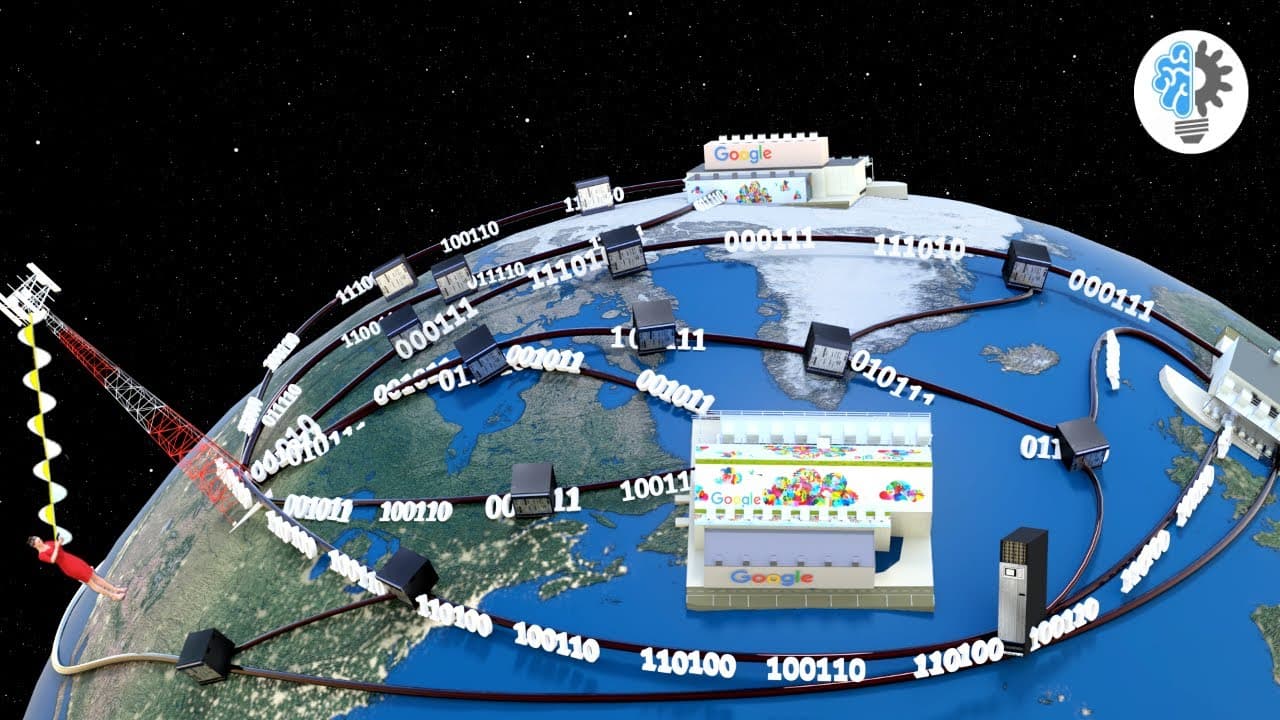
How does the internet work? The video you are watching now traveled thousands of miles from a Google Data Center to reach you. Let's learn how the internet works by getting to understand the details of this data's incredible journey. The data center which can be thousands of miles away from you has your video stored inside it. how does this data re... Read More
Key Insights
- 🚠 Optical fiber cables, not satellites, are used to transmit data from data centers to devices, minimizing latency.
- 🧑🏭 IP addresses uniquely identify devices on the internet, acting as shipping addresses for data transmission.
- 👤 DNS servers translate domain names into IP addresses, making it easier for users to access websites.
- 🙂 Data is transmitted in the form of light pulses through optical fiber cables, which are laid across the seabed.
- 😫 Protocols set rules for data packet conversion and routing, ensuring the efficient flow of data.
- ❓ ICANN is an organization that manages aspects like IP address assignment and domain name registration for the internet.
- 😌 The internet's efficiency lies in the way data is divided into packets and routed through the best available paths.
Install to Summarize YouTube Videos and Get Transcripts
Explore YouTube Video Summarizer or Get YouTube Transcript Extractor
Questions & Answers
Q: How does data travel from a data center to my device?
Data is transmitted through a complex network of optical fiber cables, which connect the data center to your device via routers and cellular towers.
Q: What is an IP address and why is it important?
An IP address is a unique string of numbers that identifies a device on the internet. It acts as a shipping address, allowing data to reach its destination accurately.
Q: How are domain names related to IP addresses?
Domain names like youtube.com or facebook.com correspond to specific IP addresses, making it easier for users to remember and access websites instead of using lengthy IP address numbers.
Q: What is the role of DNS servers?
DNS servers provide a phone book-like service for the internet, translating domain names into their corresponding IP addresses, allowing users to access websites by simply entering the domain name.
Q: How are data packets transmitted efficiently over the internet?
Data is divided into packets and transmitted in chunks. Each packet contains sequence numbers, IP addresses, and the content. The packets take different routes to reach the destination device, ensuring efficient data transmission.
Summary & Key Takeaways
-
Data stored in a data center is transmitted to devices via a complex network of optical fiber cables, rather than satellites, to minimize latency.
-
Every device connected to the internet has a unique IP address, which acts as a shipping address for data transmission.
-
DNS servers serve as a phone book for the internet, translating domain names into IP addresses.
-
Data is transmitted in the form of light pulses through optical fiber cables, which are laid across the seabed and connected to routers for delivery to devices.
Read in Other Languages (beta)
Share This Summary 📚
Summarize YouTube Videos and Get Video Transcripts with 1-Click
Try YouTube Summary with ChatGPT & Claude or YouTube Transcript Generator
Explore More Summaries from Lesics 📚





Summarize YouTube Videos and Get Video Transcripts with 1-Click
Try YouTube Summary with ChatGPT & Claude or YouTube Transcript Generator