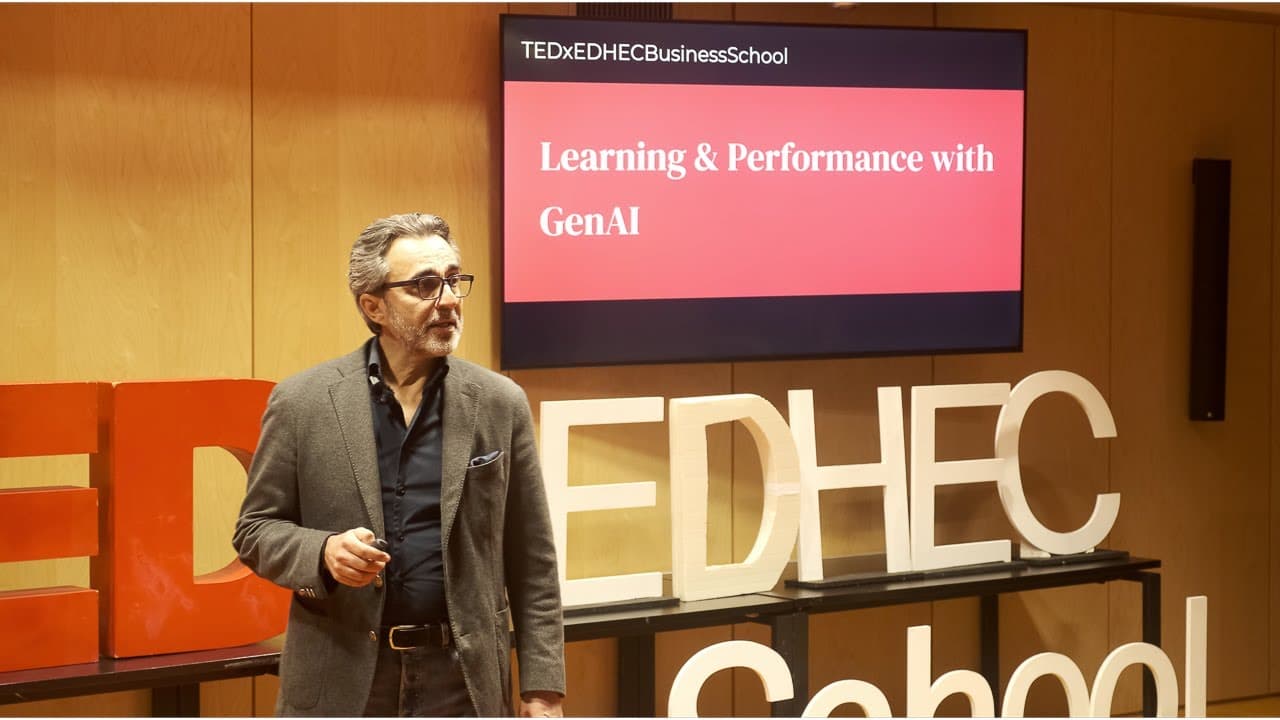
Learning and performance with GenAI | Franck Nassiri | TEDxEDHECBusinessSchool
TL;DR
AI is transforming education but poses risks to academic integrity and critical thinking.
Transcript
Before I discovered this passion for teaching strategy at EDC uh and uh training managers in corporation, I was a tech engineer. I studied hardware engineering and worked on designing semiconductors also called chips. Um when I joined my first chip design projects 25 years ago, I had no idea that one day these tiny components will become so critica... Read More
Key Insights
- 🫨 The evolution of technology has consistently driven societal change, with AI now poised to lead a new revolution akin to earlier advances in electricity and digital technology.
- 😨 Historical resistance to new technologies often stems from fears surrounding safety and reliability, echoing current apprehensions about AI in everyday life and work.
- 🥺 Generative AI applications function based on patterns learned during training; they do not possess true understanding, which can lead to inaccuracies in responses.
- 😒 Academic institutions face a dual challenge: maintaining academic integrity while also fostering environments where authentic learning can thrive amidst the use of AI tools.
- 💭 The misuse of AI tools can jeopardize students' skill development, encouraging a generation of learners who may struggle with independent thought and critical analysis.
- 👤 Effective collaboration between skilled users and advanced AI systems has the potential to enhance productivity, but caution is needed to avoid over-dependence on technology.
- 🧑🎓 Narrow AI applications, specifically designed for educational environments, can provide more accurate support and minimize misinformation risks in student learning.
Install to Summarize YouTube Videos and Get Transcripts
Explore YouTube Video Summarizer or Get YouTube Transcript Extractor
Questions & Answers
Q: How has AI been compared to previous industrial revolutions?
AI is often referred to as the new electricity, highlighting its invisible yet pervasive influence across industries. Just as electricity transformed daily life and industry in previous revolutions, AI is expected to revolutionize automation, decision-making, and personalization across digital platforms, showing both its potential benefits and risks.
Q: What are some concerns regarding the use of generative AI in education?
Generative AI raises issues of academic integrity and the potential for students to rely too heavily on technology as a shortcut for learning. This reliance can impede the development of essential skills like critical thinking and problem-solving, which are crucial in professional environments.
Q: What are the potential ramifications of students misusing generative AI tools?
When students misuse generative AI, they risk bypassing opportunities to develop key cognitive skills. This can lead to a lack of preparedness for the workforce, where independent thought and integrity are valued. Additionally, eroding personal ethics diminishes trust in academic environments and society at large.
Q: How can educational institutions improve the use of AI tools?
Institutions can enhance AI's effectiveness in education by developing specialized applications tailored to academic contexts. Training these AI systems on relevant datasets can increase accuracy and authenticity in learning, while also providing structured guidance to help students engage with the materials meaningfully.
Q: What did research by the Boston Consulting Group reveal about AI and human collaboration?
The research indicated that the best outcomes occur when skilled humans use highly capable generative AI tools. Conversely, over-reliance on AI can hinder performance, especially with less skilled users or mid-tier AI, emphasizing the importance of balance and expertise in harnessing these technologies.
Q: What is meant by AI hallucinations in generative applications?
AI hallucinations occur when generative AI confidently presents inaccurate or false information, leading users to accept incorrect statements as truth. This can misguide users and spread misinformation, highlighting the importance of critical evaluation of AI-generated content in learning processes.
Summary & Key Takeaways
-
The speaker reflects on their journey from hardware engineering to educational strategy, acknowledging the critical role of technology in modern economies, particularly the emergence of AI as a transformative force.
-
Historical perspectives on technological revolutions illustrate the fears and adaptations societies experience during breakthroughs, drawing parallels with today's AI advancements compared to past changes like electricity and the internet.
-
The discourse highlights challenges in higher education regarding the misuse of AI tools, emphasizing the need for institutions to adapt assessments and teaching methods to ensure integrity and authentic learning experiences.
Read in Other Languages (beta)
Share This Summary 📚
Summarize YouTube Videos and Get Video Transcripts with 1-Click
Try YouTube Summary with ChatGPT & Claude or YouTube Transcript Generator
Explore More Summaries from TEDx Talks 📚




Summarize YouTube Videos and Get Video Transcripts with 1-Click
Try YouTube Summary with ChatGPT & Claude or YouTube Transcript Generator