Unit 9: Value of Information, Video 3: Expected Value of Sample Information
TL;DR
The value of information in decision-making is calculated using complex equations that involve probabilities, test results, and revisions of prior probabilities. However, this detailed analysis may not accurately reflect real-world outcomes, so alternative methods should be considered.
Transcript
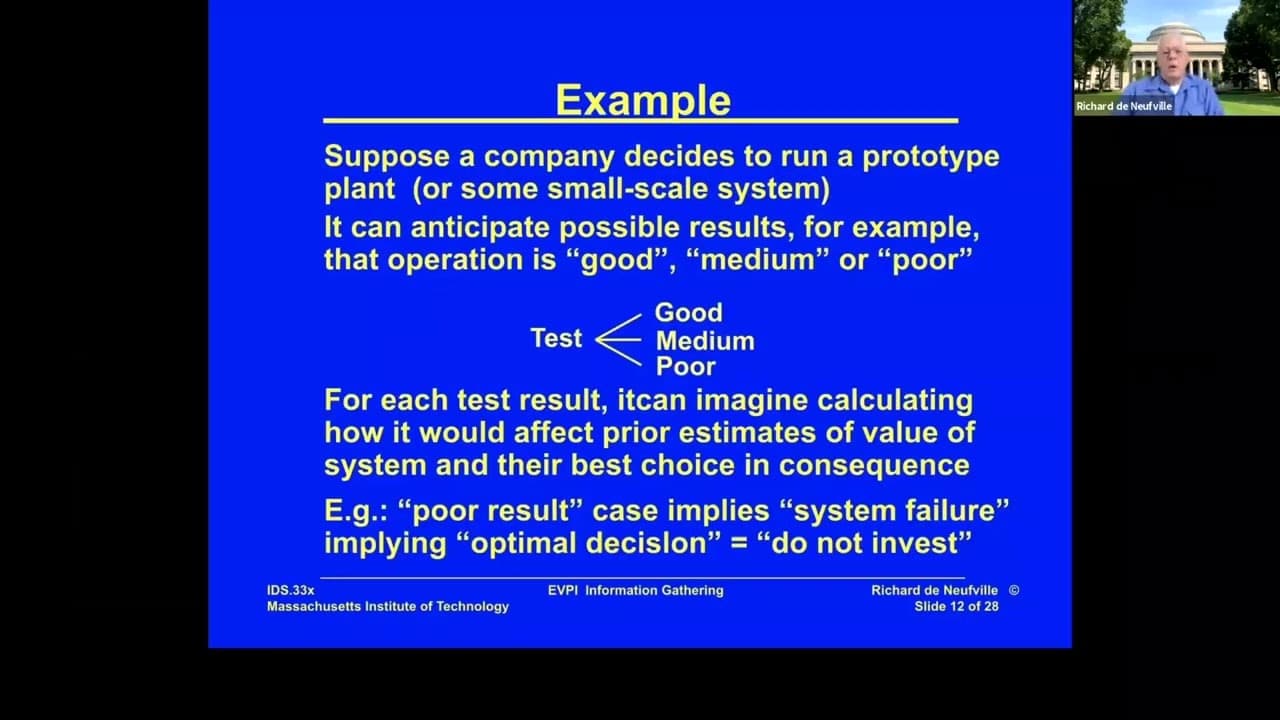
[SQUEAKING] [RUSTLING] [CLICKING] RICHARD DE NEUFVILLE: So in equation form, the expected value of information is this one-line formula. It basically says, the expected value after the test is the expected value without the test. So the expected value after the test is you calculate that based upon your-- fro doing the decision tree, your optimal s... Read More
Key Insights
- 💁 The value of information in decision-making is determined by comparing the expected value before and after obtaining test results.
- 🏆 Estimating the probabilities of test results can be challenging and subjective, requiring prior knowledge and experience.
- 🏆 The optimal decision after obtaining test results depends on revised probabilities and the correlation between the test results and the actual outcomes.
Install to Summarize YouTube Videos and Get Transcripts
Explore YouTube Video Summarizer or Get YouTube Transcript Extractor
Questions & Answers
Q: How is the expected value of information calculated in decision-making?
The expected value of information is calculated by comparing the expected value without the test to the expected value after the test, which takes into account the optimal decision given the test result. This calculation is based on decision trees and revised probabilities.
Q: What factors influence the optimal decision after obtaining test results?
The optimal decision after obtaining test results is influenced by the revised probabilities, which take into account the prior probabilities and the correlation between the test results and the actual outcomes. These factors help determine the best set of decisions based on the test result.
Q: Why is estimating the probability of each possible test result challenging?
Estimating the probability of each possible test result is challenging because it requires prior knowledge and experience. Assessing the likelihood of good, medium, or poor outcomes requires a track record or historical data, but even then, it can be subjective and uncertain.
Q: Is the detailed analysis of the value of information accurate?
While the mathematical calculations may be correct, the full analysis of the value of information is a complicated process with many assumptions. This means that even if the math is correct, the real-world outcomes may not align with the analysis. Therefore, it is important to be skeptical of such detailed analysis and consider alternative methods.
Summary & Key Takeaways
-
The expected value of information is calculated based on optimal decisions and revised probabilities after obtaining test results.
-
Each test result has its own probability of occurring and revises the probabilities for the decision-making process.
-
Estimating the probability of each possible test result is challenging but necessary for calculating the optimal decision and expected probability value.
Read in Other Languages (beta)
Share This Summary 📚
Summarize YouTube Videos and Get Video Transcripts with 1-Click
Try YouTube Summary with ChatGPT & Claude or YouTube Transcript Generator
Explore More Summaries from MIT OpenCourseWare 📚



Summarize YouTube Videos and Get Video Transcripts with 1-Click
Try YouTube Summary with ChatGPT & Claude or YouTube Transcript Generator