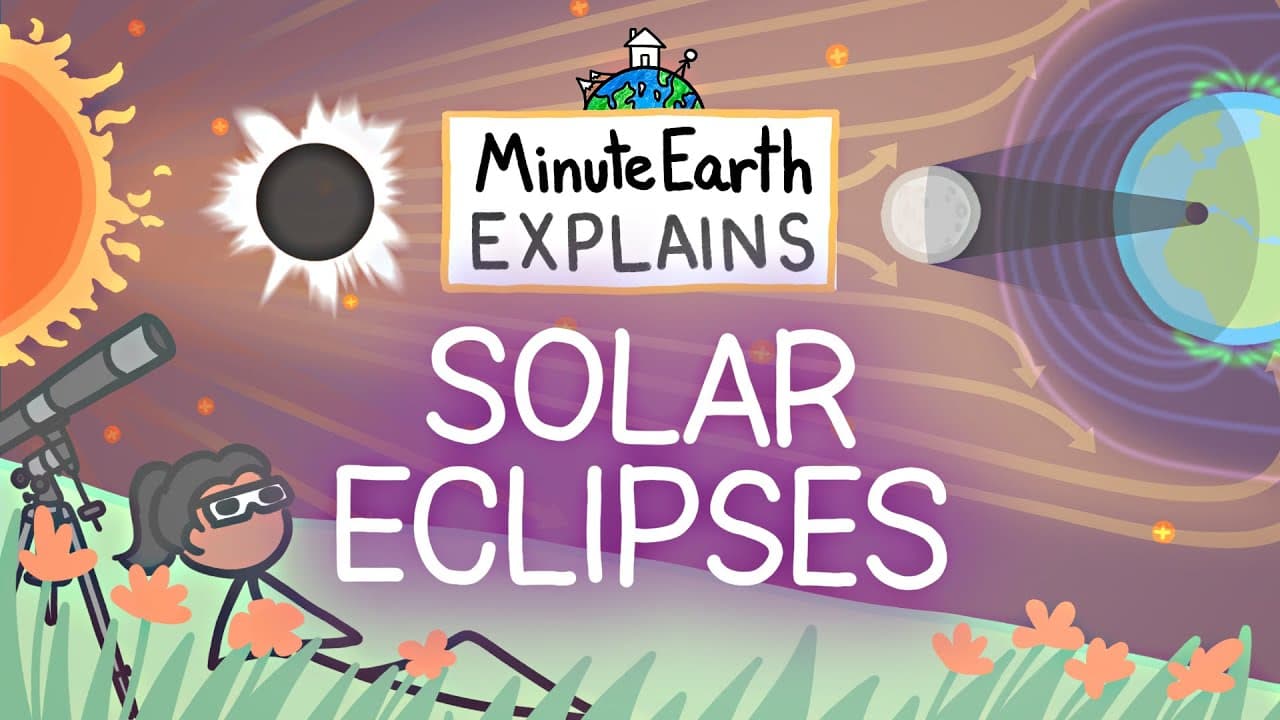
MinuteEarth Explains: Solar Eclipses
TL;DR
Solar eclipses, historically terrifying omens, unveil fascinating patterns and insights about Earth's celestial phenomena.
Transcript
[Cameron] Hi, I’m Cameron From MinuteEarth and I'm about to show you some videos that will hopefully tell you everything you ever wanted to know about solar eclipses. Before first, I want to talk about my shirt. This shirt shows what solar eclipses might look like from the surface of other planets in the solar system. And to get your own ... Read More
Key Insights
- 😨 Solar eclipses shaped ancient beliefs, with the fear and mystery surrounding these events.
- 👷 Stonehenge's construction shows early human fascination with celestial observations and predictions.
- 🖐️ Lunar eclipses played a crucial role in understanding eclipse patterns through historical observations.
- 🤱 Solar eclipse paths depend on the moon's shadow speed relative to Earth's rotation, resulting in their west to east movement.
- 💖 Animals exhibit diverse behaviors during eclipses, sparking scientific curiosity and anecdotal accounts.
- 🦻 Eclipses aided in scientific discoveries, from understanding Earth's rotation changes to confirming General Relativity.
- 🥺 Changes in the Moon's distance from Earth over time led to more annular eclipses than total eclipses.
Install to Summarize YouTube Videos and Get Transcripts
Explore YouTube Video Summarizer or Get YouTube Transcript Extractor
Questions & Answers
Q: How did ancient civilizations perceive solar eclipses?
Ancient civilizations saw solar eclipses as terrifying omens, leading to myths and elaborate explanations for the phenomenon. The Chinese, for example, interpreted eclipses as the sun being eaten by a dragon, showcasing the fear and mystery surrounding these events.
Q: What role did Stonehenge play in observing eclipses?
Stonehenge, constructed approximately 5,000 years ago, served as a astronomical observatory. The alignment of its stones allowed for tracking the positions of the Sun and the Moon, potentially used to predict lunar eclipses, showcasing ancient understanding of celestial events.
Q: How did ancient astronomers predict lunar eclipses?
Babylonian astronomers observed lunar eclipses, linking them to patterns that recur approximately every 18 years, 11 days, and 8 hours, known as the saros cycle. By tracking these patterns, they could predict future lunar eclipses with remarkable accuracy.
Q: Why do solar eclipses appear to move from west to east?
The direction of solar eclipses moving from west to east is due to the moon's shadow traveling at a speed faster than the Earth's rotational speed. This discrepancy in linear speeds causes eclipses to traverse the Earth's surface in an easterly direction.
Summary & Key Takeaways
-
Solar eclipses have intrigued humans for centuries, once considered ominous events.
-
Eclipses were tracked by ancient civilizations, leading to the discovery of patterns and Earth's rotation changes.
-
Animals exhibit peculiar behaviors during eclipses, sparking scientific curiosity and insight.
Read in Other Languages (beta)
Share This Summary 📚
Summarize YouTube Videos and Get Video Transcripts with 1-Click
Try YouTube Summary with ChatGPT & Claude or YouTube Transcript Generator
Explore More Summaries from MinuteEarth 📚






Summarize YouTube Videos and Get Video Transcripts with 1-Click
Try YouTube Summary with ChatGPT & Claude or YouTube Transcript Generator