Low pass RC network | Exponential input | Pulse Digital Circuits | Lec-07
TL;DR
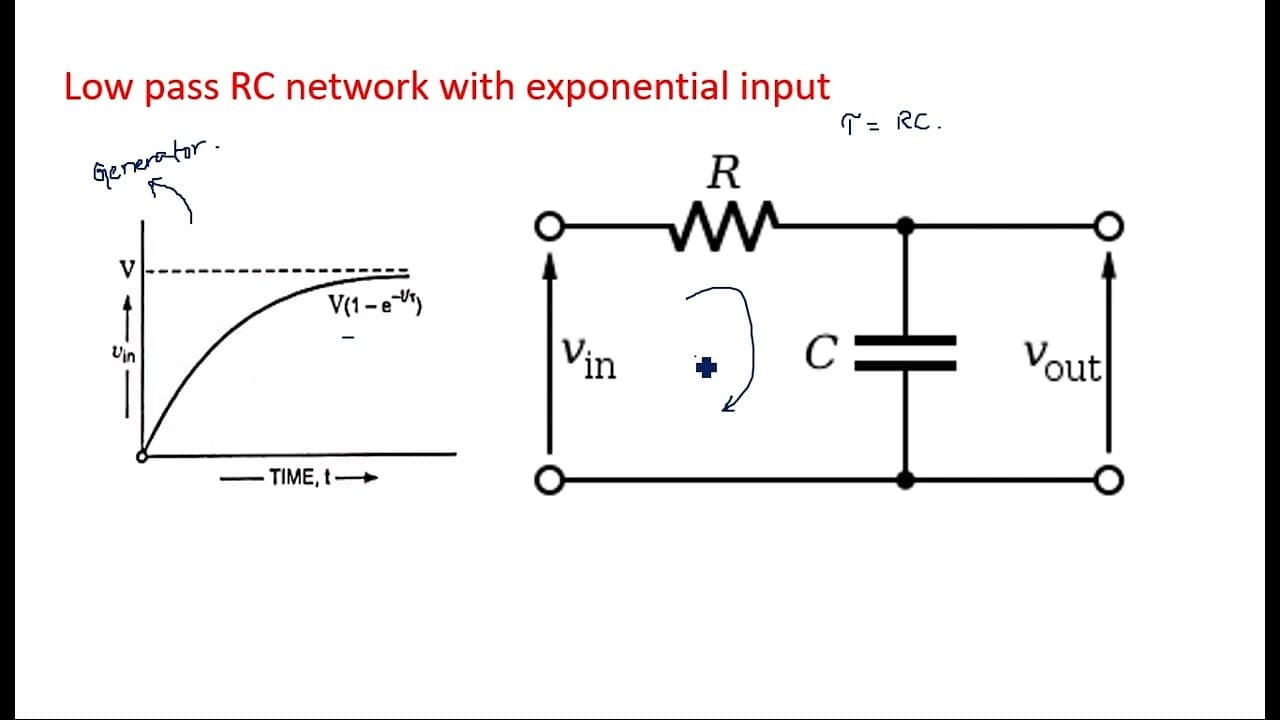
This video explains the operation of low pass RC networks with exponential input signals.
Transcript
hi everyone in this video you are going to learn about the operation of low pass RC network with the exponential input we have seen different inputs in the previous videos now this video explains how low pass RC network behaves then we are having exponential input with an amplitude of like this V into e 1 minus E power minus t by Tau okay T by Tau ... Read More
Key Insights
- 🔡 The operational behavior of low pass RC networks significantly depends on the characteristics of the input signal.
- ⌛ Understanding the time constants for both the circuit and the input generator is crucial for accurate circuit analysis.
- ⚡ Laplace transforms simplify the calculation of voltage and current in RC networks, making circuit analysis more efficient.
- 👶 The exponential input is pivotal in determining how quickly the RC network stabilizes to a new output value.
- 🦻 The differentiation between time constants aids in properly predicting circuit behavior in dynamic situations.
- 😘 Practical applications of low pass filters include audio processing, signal conditioning, and smoothing outputs in electronic devices.
- 🎨 The tutorial underscores the importance of theoretical knowledge in designing practical electronic circuits.
Install to Summarize YouTube Videos and Get Transcripts
Explore YouTube Video Summarizer or Get YouTube Transcript Extractor
Questions & Answers
Q: What is a low pass RC network and how does it function?
A low pass RC network is a circuit made of a resistor (R) and capacitor (C) that allows low-frequency signals to pass while attenuating higher-frequency signals. It achieves this by using the capacitive reactance, which decreases with increasing frequency, leading to a decay in output voltage for high-frequency inputs.
Q: How are the time constants in the video differentiated?
The video emphasizes that the time constant associated with the input signal (from the signal generator) is distinct from the time constant of the RC circuit. The circuit time constant, defined as tau = RC, influences how the circuit responds to incoming signals, while the generator's time constant depends on its internal resistance and capacitance.
Q: Why is the Laplace transform utilized in analyzing the circuit?
The Laplace transform is used for solving differential equations in circuit analysis as it converts time-domain functions into frequency-domain functions, simplifying calculations. It enables easy manipulation of the equations by converting derivatives into algebraic terms, making it simpler to analyze the behavior of circuits under changing conditions.
Q: Can you explain the role of the exponential input in this context?
The exponential input, represented as V * (1 - e^(-t/tau)), influences the behavior of the low pass RC network by providing a gradual change in voltage. This input allows for the analysis of how quickly the circuit responds to changes and achieves a steady-state condition, which is crucial for designing effective circuits that filter signals.
Summary & Key Takeaways
-
The video covers the behavior of low pass RC networks when subjected to exponential input signals, explaining key concepts like time constants.
-
It distinguishes between the time constant of the input signal from the generator and the time constant of the RC circuit itself, emphasizing their differences.
-
The application of Laplace transforms for circuit analysis is demonstrated, showcasing techniques for deriving output voltage equations.
Read in Other Languages (beta)
Share This Summary 📚
Summarize YouTube Videos and Get Video Transcripts with 1-Click
Try YouTube Summary with ChatGPT & Claude or YouTube Transcript Generator