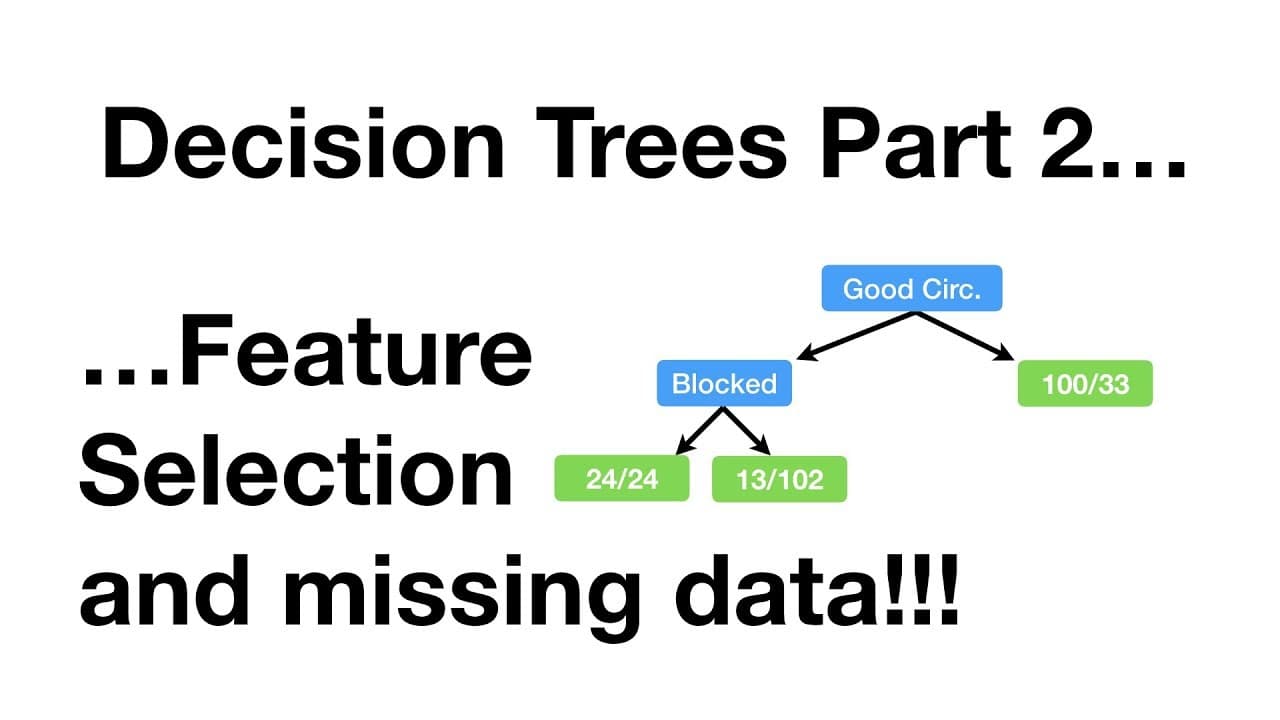
StatQuest: Decision Trees, Part 2 - Feature Selection and Missing Data
TL;DR
Decision trees use feature selection and various techniques to handle missing data for better predictions.
Transcript
when you've got too much data don't freak out when you've got missing data don't freak out you've got stat quest hello I'm Josh star and welcome to stat quest today we're gonna be talking about decision trees part two feature selection and missing data this is just a short and sweet stat quest to touch on a few topics we didn't get to in the origin... Read More
Key Insights
- 🌲 Feature selection in decision trees simplifies the model by focusing on important predictors.
- 🌲 Handling missing data in decision trees involves imputation based on common values or correlated features.
- 🌲 Overfitting is a common issue in decision trees, which can be mitigated through proper feature selection techniques.
- 🌲 Impurity reduction is essential in decision tree feature selection to evaluate the impact of splitting on a feature.
- 🦮 Correlated features can be used to guide imputation of missing data in decision trees.
- 🌲 Linear regression can be utilized to predict missing values in decision trees based on correlated features.
- 🌲 Decision trees benefit from simpler structures achieved through feature selection for better generalization.
Install to Summarize YouTube Videos and Get Transcripts
Explore YouTube Video Summarizer or Get YouTube Transcript Extractor
Questions & Answers
Q: What is feature selection in decision trees and why is it important?
Feature selection in decision trees involves choosing the most relevant features that reduce impurity, simplifying the tree structure and preventing overfitting by focusing on key predictors.
Q: How can missing data be handled in decision trees?
Missing data in decision trees can be filled with the most common value, using correlated features for guidance, or even imputing values based on linear regression techniques for accurate predictions.
Q: Why is overfitting a concern in decision trees, and how does feature selection help prevent it?
Overfitting in decision trees occurs when the model fits the training data too closely, leading to poor generalization. Feature selection helps by simplifying the tree structure and focusing on important features, reducing the chances of overfitting.
Q: What role does impurity reduction play in decision tree feature selection?
Impurity reduction is crucial in decision tree feature selection as it measures the effectiveness of splitting on a feature, guiding the selection process to ensure optimal tree structure.
Summary & Key Takeaways
-
Decision trees use feature selection to simplify the tree structure by choosing important features that reduce impurity.
-
Missing data in decision trees can be handled by imputing the most common value or using correlated data to make informed guesses.
-
Feature selection and handling missing data are crucial in decision tree models to prevent overfitting and improve accuracy.
Read in Other Languages (beta)
Share This Summary 📚
Summarize YouTube Videos and Get Video Transcripts with 1-Click
Try YouTube Summary with ChatGPT & Claude or YouTube Transcript Generator
Explore More Summaries from StatQuest with Josh Starmer 📚




Summarize YouTube Videos and Get Video Transcripts with 1-Click
Try YouTube Summary with ChatGPT & Claude or YouTube Transcript Generator