Why Is the Democratic Republic of the Congo So Poor Despite Its Wealth?
TL;DR
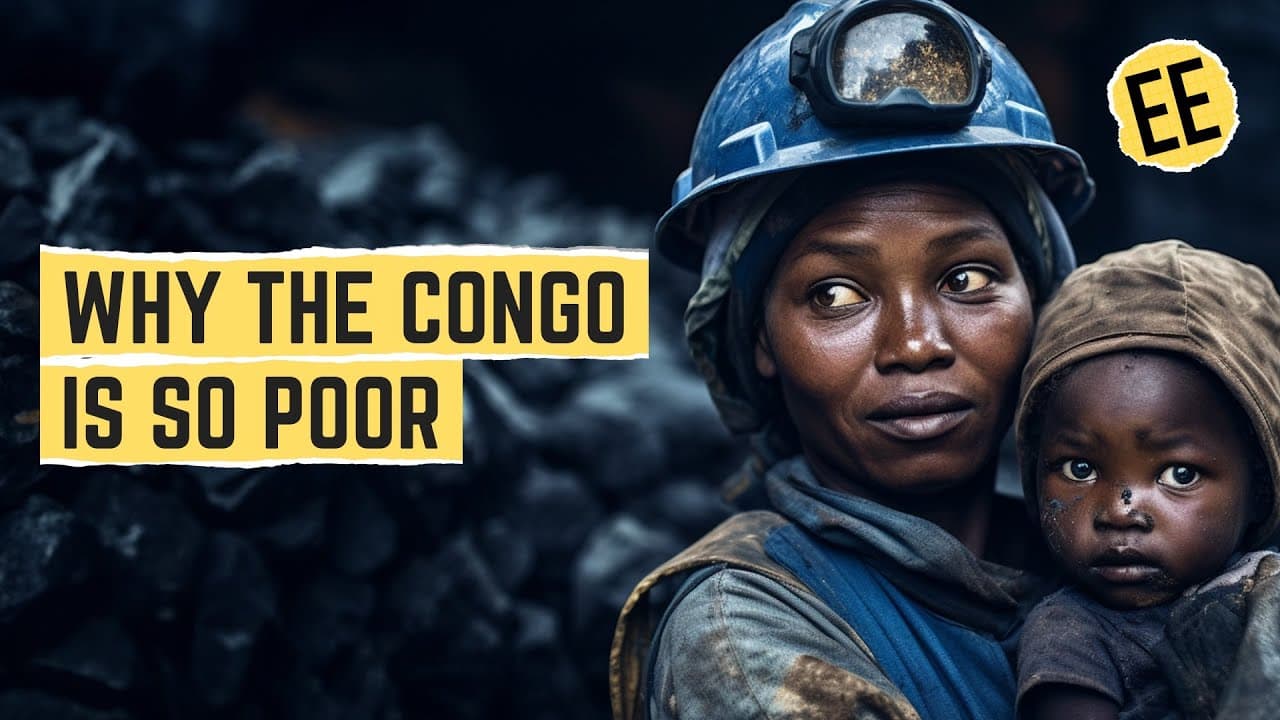
The Democratic Republic of the Congo is one of the poorest countries, with a GDP per capita of just $584, despite having vast mineral resources worth $24 trillion. Corruption, ongoing conflict, and economic mismanagement have prevented effective resource extraction and foreign investment, trapping the population in severe poverty and reliance on household production.
Transcript
- [Narrator] This is the Democratic Republic of the Congo, one of if not the single, poorest country in the world by multiple economic measurements. The country has a GDP per capita of just $584.00, which means that the average person living in the country is producing less than $2.00 worth of wealth every single day, and they are living on even le... Read More
Key Insights
- The Democratic Republic of the Congo (DRC) is one of the poorest countries globally, with a GDP per capita of just $584, highlighting severe economic challenges.
- Despite its poverty, the DRC is rich in natural resources, with reserves valued at $24 trillion, including essential minerals like cobalt and lithium.
- The DRC's economic potential is hindered by corruption, war, and mismanagement, preventing effective resource extraction and foreign investment.
- The country's history of instability and lack of infrastructure has deterred international companies from investing in its resource-rich lands.
- Household production in the DRC is high, as people rely on self-sufficiency due to limited economic opportunities and low GDP figures.
- The DRC's economic growth is positive, having doubled its economy in the past decade, but largely driven by population growth rather than industrial development.
- International financial institutions like the IMF have attempted to aid the DRC with loans, but corruption has led to mismanagement of these funds.
- The DRC's geopolitical and economic issues have significant human consequences, with the average citizen living on less than $2 a day.
Install to Summarize YouTube Videos and Get Transcripts
Explore YouTube Video Summarizer or Get YouTube Transcript Extractor
Questions & Answers
Q: Why is the DRC considered one of the poorest countries despite its resource wealth?
The Democratic Republic of the Congo is considered one of the poorest countries due to its low GDP per capita of $584 and the extreme poverty experienced by its citizens, who live on less than $2 a day. This is despite having vast natural resources valued at $24 trillion. The country's wealth potential is hindered by corruption, war, and economic mismanagement, preventing effective resource extraction and foreign investment.
Q: What resources does the DRC possess, and why are they important?
The DRC possesses vast reserves of natural resources, including gemstones, metal ores, petroleum, and significant quantities of coltan, cobalt, and lithium. These minerals are essential for producing energy storage devices and electronics, particularly in the growing electric vehicle and battery storage industries. The global demand for these materials is expected to outstrip supply, highlighting the DRC's potential importance in these markets.
Q: What historical factors have contributed to the DRC's current economic state?
The DRC's current economic state is influenced by its history of instability and exploitation. After gaining independence from Belgium in 1960, the country experienced economic chaos, political upheaval, and civil conflict. The Congo Crisis and subsequent dictatorship under President Mobutu further exacerbated instability. These historical factors have deterred foreign investment and hindered economic development, leaving the DRC impoverished despite its resource wealth.
Q: How does household production affect the DRC's economy?
Household production significantly affects the DRC's economy by enabling citizens to be self-sufficient in the absence of formal economic opportunities. People rely on household production for food, water, and housing, which are not counted in GDP figures. While this self-sufficiency helps individuals survive extreme poverty, it also perpetuates the cycle of poverty by limiting specialization and economic growth, as households focus on meeting their immediate needs rather than participating in the broader economy.
Q: What role have international financial institutions played in the DRC's economy?
International financial institutions like the International Monetary Fund (IMF) and the World Bank have attempted to assist the DRC by providing loans to help develop infrastructure and industries. However, these efforts have been undermined by corruption and mismanagement, with funds often embezzled by government officials. As a result, the intended economic development has not materialized, and the DRC continues to struggle with poverty and underdevelopment.
Q: What challenges do international companies face when investing in the DRC?
International companies face significant challenges when investing in the DRC due to the country's instability, corruption, and lack of infrastructure. The risk of nationalization, ongoing conflicts, and power struggles makes it difficult for companies to justify the significant investments required for resource extraction. Additionally, the need for stability and effective governance to ensure profitable operations is often unmet, deterring potential investors despite the DRC's rich resource deposits.
Q: How does the DRC's economic growth compare to its overall development?
The DRC's economic growth has been positive, with the economy doubling in size over the past decade. However, this growth is largely attributed to population growth rather than significant industrial or economic development. The country remains heavily reliant on household production, with limited formal economic opportunities. As a result, the overall development and improvement in living standards for its population have been minimal, keeping the DRC at the bottom of global economic rankings.
Q: What is purchasing power parity, and how does it relate to the DRC's economy?
Purchasing power parity (PPP) is an economic theory used to compare the relative value of currencies by considering the cost of living and inflation rates between countries. It adjusts GDP figures to reflect the actual purchasing power of citizens. In the DRC, the GDP per capita is $584, but when adjusted for PPP, it is $1,179, indicating that the average person lives on the equivalent of $4 a day. This adjustment provides a more accurate picture of living standards by accounting for the lower cost of living in the DRC compared to more developed economies.
Summary & Key Takeaways
-
The Democratic Republic of the Congo (DRC) is extremely poor, with a GDP per capita of $584, yet it has vast mineral resources worth $24 trillion. Corruption, war, and economic mismanagement have prevented the country from capitalizing on these resources, keeping it impoverished despite its potential wealth.
-
The DRC's economic struggles are compounded by a lack of foreign investment, as instability and corruption deter international companies. The country relies heavily on household production, with citizens living on less than $2 a day, highlighting the severe poverty and limited economic opportunities available.
-
Despite doubling its economy in the past decade, the DRC remains at the bottom of the global economic leaderboard. Efforts by international financial institutions to assist have been undermined by corruption, leaving the country unable to develop industries or improve living standards for its population.
Read in Other Languages (beta)
Share This Summary 📚
Summarize YouTube Videos and Get Video Transcripts with 1-Click
Try YouTube Summary with ChatGPT & Claude or YouTube Transcript Generator
Explore More Summaries from Economics Explained 📚
Summarize YouTube Videos and Get Video Transcripts with 1-Click
Try YouTube Summary with ChatGPT & Claude or YouTube Transcript Generator