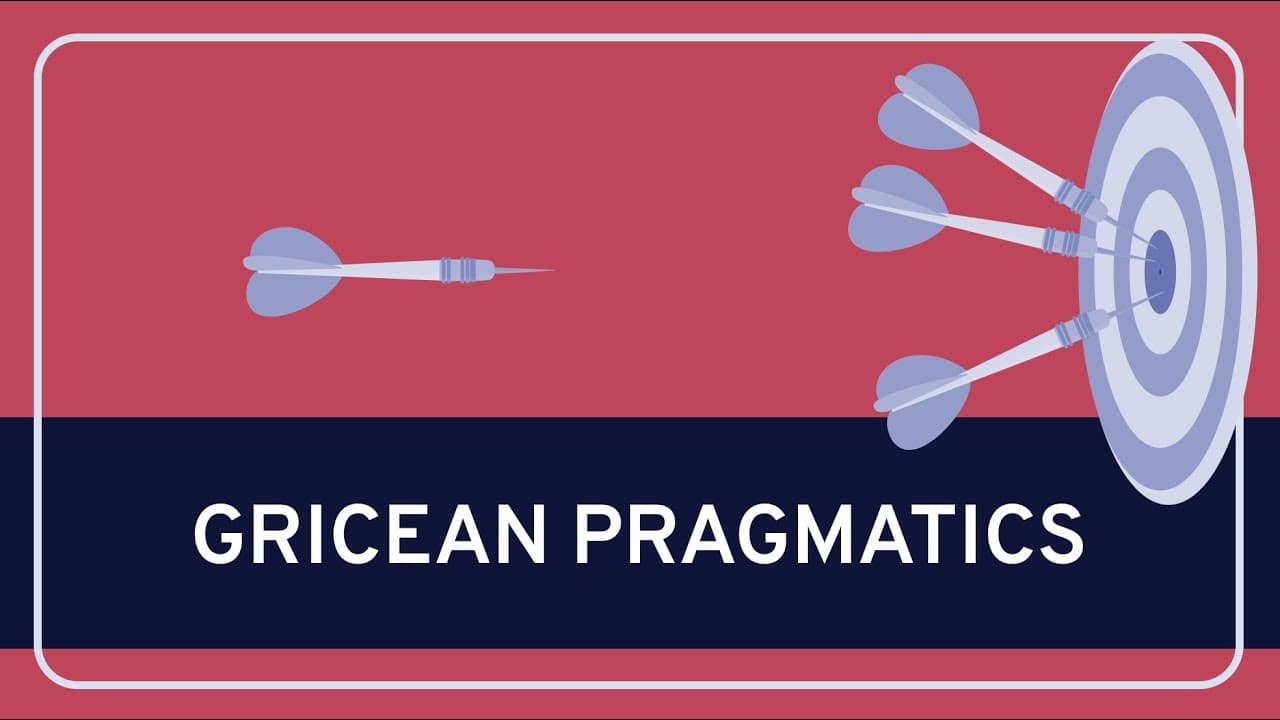
PHILOSOPHY - Language: Gricean Pragmatics [HD]
TL;DR
Gricean pragmatics explains how language conveys more than literal meanings.
Transcript
(intro music) My name is Karen Lewis, and I'm an assistant[br]professor of philosophy at Barnard College, Columbia University. And today, I want to talk to[br]you about Gricean pragmatics. Pragmatics is the study of how people use language in real conversations, and in books and emails[br]and other sorts of media of language use. Pragmatics, on the... Read More
Key Insights
- Pragmatics studies how language is used in real conversations, distinguishing it from semantics, which focuses on literal meanings.
- Gricean pragmatics explores how people communicate more than what is literally stated through implicatures, which are implied meanings.
- The Cooperative Principle is central to Grice's theory, suggesting that conversations are cooperative efforts guided by rational rules.
- Grice identified four conversational maxims: Quantity, Quality, Relation, and Manner, which people follow to achieve effective communication.
- The Maxim of Quantity advises providing the right amount of information, neither too little nor too much, for a given conversational purpose.
- The Maxim of Quality emphasizes truthfulness, discouraging statements believed to be false or lacking sufficient evidence.
- The Maxim of Relation insists on relevance, ensuring contributions are pertinent to the conversation.
- The Maxim of Manner focuses on clarity, urging speakers to avoid ambiguity and obscurity in their expressions.
Install to Summarize YouTube Videos and Get Transcripts
Explore YouTube Video Summarizer or Get YouTube Transcript Extractor
Questions & Answers
Q: What is the main focus of pragmatics as discussed in the video?
Pragmatics focuses on the study of how people use language in real conversations to communicate more than the literal meanings of words. It examines the ways in which context, shared knowledge, and conversational principles allow speakers to convey implied meanings, known as implicatures, beyond what is explicitly stated.
Q: How does Grice's Cooperative Principle relate to conversation?
Grice's Cooperative Principle suggests that conversations are cooperative activities among rational agents. Participants aim to understand each other and be understood, following rational rules to achieve effective communication. This principle underlies the way people convey more than literal meanings, as they assume others are adhering to conversational maxims that guide informative, truthful, relevant, and clear exchanges.
Q: What are the four conversational maxims proposed by Grice?
Grice proposed four conversational maxims: Quantity, Quality, Relation, and Manner. The Maxim of Quantity advises providing the right amount of information. The Maxim of Quality emphasizes truthfulness. The Maxim of Relation insists on relevance. The Maxim of Manner focuses on clarity, urging speakers to avoid ambiguity and obscurity. These maxims guide effective communication by ensuring contributions are informative, truthful, relevant, and clear.
Q: Can you explain the Maxim of Quantity with an example?
The Maxim of Quantity advises making contributions as informative as required, but not more so. For instance, if discussing movie options, one should list all local showtimes, not just one film or every film nationwide. This maxim ensures the right amount of information is shared, aiding decision-making without overwhelming or under-informing the audience.
Q: How does the Maxim of Quality influence communication?
The Maxim of Quality emphasizes truthfulness in communication. It advises against saying what one believes to be false or lacks adequate evidence for. This maxim ensures that information shared in conversation is reliable and credible, facilitating trust and mutual understanding. For example, when discussing movie showtimes, one should only mention times they know to be accurate.
Q: What role does the Maxim of Relation play in conversations?
The Maxim of Relation insists that contributions to a conversation should be relevant. This means speakers should say things pertinent to the topic at hand, avoiding unrelated information. This maxim helps maintain focus and coherence in discussions, ensuring that all contributions serve the conversation's purpose and aid in achieving its goals.
Q: How does the Maxim of Manner ensure effective communication?
The Maxim of Manner focuses on clarity and orderliness in communication. It advises avoiding obscurity and ambiguity, encouraging speakers to be brief and orderly. This maxim ensures that messages are easily understood and interpreted correctly, preventing confusion and miscommunication. For example, when giving directions, one should be straightforward rather than using complex or vague language.
Q: How do conversational implicatures arise according to Grice?
Conversational implicatures arise when speakers convey meanings beyond literal words by adhering to the Cooperative Principle and conversational maxims. Listeners assume speakers are being cooperative and rational, allowing them to infer implied meanings based on context, shared knowledge, and the conversation's purpose. This process enables communication of nuanced ideas without explicit statements, enriching conversational interactions.
Summary & Key Takeaways
-
Gricean pragmatics is a branch of philosophy that examines how people use language to convey meanings beyond literal words. It distinguishes itself from semantics by focusing on implied meanings, known as implicatures, which arise from conversational context and shared knowledge.
-
H.P. Grice's theory highlights the Cooperative Principle, suggesting that conversations are cooperative activities where participants follow rational rules to communicate effectively. This principle is supported by four conversational maxims: Quantity, Quality, Relation, and Manner.
-
Each maxim plays a role in ensuring effective communication. Quantity ensures the right amount of information, Quality emphasizes truthfulness, Relation insists on relevance, and Manner focuses on clarity. These maxims help explain how more is communicated than what is literally said.
Read in Other Languages (beta)
Share This Summary 📚
Summarize YouTube Videos and Get Video Transcripts with 1-Click
Try YouTube Summary with ChatGPT & Claude or YouTube Transcript Generator
Explore More Summaries from Wireless Philosophy 📚
Summarize YouTube Videos and Get Video Transcripts with 1-Click
Try YouTube Summary with ChatGPT & Claude or YouTube Transcript Generator