directions tricks in reasoning | Part-10 | Pratik Shrivastava
TL;DR
Learn how to solve direction-related questions important for competitive exams.
Transcript
hello friends welcome back our today's topic is direction as you know derrickson is one of the very important topic for all kind of competitive exams let it be Bank SEC railways UPC CSAT and placement trainings in all those exams in whom two to three questions will be asked from derrickson so let's understand the question and try to solve this is o... Read More
Key Insights
- 🤔 Direction questions are integral to competitive exams, often requiring quick analytical thinking and logical reasoning.
- 🥺 Understanding and visualizing cardinal directions leads to better accuracy in navigating direction problems.
- ❓ Maintaining proportionality in distance representation within diagrams is vital for solving directional navigation problems correctly.
- 🤢 The relationship between seating arrangements and directional orientation can reveal important insights for interpreting analogies in logic problems.
- 🧡 Practice with variations of direction and arrangements prepares candidates to tackle a broad range of possible exam questions more effectively.
- 🧘 Mistakes in direction questions often stem from confusion between relative positions; clarity in drawing aids accuracy.
- 🤢 The logical deduction involved in seating arrangements blends analytical reasoning with spatial awareness, vital for many competitive contexts.
Install to Summarize YouTube Videos and Get Transcripts
Explore YouTube Video Summarizer or Get YouTube Transcript Extractor
Questions & Answers
Q: Why are direction questions important for competitive exams?
Direction questions are critical in competitive exams because they test logical reasoning and spatial awareness. They typically appear in various formats across exams like banking and civil services, requiring candidates to solve problems effectively and accurately to demonstrate their cognitive skills.
Q: How can one accurately represent movements in direction questions?
To represent movements accurately, it's essential to draw a directional diagram. Begin by marking the cardinal directions (North, East, South, West) and plotting movements according to the specified distances and directions. Maintaining proportional distances in the diagram helps visualize the final position and direction effectively.
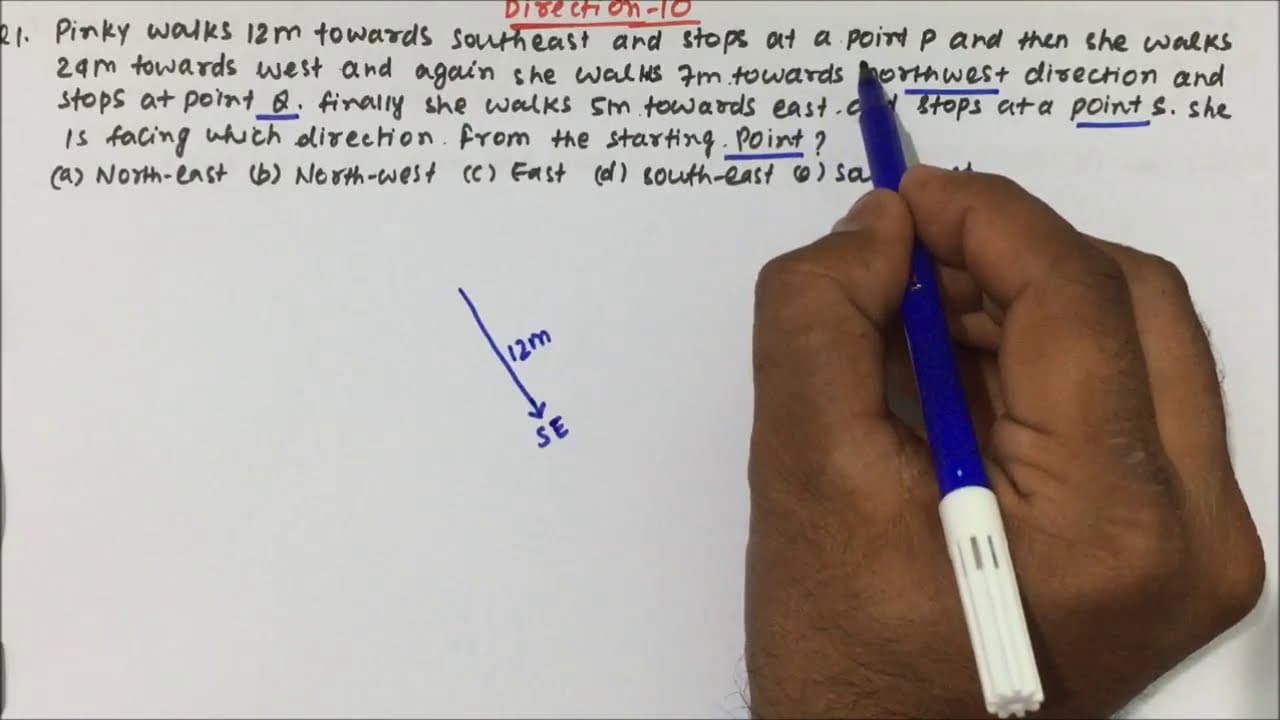
Q: In the first question, what was Pinky's final facing direction?
After completing her movements, Pinky was ultimately facing the southwest direction. This was determined by analyzing her path: moving southeast first, then west, followed by northwest, and finally east, leading her to end up directed towards the southwest from her starting position.
Q: How does one solve the seating arrangement problem in the second question?
To solve the seating arrangement problem, begin by identifying each person's position based on the given clues about their facing direction. Drawing a diagram helps visualize their placements at the table, ensuring that the seating adheres to the rules about the genders and the directions they face, thus allowing for an accurate interpretation of the situation.
Summary & Key Takeaways
-
The content explains the significance of direction questions in competitive exams such as Bank, SEC, and Railways, emphasizing their common occurrence.
-
It provides step-by-step solutions to two direction-related questions, illustrating how to visualize movements and final positions using directional diagrams.
-
The first question involves tracing Pinky's path through various directions, ultimately determining she faces southwest; the second question assesses the seating positions of men and women relative to each other.
Read in Other Languages (beta)
Share This Summary 📚
Summarize YouTube Videos and Get Video Transcripts with 1-Click
Try YouTube Summary with ChatGPT & Claude or YouTube Transcript Generator