Will We Ever Finish the Periodic Table?
TL;DR
The periodic table may not be complete, with predictions of elements beyond 173 and potential "islands of stability."
Transcript
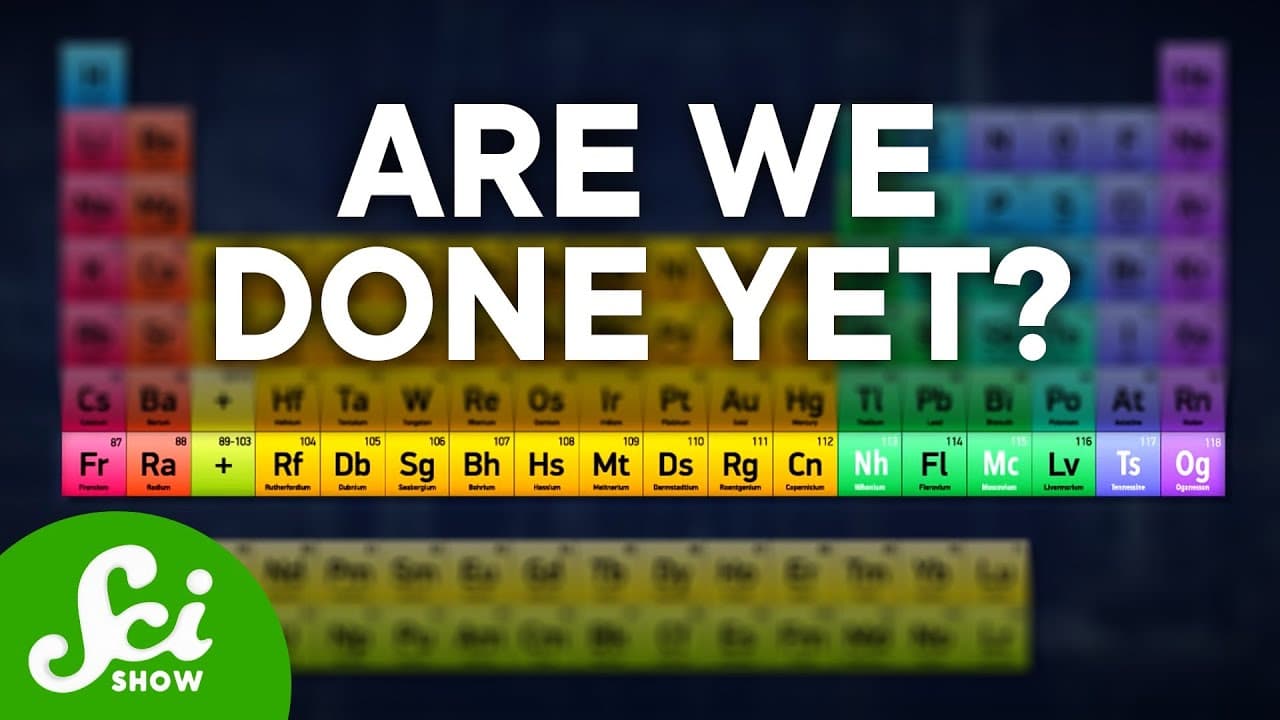
With four new elements being named, the periodic table finally looks full. So it’s done, right? I mean, the periodic table is full. We’ve discovered all the elements up to 118, and filled in the whole bottom row. So there are no more elements to add, right? Well, not exactly. Just because the table looks full doesn’t mean that it’s complete -- it j... Read More
Key Insights
- 🚰 The periodic table may not be complete, as predictions extend beyond element 173.
- 🫀 Earlier atomic weight-based organization has now shifted to atomic number for elements.
- 🥺 Predictions of electron speeds led to theories of an end to the table at atomic number 137.
- 🍝 "Islands of stability" suggest more stable elements could exist past the current table.
- 👶 New elements are highly unstable, decaying quickly after creation.
- 🌗 Potential for longer-lasting elements challenges the current understanding of the periodic table.
- 🤨 Unknown territory beyond element 118 raises questions about the table's future.
Install to Summarize YouTube Videos and Get Transcripts
Explore YouTube Video Summarizer or Get YouTube Transcript Extractor
Questions & Answers
Q: Why did Elliot Quincy Adams predict an end to the periodic table at atomic weight 256?
Adams believed that elements with atomic weights above 256 were impossible based on earlier knowledge of atomic structure, which organized elements by weight before the discovery of protons.
Q: How did Richard Feynman calculate an end to the periodic table at atomic number 137?
Feynman's calculations centered on electron speeds surpassing light in nuclei with 137 protons, suggesting an impossibility in creating elements beyond this atomic number.
Q: What are "islands of stability" in relation to the periodic table?
"Islands of stability" refer to sets of elements that are surprisingly stable due to specific arrangements of protons and neutrons, potentially leading to elements lasting longer and expanding the periodic table beyond its current limits.
Q: How close are scientists to reaching potential islands of stability in the periodic table?
Scientists have already created elements up to 118 and predict the first island of stability could occur around atomic number 122 or 126, indicating we are approaching the discovery of more stable elements.
Summary & Key Takeaways
-
The periodic table may not be complete despite appearing full, with earlier predictions limiting elements to atomic weight 256.
-
Physicists like Richard Feynman theorized an end at atomic number 137 due to electron speeds surpassing light, but newer calculations suggest up to 173.
-
Islands of stability could reveal more stable elements beyond 118, potentially lasting longer and expanding the periodic table.
Read in Other Languages (beta)
Share This Summary 📚
Summarize YouTube Videos and Get Video Transcripts with 1-Click
Try YouTube Summary with ChatGPT & Claude or YouTube Transcript Generator
Explore More Summaries from SciShow 📚


Summarize YouTube Videos and Get Video Transcripts with 1-Click
Try YouTube Summary with ChatGPT & Claude or YouTube Transcript Generator