How to Implement Gradient Descent in Machine Learning?
TL;DR
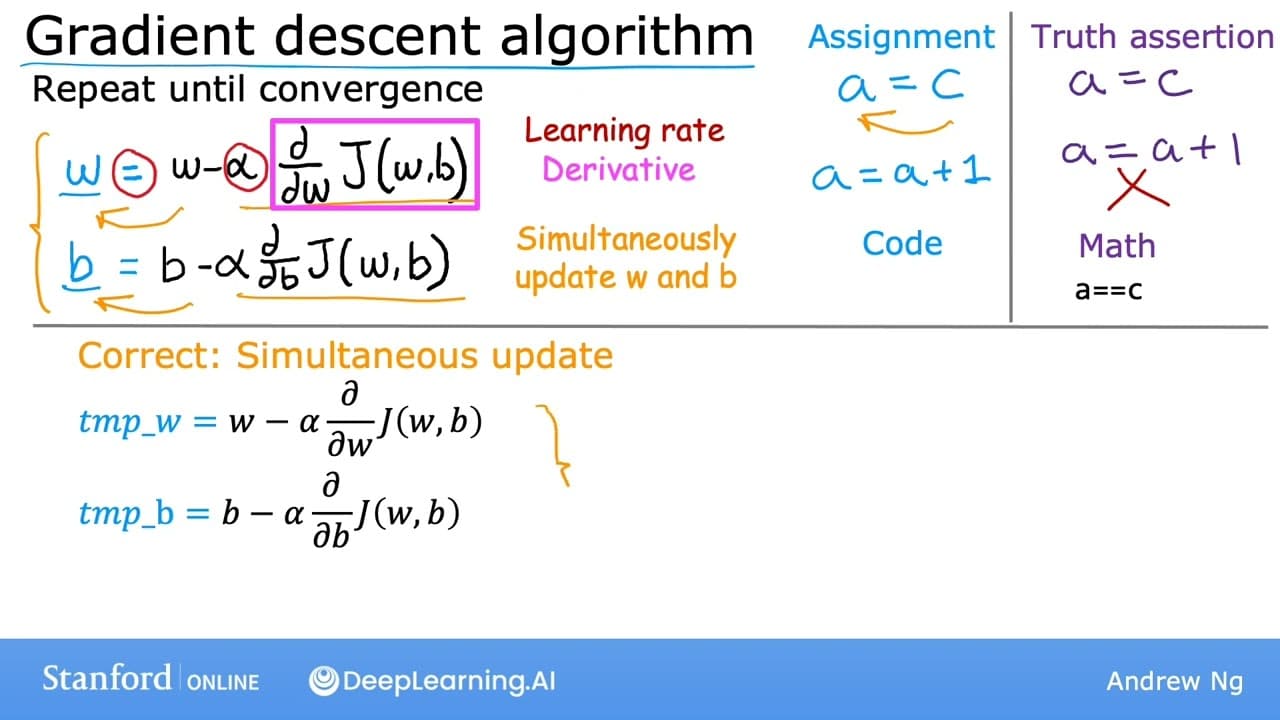
To implement gradient descent, simultaneously update the parameters W and B using the formula: W = W - α * (∂J/∂W) and B = B - α * (∂J/∂B), where α is the learning rate. The learning rate dictates the size of steps taken towards the local minimum, while the derivatives guide the direction of these steps.
Transcript
let's take a look at how you can actually implement the gradient descent algorithm let me write down the gradient descent algorithm here it is on each step W the parameter is updated to the old value of w minus Alpha times this term D over DW of the cost function J of WB so what this expression is saying is update your parameter W by taking the cur... Read More
Key Insights
- ☠️ The gradient descent algorithm updates parameters using the learning rate Alpha and the derivative of the cost function.
- ☠️ The learning rate controls the step size taken during gradient descent.
- 🔙 Updating parameters W and B simultaneously is crucial for efficient convergence in gradient descent.
- ❓ Correct implementation of gradient descent involves updating both parameters simultaneously to avoid inconsistencies.
- 🦮 The derivative term guides the direction of steps in gradient descent towards optimization.
- 🎰 Simultaneous updates of parameters ensure proper convergence towards local minima in machine learning models.
- ☠️ Choosing an appropriate learning rate can impact the convergence speed and effectiveness of gradient descent.
Install to Summarize YouTube Videos and Get Transcripts
Explore YouTube Video Summarizer or Get YouTube Transcript Extractor
Questions & Answers
Q: What does the learning rate signify in the gradient descent algorithm?
The learning rate, denoted by Alpha, controls the magnitude of steps taken during gradient descent. A larger Alpha corresponds to more aggressive steps, while a smaller Alpha leads to smaller steps.
Q: Why is it crucial to update both parameters (W and B) simultaneously in gradient descent?
Simultaneously updating W and B ensures that the algorithm converges efficiently towards a local minimum. Updating one parameter before the other can lead to inconsistencies in parameter values and convergence.
Q: How does the derivative term affect the direction of steps in gradient descent?
The derivative term of the cost function J determines the direction for taking steps in gradient descent. It guides the algorithm towards the steepest downhill direction to optimize parameters efficiently.
Q: What is the significance of implementing gradient descent correctly in machine learning algorithms?
Implementing gradient descent correctly, with simultaneous updates for parameters, ensures efficient convergence towards optimal parameter values, leading to effective machine learning models.
Summary & Key Takeaways
-
The gradient descent algorithm updates parameters W and B by taking steps according to a learning rate and the derivative of the cost function.
-
The learning rate controls the size of steps taken downhill, while the derivative term directs the direction of the steps.
-
Implementing gradient descent involves updating both W and B simultaneously to converge towards a local minimum efficiently.
Read in Other Languages (beta)
Share This Summary 📚
Summarize YouTube Videos and Get Video Transcripts with 1-Click
Try YouTube Summary with ChatGPT & Claude or YouTube Transcript Generator
Explore More Summaries from DeepLearningAI 📚


![How Does the Logistic Regression Decision Boundary Work? — #33 Machine Learning Specialization [Course 1, Week 3, Lesson 1] thumbnail](/_next/image?url=https%3A%2F%2Fi.ytimg.com%2Fvi%2F0az8RjxLLPQ%2Fhqdefault.jpg&w=750&q=75)
Summarize YouTube Videos and Get Video Transcripts with 1-Click
Try YouTube Summary with ChatGPT & Claude or YouTube Transcript Generator