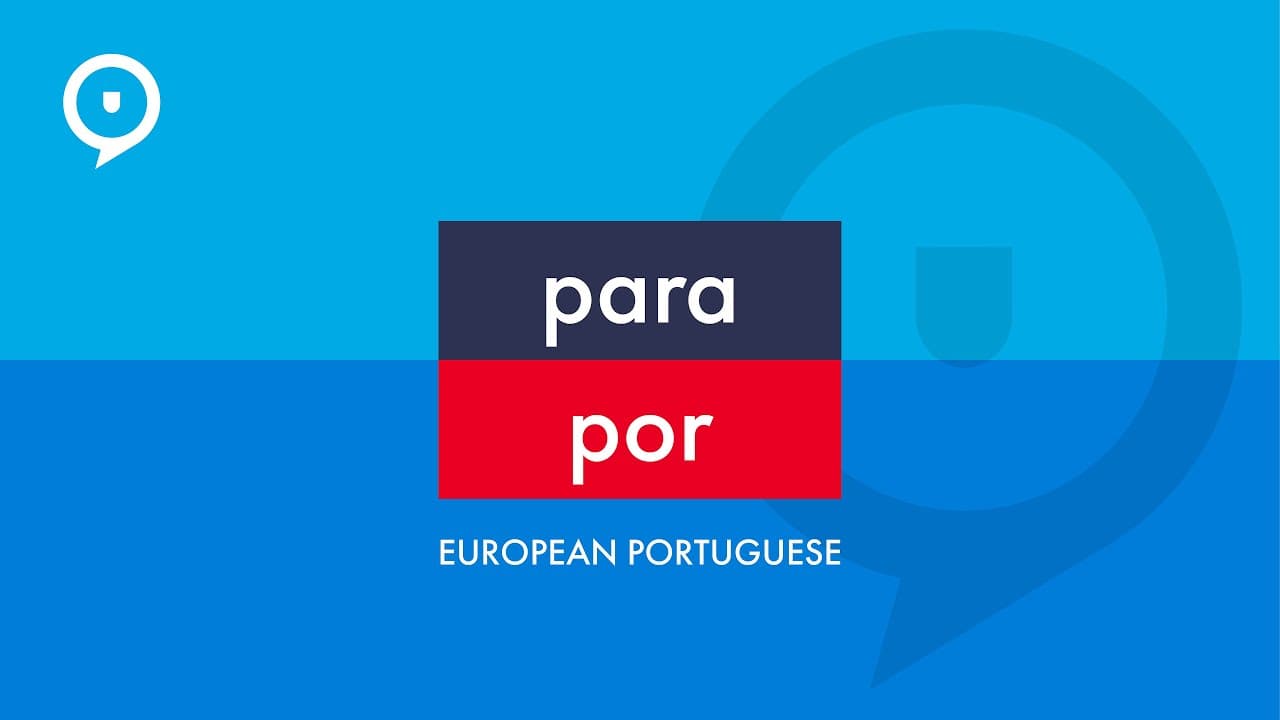
European Portuguese - para vs. por (+ dialogue)
TL;DR
Explains the difference between 'para' and 'por' with examples and dialogue.
Transcript
hola welcome to the portuguese lab podcast today we are looking at the difference between the prepositions pare and put i'll explain the difference with a few examples and after that you'll listen to a dialog where you can see both words in action the translation of the examples is available on the video and as always if you're a member of the port... Read More
Key Insights
- The podcast focuses on the Portuguese prepositions 'para' and 'por', explaining their different uses with examples.
- 'Para' is used to indicate destination, direction, goal, or purpose, whether in a physical or abstract sense.
- Examples include 'I'm going to the office' for destination and 'I work out to be healthy' for goal.
- 'Por' focuses on the journey or path taken, not the destination, such as 'I go through the forest'.
- When discussing duration, 'por' is used to indicate the time spent, like 'I stayed in Portugal for two months'.
- In some cases, the preposition 'por' can be omitted, especially when discussing duration.
- The podcast includes a dialogue to illustrate the use of 'para' and 'por' in context.
- Portuguese Lab Academy offers structured courses to help learners with grammar, vocabulary, and pronunciation.
Install to Summarize YouTube Videos and Get Transcripts
Explore YouTube Video Summarizer or Get YouTube Transcript Extractor
Questions & Answers
Q: What is the main focus of the podcast episode?
The main focus of the podcast episode is to explain the differences between the Portuguese prepositions 'para' and 'por'. The episode provides examples and a dialogue to help learners understand when to use each preposition, emphasizing common situations where learners often get confused.
Q: How is 'para' typically used in Portuguese?
'Para' is typically used in Portuguese to indicate a destination, direction, goal, or purpose. It can refer to both physical movements, such as going to a place, and abstract ideas, like having a goal. It's about moving from a starting point to an endpoint, either literally or figuratively.
Q: What does 'por' emphasize in its usage?
'Por' emphasizes the journey or path taken rather than the destination. It is used to describe the route, the process, or the duration of an action. For instance, it can describe going through a place or the time spent doing something, focusing on the experience rather than the endpoint.
Q: Can 'por' be omitted in some cases?
Yes, 'por' can often be omitted, particularly when discussing the duration of time. In many instances, especially in spoken Portuguese, the preposition is left out because the context makes it clear. This is common when stating how long something lasts, like saying 'I stayed in Portugal two months.'
Q: What resources does Portuguese Lab Academy offer?
Portuguese Lab Academy offers a variety of resources for learning European Portuguese, including step-by-step online courses focused on grammar, vocabulary, verb conjugations, pronunciation, and dialogues. The academy provides structured learning and practice, supporting learners from beginner to upper-intermediate levels.
Q: Why is understanding 'para' and 'por' important for learners?
Understanding 'para' and 'por' is crucial for learners because these prepositions are commonly used in Portuguese and can significantly change the meaning of a sentence. Mastering their usage helps learners communicate more accurately and effectively, avoiding misunderstandings in both spoken and written Portuguese.
Q: What examples are provided for 'para'?
Examples provided for 'para' include sentences like 'I'm going to the office,' which indicates a destination, and 'I work out to be healthy,' which represents a goal. These examples illustrate how 'para' is used to denote endpoints or purposes in both physical and abstract contexts.
Q: How does the podcast demonstrate the prepositions in context?
The podcast demonstrates the prepositions 'para' and 'por' in context by including a dialogue that showcases their usage. This dialogue helps listeners see how these prepositions function in real-life conversations, providing practical examples that reinforce the explanations given earlier in the episode.
Summary & Key Takeaways
-
The podcast episode discusses the difference between the Portuguese prepositions 'para' and 'por'. 'Para' is used for indicating destination, direction, or purpose, while 'por' focuses on the path or duration. Examples and a dialogue are provided to illustrate their usage.
-
The episode emphasizes common situations where learners struggle with 'para' and 'por'. It explains that 'para' relates to endpoints and goals, whereas 'por' concerns the journey or duration. A dialogue demonstrates these prepositions in action.
-
Portuguese Lab Academy offers resources for learning European Portuguese, including grammar, vocabulary, and pronunciation courses. The podcast encourages listeners to join the academy for structured learning and practice, supported by examples and dialogues.
Read in Other Languages (beta)
Share This Summary 📚
Summarize YouTube Videos and Get Video Transcripts with 1-Click
Try YouTube Summary with ChatGPT & Claude or YouTube Transcript Generator
Explore More Summaries from Portuguese Lab 📚





Summarize YouTube Videos and Get Video Transcripts with 1-Click
Try YouTube Summary with ChatGPT & Claude or YouTube Transcript Generator