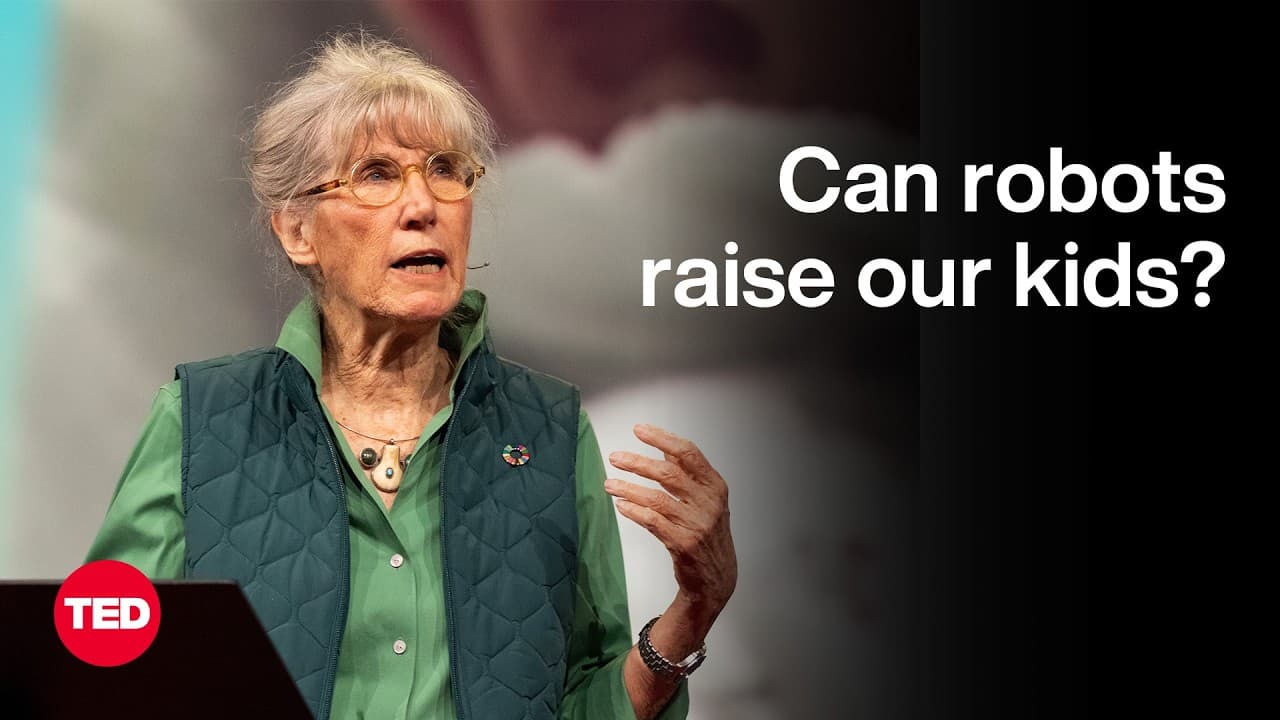
Are We Still Human If Robots Help Raise Our Babies? | Sarah Blaffer Hrdy | TED
TL;DR
AI's role in childcare may reshape human empathy.
Transcript
I guess you've already figured out. Like it or not, artificial intelligence is going to change the nature of human work. But will it change human nature? That's going to depend on what we do with it. Right away, the mother and the grandmother in me wants to know, oh, hey, can we program robots to help us care for our sleep-depriving, time-consuming... Read More
Key Insights
- AI is poised to change the nature of human work, raising questions about its impact on human nature and empathy.
- Historically, shared childcare was crucial for human evolution, fostering mutual understanding and cooperation.
- Modern parents often rely on technology for childcare, with 40% of US toddlers owning tablets.
- Future robots may provide extensive childcare services, but this raises concerns about the loss of human social engagement.
- Human infants have evolved to be highly social, developing intersubjective sensibilities and caring about their reputations.
- Neuroscientific research shows early activation of social brain circuits in infants, highlighting the importance of social interactions.
- The evolution of human social capabilities prepared our ancestors for advanced cooperation and technological achievements.
- The future of human nature depends on how AI and robots are integrated into childcare and upbringing.
Install to Summarize YouTube Videos and Get Transcripts
Explore YouTube Video Summarizer or Get YouTube Transcript Extractor
Questions & Answers
Q: How might AI impact human nature according to the talk?
AI could impact human nature by altering the way we raise children. As robots potentially take on roles in childcare, there is a concern that essential human social interactions and empathy could diminish. The talk emphasizes the historical importance of shared childcare in human evolution, fostering mutual understanding and cooperation.
Q: What historical factors contributed to human evolution according to Hrdy?
According to Sarah Blaffer Hrdy, shared childcare played a crucial role in human evolution. This practice fostered mutual understanding and cooperation among early humans, allowing them to survive and thrive despite environmental challenges. The evolution of social capabilities was essential for the development of advanced cooperation and technological achievements.
Q: What role does technology currently play in childcare?
Technology plays a significant role in modern childcare, with many parents using devices to monitor and entertain their babies. The talk highlights that 40% of US toddlers have their own tablets. This reliance on technology raises concerns about the potential loss of essential human social interactions and the impact on empathy and social development.
Q: What concerns does Hrdy raise about robots in childcare?
Hrdy raises concerns that robots providing childcare services could lead to a loss of essential human social interactions. She questions whether robots could replace the engagement needed for the development of empathy and social skills in children. The talk emphasizes the importance of human interaction in fostering mutual understanding and cooperation.
Q: How do human infants differ from other apes in social development?
Human infants differ from other apes in their social development by being highly social and developing intersubjective sensibilities early in life. They care about their reputations and engage in social interactions that are crucial for mutual understanding. This social nature is supported by neuroscientific findings showing early activation of social brain circuits in infants.
Q: What neuroscientific findings are discussed in the talk?
The talk discusses neuroscientific findings that show early activation of social brain circuits in infants, specifically in the medial prefrontal cortex. These findings suggest that infants are inherently social beings, processing eye gaze, actions, and deciding whom to trust and emulate. This early social development is crucial for fostering mutual understanding and cooperation.
Q: What is the potential future of human nature with AI integration?
The potential future of human nature with AI integration depends on how AI and robots are incorporated into childcare and upbringing. If robots take on significant roles in childcare, there is a concern that essential human social interactions and empathy could diminish. The talk emphasizes the importance of maintaining human engagement to preserve the empathy that defines us.
Q: What is Hrdy's main question about the future of humanity?
Hrdy's main question about the future of humanity is whether humans will still be interested in the thoughts and emotions of others, eligible for mutual understanding, if AI and robots play significant roles in childcare. She questions whether the empathy that defines us could be lost if human engagement is replaced by technology in child-rearing.
Summary & Key Takeaways
-
Sarah Blaffer Hrdy explores how AI could change human nature by altering the way we raise children. She emphasizes the historical importance of shared childcare in human evolution, fostering mutual understanding and cooperation. Hrdy questions whether robots could replace human engagement, potentially impacting empathy and social development.
-
The talk highlights the role of technology in modern childcare, with many parents using devices to monitor and entertain babies. Hrdy raises concerns about the implications of robots providing childcare services, questioning whether this could lead to a loss of essential human social interactions and empathy.
-
Hrdy discusses the evolution of human social capabilities, noting that infants are inherently social beings. She presents neuroscientific findings showing early activation of social brain circuits in infants, suggesting that the future of human nature will depend on how AI and robots are integrated into childcare and upbringing.
Read in Other Languages (beta)
Share This Summary 📚
Summarize YouTube Videos and Get Video Transcripts with 1-Click
Try YouTube Summary with ChatGPT & Claude or YouTube Transcript Generator
Explore More Summaries from TED 📚




Summarize YouTube Videos and Get Video Transcripts with 1-Click
Try YouTube Summary with ChatGPT & Claude or YouTube Transcript Generator