3.2.1 Introduction to Logistical Regression - Video 1: Replicating Expert Assessment
TL;DR
Using analytics, this lecture explores how to assess and improve the quality of healthcare by modeling expert assessments and introduces the technique of logistic regression.
Transcript
In this lecture, we'll examine how analytics can model an expert, in this case a physician, in the context of assessing the quality of healthcare patients receive, and introduce a technique called logistic regression to achieve this objective. From the early 2000s, I was a member of the board of a company called D2Hawkeye, a medical data mining com... Read More
Key Insights
- 😷 Claims data generated from insured patients' visits to medical providers can be used to assess healthcare quality.
- 👻 Assessing healthcare quality allows for interventions and improvements for patients with low-quality care and better cost control.
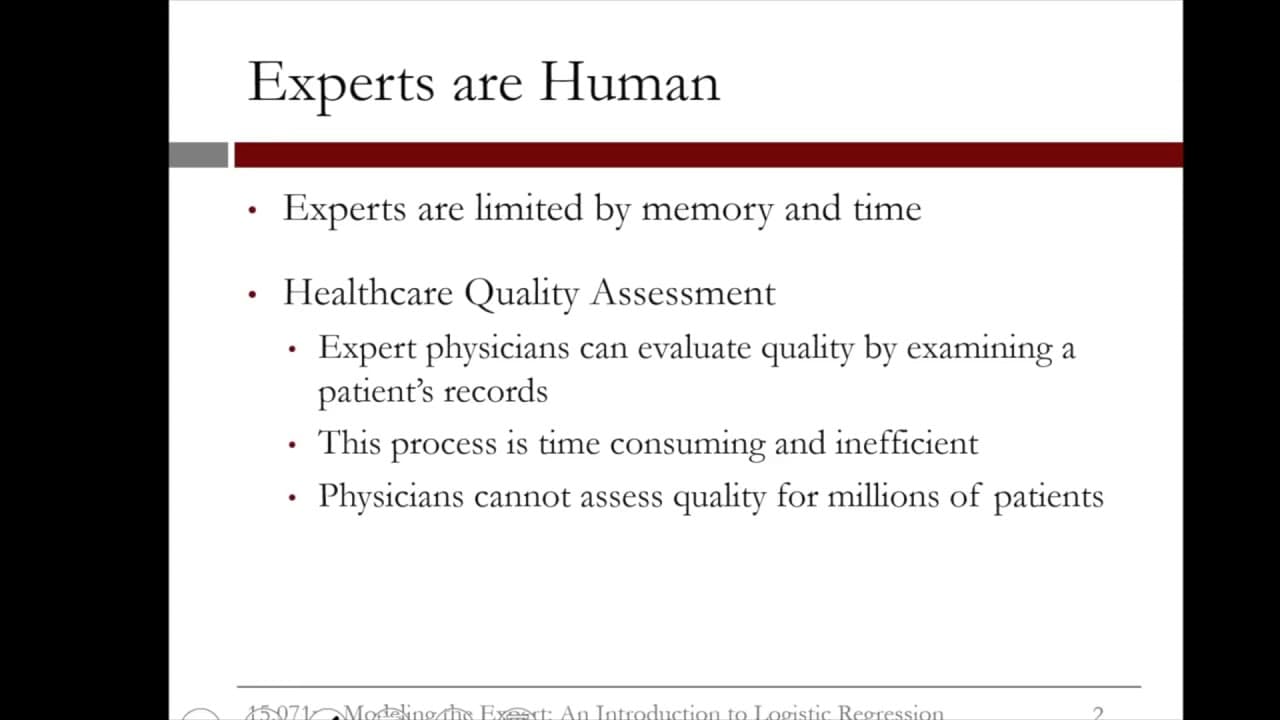
- ⌛ Physicians currently assess quality using their expertise and intuition, but it is a time-consuming and inefficient process.
- 🌥️ Analytics tools can replicate expert assessments on a large scale by learning from human judgment and improving predictability.
- 📞 Claims data are essential for evaluating the quality of healthcare received by insured patients and identifying areas for improvement.
- ❓ The process of defining and assessing the quality of healthcare is complex and not algorithmically understood.
- 😨 Using analytics can help identify poor quality care and improve outcomes for patients on a large scale.
Install to Summarize YouTube Videos and Get Transcripts
Explore YouTube Video Summarizer or Get YouTube Transcript Extractor
Questions & Answers
Q: Why is assessing the quality of healthcare important?
Assessing healthcare quality is crucial because it allows for interventions and improvements for patients receiving low-quality care, as well as better cost control.
Q: How do physicians currently assess healthcare quality?
Physicians assess quality by examining patient records, but it is a time-consuming and inefficient process, making it impossible to evaluate quality for millions of patients.
Q: Can analytics tools replicate expert assessments on a large scale?
Yes, the goal is to develop analytics tools that learn from expert human judgment, interpret the results, and adjust the model to improve predictability, enabling large-scale predictions and evaluations of healthcare quality.
Q: What is the purpose of using claims data in assessing healthcare quality?
Claims data provide a means to evaluate the quality of healthcare received by insured patients and identify areas for improvement or intervention.
Summary & Key Takeaways
-
Claims data are generated when insured patients visit medical providers for diagnosis, procedures, or medication, and can be used to assess healthcare quality.
-
Assessing healthcare quality is important for identifying patients with low-quality care and improving outcomes for them, as well as controlling costs.
-
Currently, physicians assess quality using their expertise and intuition, but it is time-consuming and inefficient to evaluate millions of patient records.
Read in Other Languages (beta)
Share This Summary 📚
Summarize YouTube Videos and Get Video Transcripts with 1-Click
Try YouTube Summary with ChatGPT & Claude or YouTube Transcript Generator
Explore More Summaries from MIT OpenCourseWare 📚



Summarize YouTube Videos and Get Video Transcripts with 1-Click
Try YouTube Summary with ChatGPT & Claude or YouTube Transcript Generator