Line Graph | Production Rise | DI | Reasoning | Part - 02 | Bharath Kumar
TL;DR
A detailed explanation of interpreting line graph data and calculating percentage increases over years.
Transcript
hi everyone welcome to the session in this session I am going to explaining about a line graph data interpretation here I am going to explaining about line graph data interpretation here in the last session we have started length of return operation let's continue the session with one more reminder data inspiration first of all we need to read the ... Read More
Key Insights
- 📈 Line graphs effectively display production trends over time, allowing users to visualize progress and changes annually.
- ⏮️ Accurate data interpretation involves systematic analysis of percentage changes while considering each year's relationship to previous values.
- 🥺 Providing clear criteria for inclusion or exclusion of data points enhances the clarity of analysis and leads to more accurate results in interpreting trends.
- 🫥 Mastering calculations involving averages and comparisons is essential for making sense of variable data presented in line graphs.
- 👨💼 Understanding production dynamics helps forecast future trends and make informed business decisions based on historical data.
- 🦻 Identifying the years with significant percentage changes aids in recognizing patterns that may influence strategic planning.
- ❓ Clear communication of methods and findings during data interpretation fosters better comprehension among individuals learning these analytical skills.
Install to Summarize YouTube Videos and Get Transcripts
Explore YouTube Video Summarizer or Get YouTube Transcript Extractor
Questions & Answers
Q: What is the importance of understanding the data in a line graph?
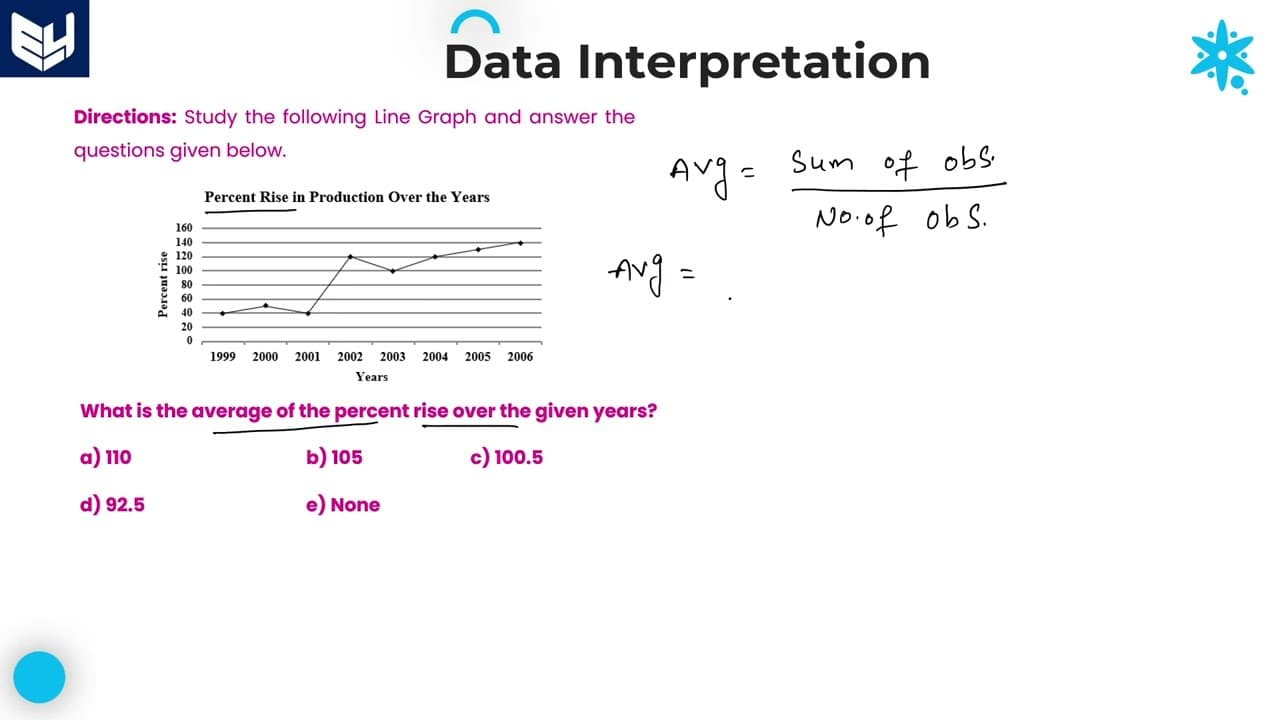
Understanding the data in a line graph is crucial for accurate interpretation. It allows us to identify trends and variations over time, such as percentage increases or decreases in production. By analyzing each data point carefully, one can derive valuable insights and respond effectively to specific queries regarding the data, fostering informed decision-making.
Q: How do you determine the number of years with a percentage rise greater than 100%?
To determine the number of years with a percentage rise greater than 100%, review the line graph values year by year. For each year, identify whether the percentage increase exceeds 100%. In the given data, four years show rises above 100%, specifically 2002, 2004, 2005, and 2006, allowing one to count and provide the correct answer easily.
Q: What steps should be followed to calculate the average percentage rise?
To calculate the average percentage rise, first, sum all the percentage values from each year, then divide that by the number of years involved. For example, if the sum of the percentages equals 740% across eight years, the average would be calculated as 740 divided by 8, yielding an average percentage rise of 92.5%.
Q: Why are specific years, like 2001 and 2003, excluded from certain calculations?
Years such as 2001 and 2003 are excluded from calculations due to their percentage rises being negative or equal to a fixed value rather than exceeding it. By focusing only on years with notable increases, one can accurately reflect the overall growth trends without bias introduced by stagnant or negative changes.
Summary & Key Takeaways
-
The session focuses on interpreting line graphs, emphasizing careful reading of the presented data related to percentage increases in production over the years from 1999 to 2006.
-
Questions are posed regarding the data, such as identifying years with percentage rises above 100% and calculating the average percentage increase, showcasing analytical skills in data interpretation.
-
Practical examples illustrate how to assess changes in production values year-on-year, enabling participants to master the necessary calculations for achieving accurate answers in data interpretation tasks.
Read in Other Languages (beta)
Share This Summary 📚
Summarize YouTube Videos and Get Video Transcripts with 1-Click
Try YouTube Summary with ChatGPT & Claude or YouTube Transcript Generator