L11.1 Harmonic transitions between discrete states
TL;DR
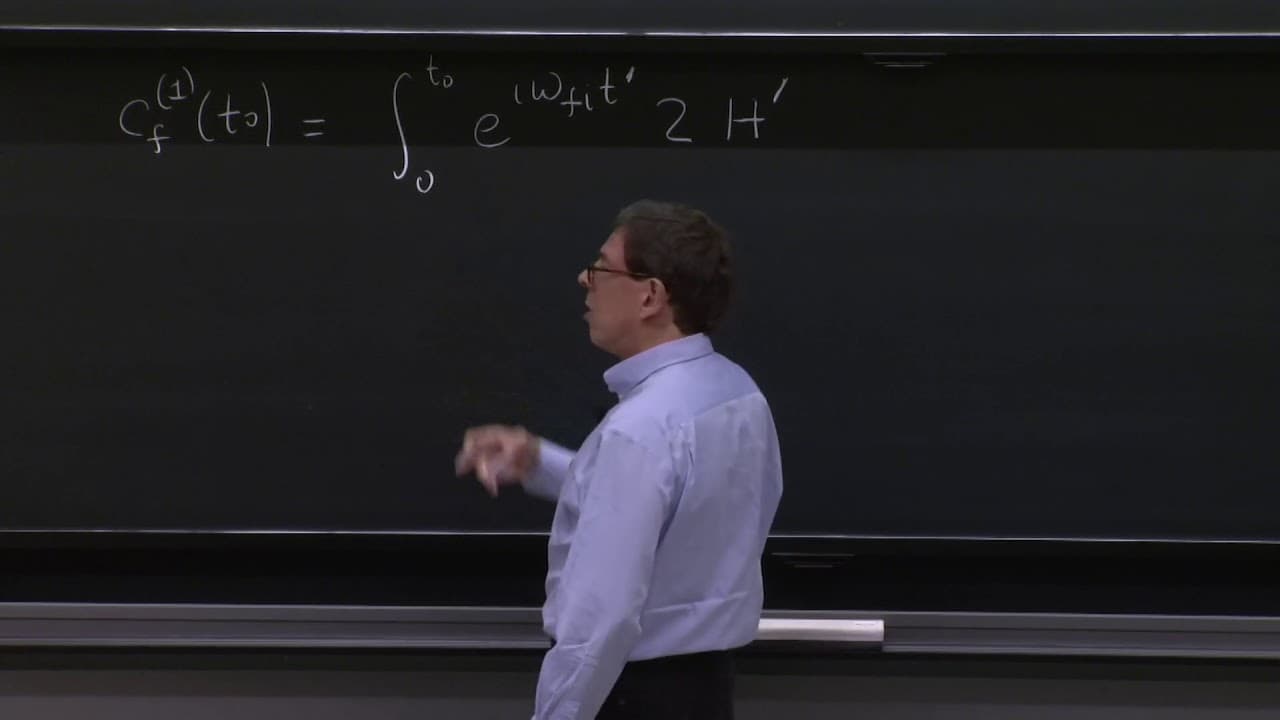
This content discusses harmonic perturbations and their application in Fermi's Golden Rule calculation for the ionization rate of hydrogen.
Transcript
PROFESSOR: Today, we have to discuss harmonic perturbations. So we've done Fermi's golden rule for constant transitions. We saw transitions from a discrete state to a continuum. And by integrating over the continuum, we found a nice rule, Fermi's golden rule, that govern the transition rate for this process. So the only thing we have to do differen... Read More
Key Insights
- ☠️ Harmonic perturbations introduce frequency dependence to transition rates in quantum systems.
- ☠️ Fermi's Golden Rule can be applied to calculate the ionization rate for hydrogen using harmonic perturbations.
- ❓ The formula for transition coefficients and transition amplitudes is derived for harmonic perturbations.
Install to Summarize YouTube Videos and Get Transcripts
Explore YouTube Video Summarizer or Get YouTube Transcript Extractor
Questions & Answers
Q: What is the significance of harmonic perturbations in quantum systems?
Harmonic perturbations introduce a frequency dependence to the perturbation, leading to novel features in transition rates. It allows for the calculation of ionization rates and other physical quantities.
Q: How is Fermi's Golden Rule applied to the calculation of the ionization rate for hydrogen?
Fermi's Golden Rule provides a formula for transition coefficients, which can be used to calculate the transition amplitudes for ionization. By substituting the known Hamiltonian and the harmonic perturbation into the formula, the ionization rate can be computed.
Q: Why is the 2 in the expression for harmonic perturbation convenient?
The 2 cancels out when the cosine function is expressed in terms of exponentials, resulting in the same form for Fermi's Golden Rule as in the case of constant perturbations. This simplifies the calculations and ensures consistency.
Q: What are the key considerations when working with harmonic perturbations?
It is important to note that the perturbation should be time independent, while the time dependence is introduced through the cosine function. Additionally, the convention is set for the frequency omega to be positive.
Summary & Key Takeaways
-
Harmonic perturbations are discussed in relation to Fermi's Golden Rule, which governs transition rates in quantum systems.
-
The content focuses on the calculation of the ionization rate for hydrogen using harmonic perturbations.
-
The calculation of transition coefficients and the derivation of the formula for transition amplitudes are explained.
Read in Other Languages (beta)
Share This Summary 📚
Summarize YouTube Videos and Get Video Transcripts with 1-Click
Try YouTube Summary with ChatGPT & Claude or YouTube Transcript Generator
Explore More Summaries from MIT OpenCourseWare 📚


Summarize YouTube Videos and Get Video Transcripts with 1-Click
Try YouTube Summary with ChatGPT & Claude or YouTube Transcript Generator