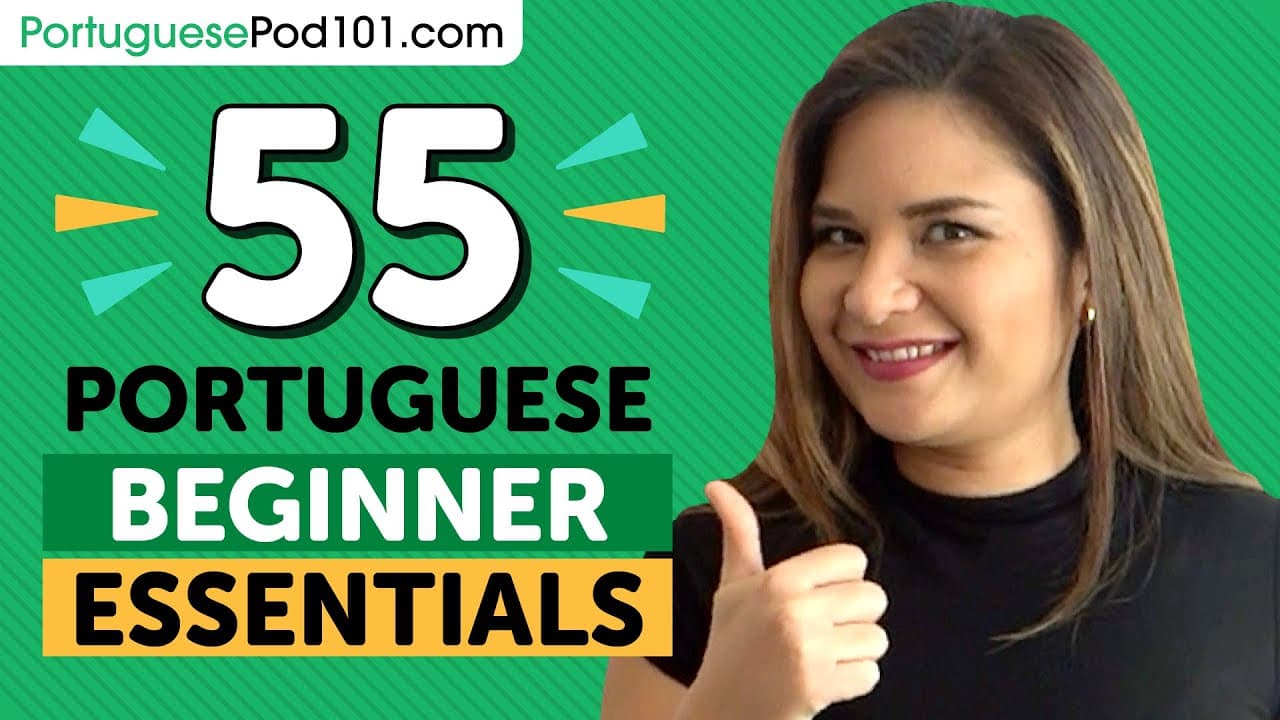
How to Learn Basic Portuguese: 55 Essential Videos
TL;DR
This video provides a comprehensive guide for beginners to learn Portuguese, covering essential vocabulary, phrases, and grammar. It includes practical tips for pronunciation, common expressions, and cultural insights to help learners understand and communicate effectively in Portuguese. The lessons are designed to be engaging and easy to follow, making it ideal for anyone starting their journey in learning Portuguese.
Transcript
do you feel like you don't speak enough Portuguese that you need to know more words then stick around with these lessons you'll pick up some of the most common words in just a few minutes now this video is a small portion of our learning program to get the full lessons translations and fluency fast study tools click the link in the description and ... Read More
Key Insights
- Portuguese uses the same alphabet as English, with a few additional accents.
- The language has a phonetic pronunciation system, making it easier to learn.
- Brazilian Portuguese has distinctive nasal vowel sounds.
- Common phrases like 'Obrigado' (Thank you) vary by gender.
- The word order in Portuguese is similar to English (SVO).
- Brazilian culture is rich and diverse, influencing language use.
- Portuguese has both formal and informal ways of addressing people.
- Learning Portuguese opens up cultural and business opportunities.
Install to Summarize YouTube Videos and Get Transcripts
Explore YouTube Video Summarizer or Get YouTube Transcript Extractor
Questions & Answers
Q: How to greet someone in Portuguese?
In Portuguese, you can greet someone with 'Oi' for 'Hi' or 'Olá' for 'Hello'. In the morning, you can say 'Bom dia' for 'Good morning', 'Boa tarde' for 'Good afternoon', and 'Boa noite' for 'Good evening' or 'Good night'. These greetings are commonly used in Brazil and are a great way to start a conversation.
Q: What is the basic structure of a Portuguese sentence?
The basic structure of a Portuguese sentence follows the Subject-Verb-Object (SVO) order, similar to English. For example, 'Eu como maçã' translates to 'I eat apple'. This structure is consistent across most sentences, making it easier for English speakers to learn Portuguese grammar.
Q: How do you say 'Thank you' in Portuguese?
To say 'Thank you' in Portuguese, you use 'Obrigado' if you are male and 'Obrigada' if you are female. This expression of gratitude is essential in Portuguese-speaking cultures, and you can enhance it by saying 'Muito obrigado/a' for 'Thank you very much'.
Q: What are some common pronunciation challenges in Portuguese?
Common pronunciation challenges in Portuguese include mastering the nasal vowel sounds and the rolled 'R'. The nasal vowels require air to pass through the nose, while the rolled 'R' involves a quick tapping motion with the tongue. Practice and listening to native speakers can help overcome these challenges.
Q: How do you ask questions in Portuguese?
To ask questions in Portuguese, you can use question words like 'O que' (What), 'Quem' (Who), 'Onde' (Where), 'Quando' (When), 'Por quê' (Why), and 'Como' (How) at the beginning of the sentence. The structure remains similar to statements, with the intonation rising at the end.
Q: What are some cultural aspects of learning Portuguese?
Learning Portuguese involves understanding Brazilian culture, which is diverse and vibrant. This includes familiarity with Brazilian music, food, festivals, and social norms. Being aware of cultural nuances can enhance communication and make interactions more meaningful.
Q: Why is it important to learn Portuguese pronunciation?
Proper pronunciation in Portuguese is crucial for being understood and communicating effectively. It helps in building confidence and prevents misunderstandings. Portuguese has unique sounds that differ from English, so focusing on pronunciation can significantly improve language proficiency.
Q: How can learning Portuguese benefit you?
Learning Portuguese can open up opportunities for travel, business, and cultural exchange, especially in Brazil, which is a major economic player in Latin America. It allows for deeper engagement with Portuguese-speaking communities and access to a rich cultural heritage.
Summary & Key Takeaways
-
The video covers the basics of Brazilian Portuguese pronunciation, including vowel and consonant sounds, with emphasis on nasal vowels and unique consonants. It provides examples and exercises to help learners master these sounds.
-
It explains common Portuguese phrases and expressions, focusing on greetings, polite expressions, and basic conversational skills. The video also highlights cultural nuances in language use.
-
The video introduces essential Portuguese grammar, including sentence structure, verb conjugations, and the use of articles. It uses practical examples to demonstrate how to form sentences and questions.
Read in Other Languages (beta)
Share This Summary 📚
Summarize YouTube Videos and Get Video Transcripts with 1-Click
Try YouTube Summary with ChatGPT & Claude or YouTube Transcript Generator
Explore More Summaries from Learn Portuguese with PortuguesePod101.com 📚




Summarize YouTube Videos and Get Video Transcripts with 1-Click
Try YouTube Summary with ChatGPT & Claude or YouTube Transcript Generator