Combinational cirucuit | Design | Example-1| STLD | Lec-78
TL;DR
This video explains designing a combinational circuit to produce the square of a 3-bit BCD input.
Transcript
hi everyone in this video I'm going to explain about an example problem on design of combinational circuit so here the design of combinational circuit always consists of three steps as I said earlier truth table uh K maps and then logic circuit so here the question is design a combinational circuit that accepts design a combinational circuit that a... Read More
Key Insights
- 😑 The design of a combinational circuit follows a systematic approach including truth tables, logic expressions, and circuit diagrams.
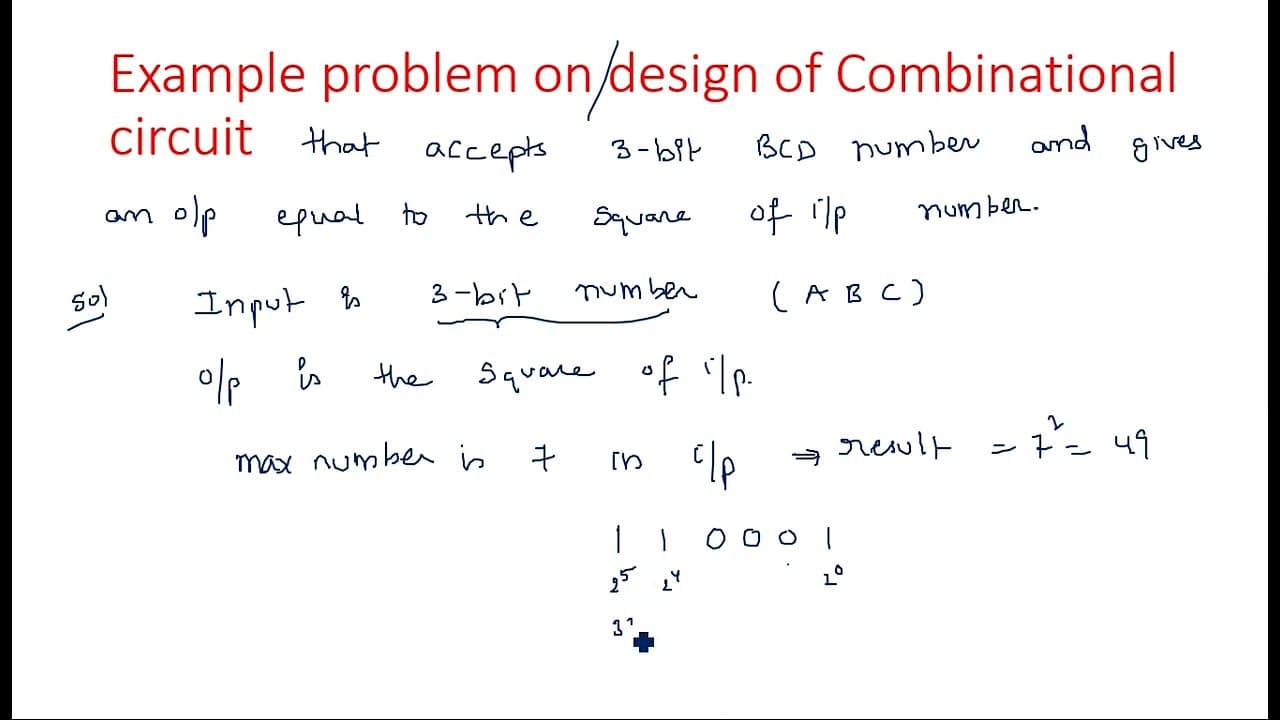
- 🫦 A 3-bit BCD input can yield squares up to 49, necessitating a six-bit binary output for adequate representation.
- 🎨 Logical simplifications often rely on understanding the rarity of occurrences of '1' in the truth table, affecting the complexity of the design.
- 💁 The ability to convert decimal squares into binary format is critical for accurately outputting results in digital circuits.
- 😑 Logic expressions derived from truth tables inform the necessary gates for the overall circuit design.
- 🎨 Visual representations of circuits clarify the functionality and interconnections of various logic components in the design.
- ❓ It is essential for circuit designers to understand binary representation and logic simplification techniques to create efficient and reliable circuits.
Install to Summarize YouTube Videos and Get Transcripts
Explore YouTube Video Summarizer or Get YouTube Transcript Extractor
Questions & Answers
Q: What is a BCD number and why is it relevant in this circuit design?
A BCD (Binary-Coded Decimal) number represents decimal digits in binary format, where each digit is encoded in its own 4 bits. In this circuit design, the 3-bit BCD enables the representation of decimal values from 0 to 7, and the circuit calculates the square of these values, which must also be output in binary.
Q: How do you derive the truth table for the given combinational circuit?
The truth table is derived by listing all possible 3-bit combinations (000 to 111), determining the decimal equivalent, calculating their squares, and converting these square results to binary. This forms a mapping between 3-bit inputs and their corresponding 6-bit binary outputs.
Q: Why is a Karnaugh map not strictly necessary for this circuit's logic simplifications?
A Karnaugh map is typically used to simplify Boolean expressions; however, in this case, the number of ones in the truth table is limited. This allows for a direct derivation of logic expressions without the need for extensive simplification, making it easier to represent outputs effectively.
Q: What maximum output size is expected for this combinational circuit, and why?
The maximum output size is six bits because the square of the highest 3-bit BCD number (7) is 49. Since 49 corresponds to binary 110001, this necessitates six bits to accurately express all possible squares of 3-bit inputs.
Q: Explain the procedure to encode the square of a decimal number into binary format.
To encode a square into binary format, first calculate the square of the decimal input. For example, if the input is 5, square it to 25, then convert 25 into binary. The binary equivalent of 25 is 11001, which needs to be represented in a 6-bit format by padding with leading zeros, resulting in 011001.
Q: What is the significance of the logic circuit diagram within the design process?
The logic circuit diagram visually represents how the derived logic expressions translate into hardware components, such as gates. This diagram assists in understanding the arrangement and connections between components, ensuring the circuit performs accurately according to the designed specifications for computing squares.
Summary & Key Takeaways
-
The video presents a step-by-step approach to designing a combinational circuit that takes a 3-bit BCD number as input and outputs its square in binary format.
-
It outlines the necessary steps, including creating a truth table, utilizing Karnaugh maps (K-maps), and deriving logic expressions for determining the output.
-
The output is represented using six bits due to the maximum square value (49) for a 3-bit BCD input, illustrating the conversion of decimal squares to binary.
Read in Other Languages (beta)
Share This Summary 📚
Summarize YouTube Videos and Get Video Transcripts with 1-Click
Try YouTube Summary with ChatGPT & Claude or YouTube Transcript Generator