What Is Trajectory Estimation and How Is It Done?
TL;DR
Trajectory estimation involves determining the height of an object over time using noisy data and parameters called Thetas. The Maximum A Posteriori (MAP) methodology minimizes a quadratic function to estimate these parameters. Additionally, Bayesian confidence intervals offer a probability range for the true trajectory, enhancing the accuracy and reliability of the estimates.
Transcript
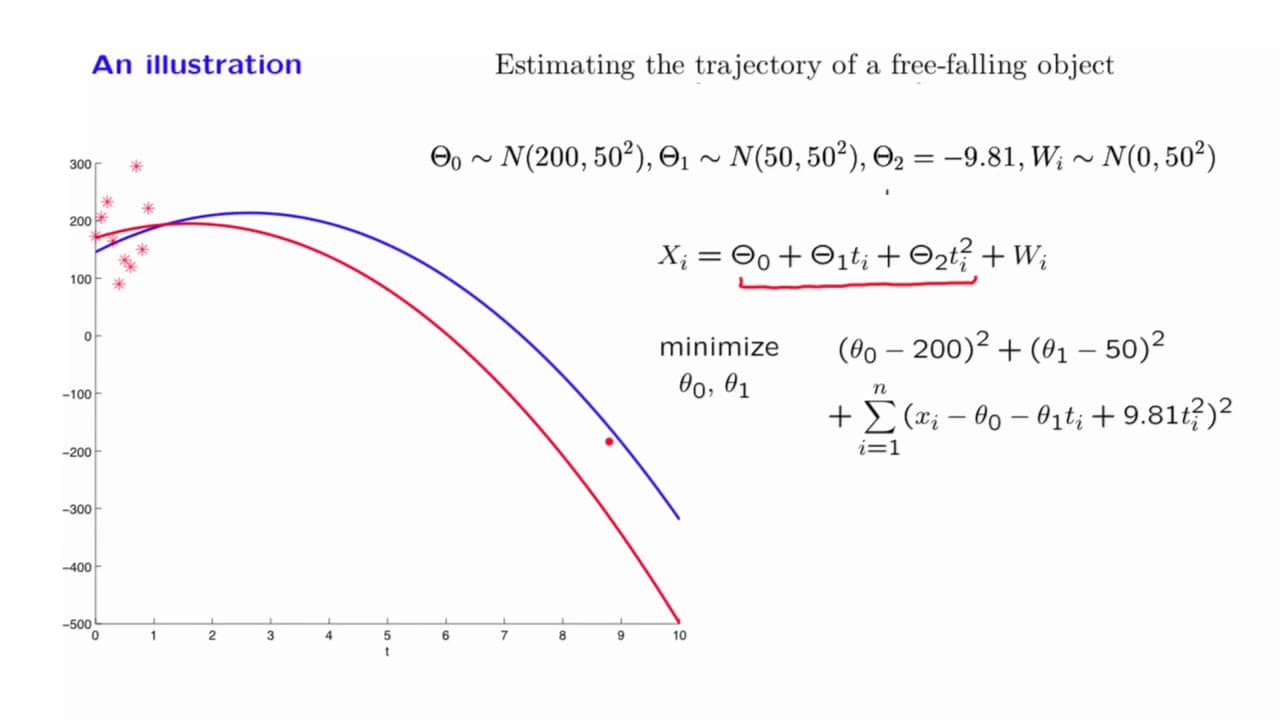
Let us now come back to the trajectory estimation problem that we introduced earlier. We have an object that moves vertically. At any given time t, the height at which the object is found is equal to this expression. It corresponds to the following-- the object starts at time 0, at some initial height Theta0, it has an initial velocity of Theta1, b... Read More
Key Insights
- ⌛ The trajectory estimation problem involves estimating the height of an object over time based on unknown parameters.
- ❓ MAP methodology can be used to estimate the parameters by minimizing a quadratic function.
- 🧡 Bayesian confidence intervals provide a range of possible values for the true trajectory and give confidence in the accuracy of the estimates.
Install to Summarize YouTube Videos and Get Transcripts
Explore YouTube Video Summarizer or Get YouTube Transcript Extractor
Questions & Answers
Q: What is the trajectory estimation problem?
The trajectory estimation problem involves estimating the height of an object over time based on certain unknown parameters and observed data points corrupted by noise.
Q: How are the Thetas and W's assumed in the model?
The Thetas and W's are assumed to be normally distributed with 0 mean and independent of each other. This allows for the use of the MAP methodology to estimate the parameters.
Q: How is the MAP methodology used to estimate the Thetas?
The MAP methodology involves maximizing the posterior distribution of the Thetas, which is equivalent to minimizing a quadratic function of the Thetas. This minimization process helps obtain the Thetas that best fit the observed data.
Q: How are Bayesian confidence intervals useful in this context?
Bayesian confidence intervals provide additional information besides point estimates. They give a range of possible values for the true trajectory and provide confidence that the estimates are accurate. Reporting confidence intervals alongside point estimates is valuable in communicating the results.
Summary & Key Takeaways
-
The content discusses the trajectory estimation problem, where the object's height over time is unknown and is described by certain parameters (Thetas).
-
Data points, corrupted by noise, are observed at specific times, and the goal is to estimate the Thetas that best fit the data.
-
The Maximum A Posteriori (MAP) methodology is used to minimize a quadratic function and obtain estimates for the parameters.
Read in Other Languages (beta)
Share This Summary 📚
Summarize YouTube Videos and Get Video Transcripts with 1-Click
Try YouTube Summary with ChatGPT & Claude or YouTube Transcript Generator
Explore More Summaries from MIT OpenCourseWare 📚


Summarize YouTube Videos and Get Video Transcripts with 1-Click
Try YouTube Summary with ChatGPT & Claude or YouTube Transcript Generator