2.2.3 An Introduction to Linear Regression - Video 2: One-variable Linear Regression
TL;DR
Linear regression is a modeling technique used to predict a dependent variable based on an independent variable, with the goal of minimizing error. R-squared is a common measure of model performance.
Transcript
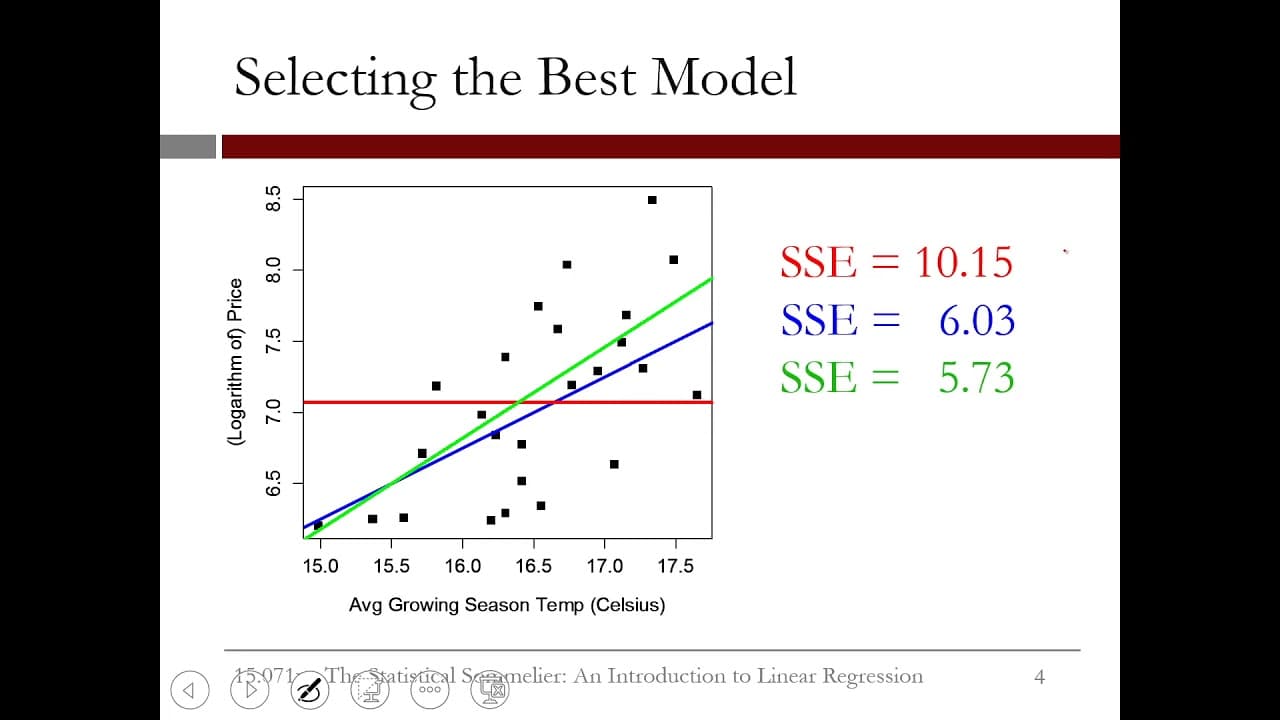
Let's discuss the method Ashenfelter used to build his model, linear regression. We'll start with one-variable linear regression, which just uses one independent variable to predict the dependent variable. This figure shows a plot of one of the independent variables, average growing season temperature, and the dependent variable, wine price. The go... Read More
Key Insights
- ⚾ Linear regression is used to predict a dependent variable based on an independent variable.
- 🫥 The model aims to minimize the sum of squared errors by finding the best-fit line.
Install to Summarize YouTube Videos and Get Transcripts
Explore YouTube Video Summarizer or Get YouTube Transcript Extractor
Questions & Answers
Q: What is linear regression?
Linear regression is a modeling technique used to predict a dependent variable using one independent variable. The goal is to find the best-fit line that minimizes the sum of squared errors.
Q: How are coefficients determined in linear regression?
The intercept term (Beta 0) and slope (Beta 1) of the line are determined based on the data. The model tries to find coefficients that minimize the difference between the predicted values and the actual values.
Q: What are residuals in linear regression?
Residuals are the errors between the predicted values and the actual values. The goal is to minimize these residuals by finding the best-fit line.
Q: How is model performance measured in linear regression?
Model performance is measured using metrics such as R-squared, which compares the model's sum of squared errors to a baseline model's sum of squared errors. A higher R-squared indicates a better fit.
Summary & Key Takeaways
-
Linear regression is a statistical method that uses one independent variable to predict a dependent variable.
-
The model aims to find a line that best fits the data and minimizes the sum of squared errors.
-
R-squared is a measure of how well the linear regression model predicts the dependent variable compared to a baseline model.
Read in Other Languages (beta)
Share This Summary 📚
Summarize YouTube Videos and Get Video Transcripts with 1-Click
Try YouTube Summary with ChatGPT & Claude or YouTube Transcript Generator
Explore More Summaries from MIT OpenCourseWare 📚


Summarize YouTube Videos and Get Video Transcripts with 1-Click
Try YouTube Summary with ChatGPT & Claude or YouTube Transcript Generator