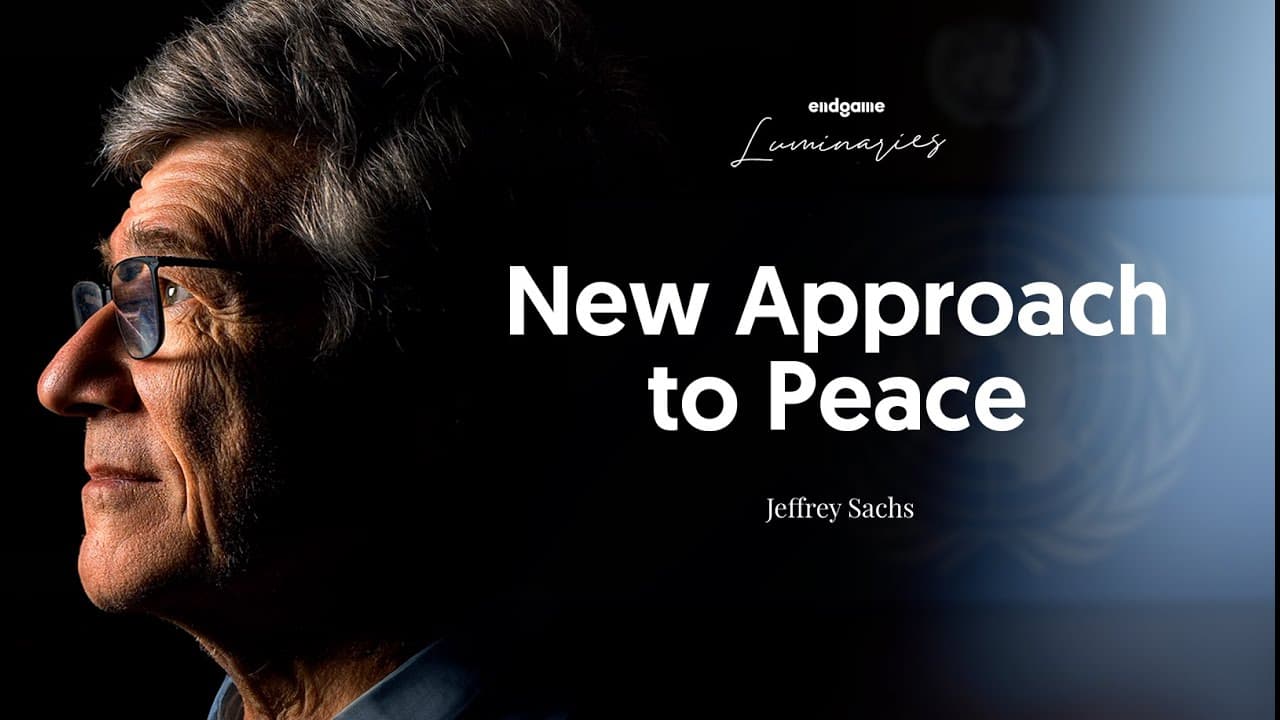
Jeffrey Sachs: There Is No Shortcut to Peace | Endgame #175 (Luminaries)
TL;DR
Jeffrey Sachs discusses geopolitical tensions and the need for diplomacy.
Transcript
This is stupid! Can you understand anything, you people in Washington, don't do this, you can't win. Today we're speaking with Jeffrey Sachs. He's a best-selling author. Economist, Professor, and Director at the Center of Sustainable Development at Columbia University, Jeffrey Sachs. Ukraine is not going to join NATO. And the United States leaders ... Read More
Key Insights
- Jeffrey Sachs emphasizes that the Ukraine conflict is a proxy war between the US and Russia, highlighting the need for diplomatic negotiations to prevent further escalation.
- Sachs critiques the United States' approach to foreign policy, stressing the importance of respecting other nations and understanding cultural nuances in diplomacy.
- The rise of multipolarity is reshaping global politics, yet the US struggles to adapt, clinging to outdated notions of unipolar dominance.
- Sachs argues that the US military's global presence exacerbates tensions and advocates for a non-interventionist approach to reduce conflicts.
- The Israeli-Palestinian conflict requires an imposed two-state solution by the UN Security Council, as current Israeli policies are untenable and violate international law.
- Education is crucial for economic development, and Sachs stresses the importance of regional cooperation, particularly in East Asia, to harness economic potential.
- The global economy's reliance on quantitative easing is unsustainable, and Sachs advocates focusing on real economic development through skills and infrastructure.
- Sachs criticizes the US for its military-industrial complex and suggests reducing military expenditures to foster a more peaceful international environment.
Install to Summarize YouTube Videos and Get Transcripts
Explore YouTube Video Summarizer or Get YouTube Transcript Extractor
Questions & Answers
Q: What is the primary cause of the Ukraine conflict according to Jeffrey Sachs?
Jeffrey Sachs attributes the Ukraine conflict to a proxy war between the US and Russia over influence in Ukraine. He argues that the US's insistence on NATO expansion into Ukraine and Georgia provoked Russia, leading to the current situation. Sachs emphasizes the need for diplomatic negotiations to resolve the conflict and prevent further escalation.
Q: How does Sachs view the US approach to diplomacy?
Sachs criticizes the US approach to diplomacy as being disrespectful and lacking cultural understanding. He believes that American diplomats often come across as rude and prescriptive, failing to respect the sovereignty and cultural nuances of other nations. Sachs advocates for a more respectful and cooperative diplomatic approach, emphasizing the importance of etiquette and understanding.
Q: What does Sachs suggest to resolve the Israeli-Palestinian conflict?
Sachs suggests that the UN Security Council should impose a two-state solution to resolve the Israeli-Palestinian conflict. He argues that the current Israeli policies are untenable and violate international law. Sachs believes that international intervention is necessary to establish a sovereign Palestinian state and ensure peace in the region.
Q: What role does education play in economic development according to Sachs?
Sachs emphasizes that education is crucial for economic development. He argues that countries should prioritize educating their children to ensure they are literate, numerate, and technologically savvy. Sachs believes that a well-educated population is essential for economic growth and that regional cooperation can enhance development opportunities.
Q: What are Sachs' views on the global economy's reliance on quantitative easing?
Sachs views the global economy's reliance on quantitative easing as unsustainable. He argues that printing money cannot create wealth and that the focus should be on the real economy. Sachs advocates for investing in education and infrastructure to drive sustainable economic development and reduce dependency on monetary policy.
Q: How does Sachs propose reducing global military tensions?
Sachs suggests reducing global military tensions by adopting a non-interventionist approach and limiting military expenditures. He criticizes the US's extensive military presence worldwide and advocates for a norm where countries do not station troops outside their borders. Sachs believes that reducing military activities and focusing on diplomacy can foster a more peaceful international environment.
Q: What is Sachs' perspective on the rise of multipolarity?
Sachs views the rise of multipolarity as a significant shift in global politics. He argues that the US struggles to adapt to this new reality, clinging to outdated notions of unipolar dominance. Sachs emphasizes the need for the US to recognize the economic rebalancing and engage in cooperative diplomacy with emerging powers to address global challenges effectively.
Q: What does Sachs suggest for East Asia's economic development?
Sachs suggests that East Asia should focus on regional cooperation to harness its economic potential. He advocates for the RCEP region to work together on infrastructure, technology, and zero-carbon energy projects. Sachs believes that by cooperating economically and reducing military tensions, East Asia can become a dynamic and prosperous region.
Summary & Key Takeaways
-
Jeffrey Sachs discusses the geopolitical landscape, emphasizing the need for diplomacy and understanding cultural nuances to address global conflicts effectively.
-
The conversation highlights the historical context of US foreign policy, critiquing its interventionist approach and advocating for a shift towards non-intervention and respect for sovereignty.
-
Sachs calls for a reevaluation of economic priorities, focusing on education and regional cooperation to drive sustainable development and reduce global tensions.
Read in Other Languages (beta)
Share This Summary 📚
Summarize YouTube Videos and Get Video Transcripts with 1-Click
Try YouTube Summary with ChatGPT & Claude or YouTube Transcript Generator
Explore More Summaries from Gita Wirjawan 📚
Summarize YouTube Videos and Get Video Transcripts with 1-Click
Try YouTube Summary with ChatGPT & Claude or YouTube Transcript Generator