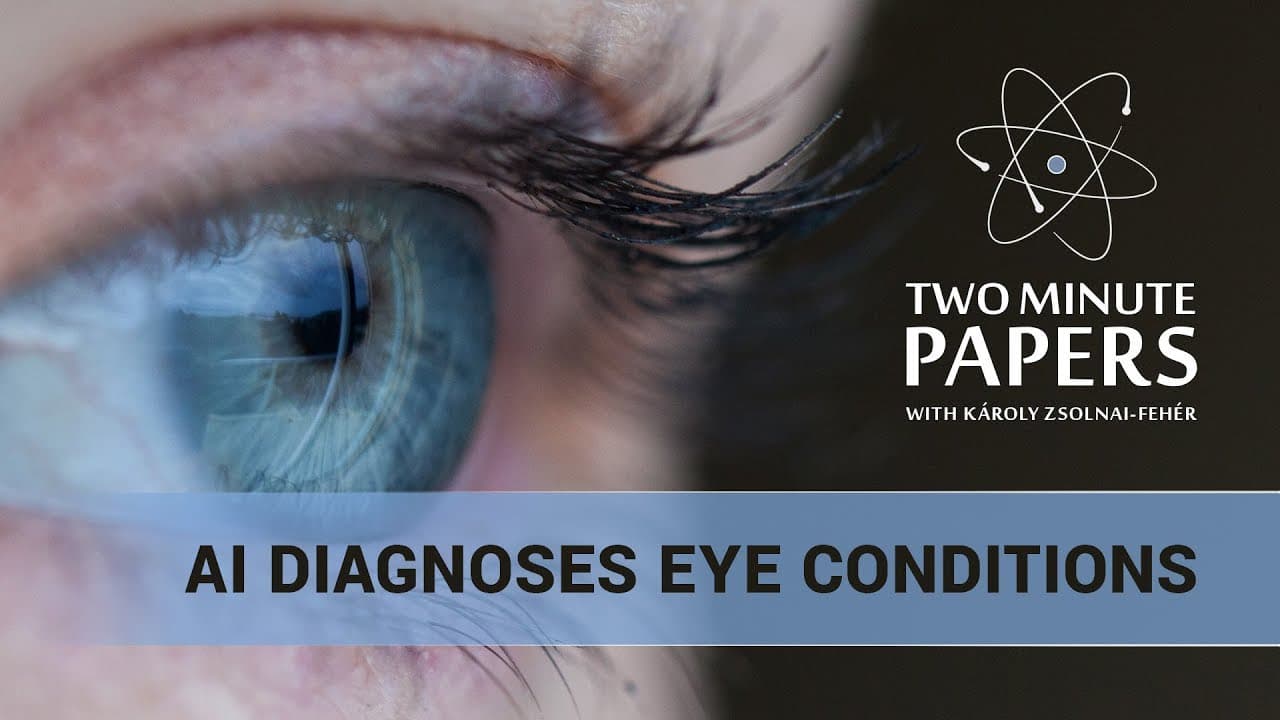
How Does DeepMind's AI Diagnose Eye Conditions?
TL;DR
DeepMind's AI diagnoses eye conditions by analyzing optical coherence tomography scans faster and with greater accuracy than human doctors. The AI processes images to identify critical areas and classify conditions, enabling doctors to prioritize urgent cases effectively. This collaboration with a leading London eye hospital enhances the practicality and reliability of the AI's diagnoses.
Transcript
Dear Fellow Scholars, this is Two Minute Papers with Károly Zsolnai-Fehér. In this video series, we often see how these amazing new machine learning algorithms can make our lives easier, and fortunately, some of them are also useful for serious medical applications. Specifically, medical imaging. Medical imaging is commonly used in most healthcare ... Read More
Key Insights
- 😷 Machine learning algorithms in medical imaging aid doctors in diagnosing conditions by processing diagnostic images efficiently.
- 🥳 AI can identify relevant parts in images and classify conditions, allowing doctors to focus on critical cases.
- 😃 Collaboration with eye hospitals ensures practicality and effectiveness of AI in medical imaging.
- 🛀 AI algorithms have shown to be as accurate as top specialists in classifying urgent cases.
- 👻 Advancements in AI allow for the handling of different imaging devices and 3D data.
- 😚 Close collaboration with medical professionals ensures the AI's practicality in clinical settings.
- 😷 AI in medical imaging is a promising tool that can revolutionize the healthcare system.
Install to Summarize YouTube Videos and Get Transcripts
Explore YouTube Video Summarizer or Get YouTube Transcript Extractor
Questions & Answers
Q: How do machine learning algorithms in medical imaging assist doctors?
Machine learning algorithms help doctors by processing large amounts of diagnostic images, identifying relevant parts, and classifying conditions for faster and more accurate diagnoses.
Q: What is the benefit of AI in medical imaging for doctors?
AI in medical imaging allows doctors to prioritize patient care by focusing on edge cases while AI processes a vast number of images quickly and accurately.
Q: How accurate are AI algorithms in medical imaging compared to human doctors?
AI algorithms in medical imaging have shown to be as accurate as the top retina specialists, outperforming optometrists in classification and decision making for urgent cases.
Q: What are some advantages of using AI in medical imaging?
AI in medical imaging can work with different imaging devices, handle 3D data, and is developed in collaboration with top-tier eye hospitals to ensure practicality and effectiveness.
Summary & Key Takeaways
-
Machine learning algorithms in medical imaging aid doctors in diagnosing conditions by processing large amounts of diagnostic images.
-
AI algorithms can analyze images to identify relevant parts and classify conditions, helping doctors prioritize patient care.
-
Collaboration with a London eye hospital ensures practicality and effectiveness of AI in medical imaging.
Read in Other Languages (beta)
Share This Summary 📚
Summarize YouTube Videos and Get Video Transcripts with 1-Click
Try YouTube Summary with ChatGPT & Claude or YouTube Transcript Generator
Explore More Summaries from Two Minute Papers 📚




Summarize YouTube Videos and Get Video Transcripts with 1-Click
Try YouTube Summary with ChatGPT & Claude or YouTube Transcript Generator