1.2.7 Variable-length Encoding
TL;DR
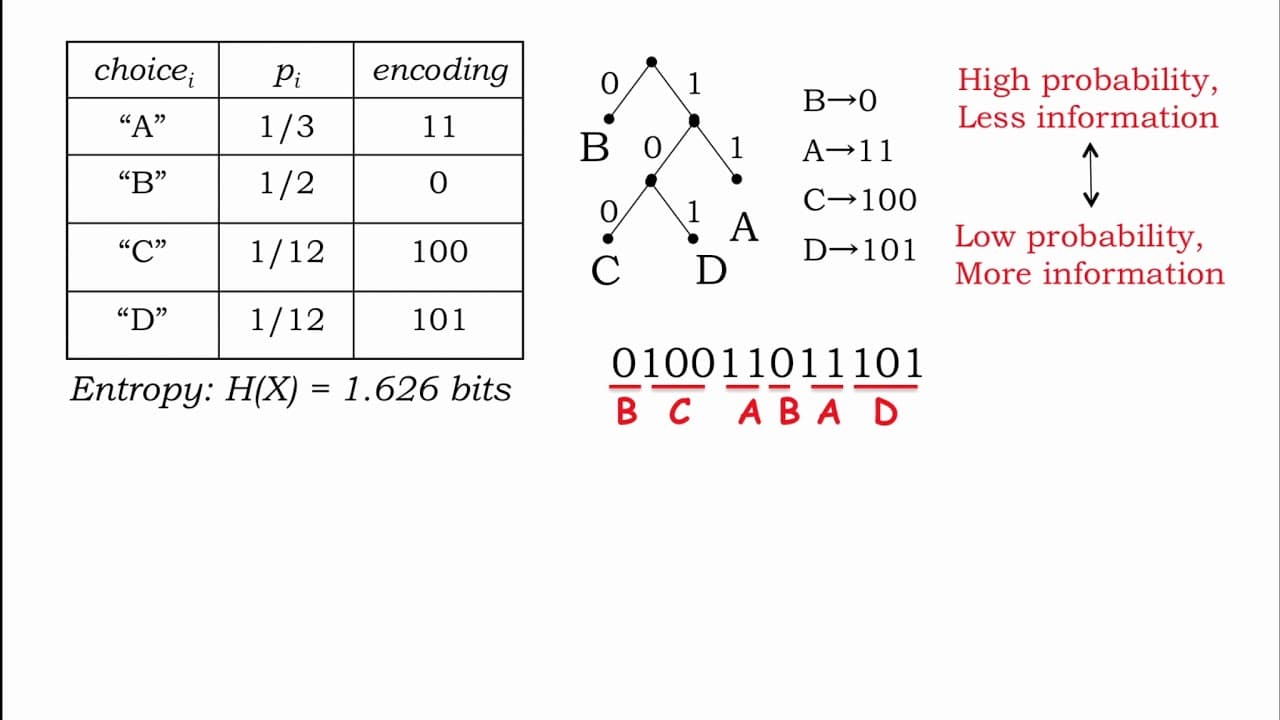
Variable-length encodings allow for shorter expected lengths of encoding compared to fixed-length encodings when choices have different information content.
Transcript
Fixed-length encodings work well when all the possible choices have the same information content, i.e., all the choices have an equal probability of occurring. If those choices don't have the same information content, we can do better. To see how, consider the expected length of an encoding, computed by considering each x_i to be encoded, and weigh... Read More
Key Insights
- 💁 Fixed-length encodings are suitable when all choices have equal information content and probability.
- 👨💻 Variable-length encodings offer shorter expected lengths by assigning shorter codes to high-probability choices and longer codes to low-probability choices.
- 🏋️ The expected length of an encoding can be calculated by weighing the length of each choice's encoding by its probability.
- ❓ Variable-length encodings can approach the entropy of the choices, but may not reach the optimal encoding.
Install to Summarize YouTube Videos and Get Transcripts
Explore YouTube Video Summarizer or Get YouTube Transcript Extractor
Questions & Answers
Q: What are fixed-length encodings and when are they effective?
Fixed-length encodings assign a specific number of bits to each choice, and they work well when all choices have the same information content and equal probability of occurring.
Q: How are variable-length encodings constructed?
Variable-length encodings assign shorter codes to high-probability choices with less information content and longer codes to low-probability choices with more information content.
Q: How can the expected length of a variable-length encoding be calculated?
The expected length is computed by multiplying the length of each choice's encoding by its probability and summing these values.
Q: How does a variable-length encoding improve efficiency compared to a fixed-length encoding?
A variable-length encoding achieves a shorter expected length, reducing the number of bits needed to encode symbols and improving efficiency.
Summary & Key Takeaways
-
Fixed-length encodings are suitable when all choices have equal probability, but variable-length encodings perform better when choices have different information content.
-
The expected length of an encoding can be calculated by considering each choice's probability and weighting the length of its encoding.
-
Variable-length encodings use shorter codes for high-probability choices and longer codes for low-probability choices.
Read in Other Languages (beta)
Share This Summary 📚
Summarize YouTube Videos and Get Video Transcripts with 1-Click
Try YouTube Summary with ChatGPT & Claude or YouTube Transcript Generator
Explore More Summaries from MIT OpenCourseWare 📚



Summarize YouTube Videos and Get Video Transcripts with 1-Click
Try YouTube Summary with ChatGPT & Claude or YouTube Transcript Generator